
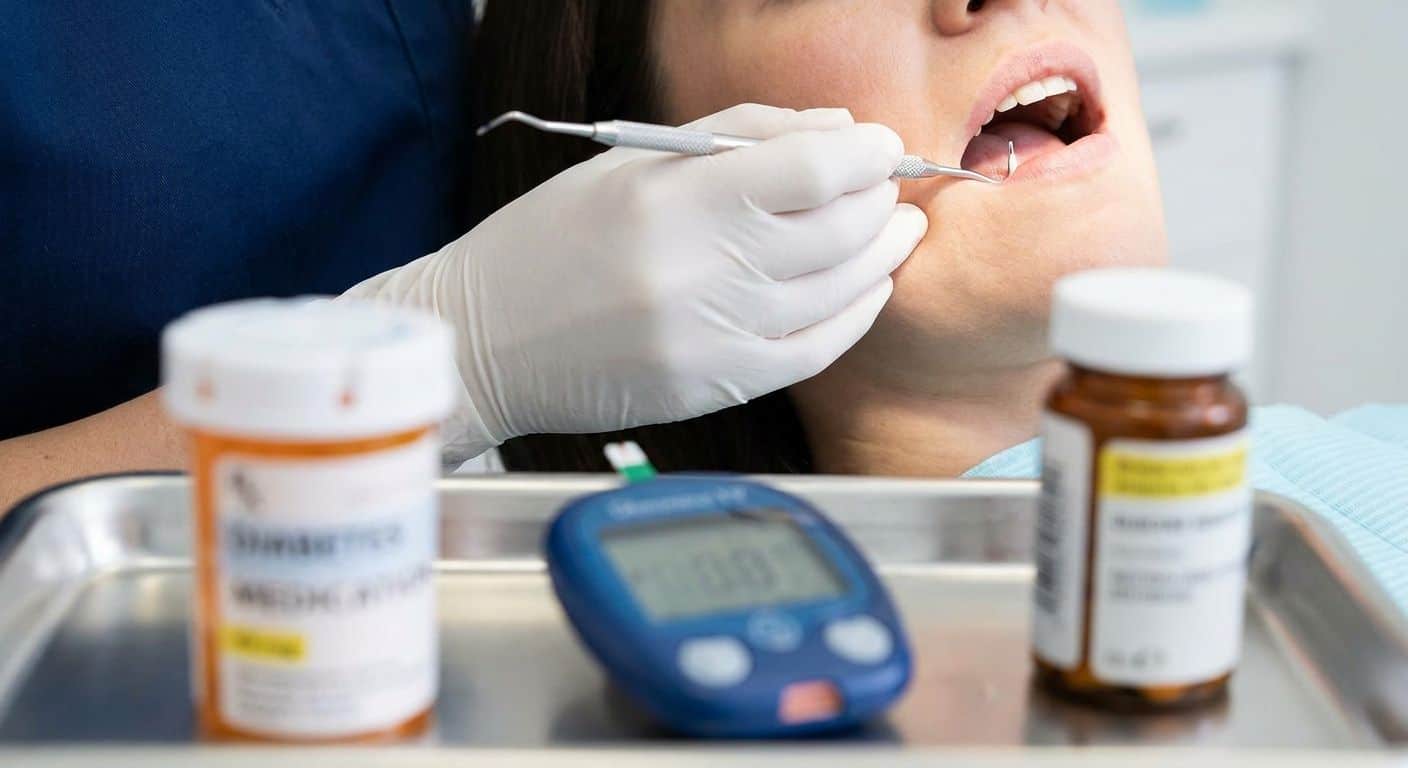
Diabetes and gum disease feed each other: uncontrolled blood sugar makes infections harder to fight, and inflamed gums make blood sugar harder to control. This guide breaks down what actually works for diabetic patients managing periodontal disease in 2026, and what to skip.
- Diabetic patients need periodontal maintenance every 3-4 months, not the standard 6 — buy into the shorter interval.
- Nonsurgical scaling and root planing is the first-line gum disease and diabetes treatment for most Type 2 patients — consider it your starting point.
- A1C above 9% often stalls healing after deep cleaning; coordinate with your physician before scheduling.
- Gum recession from long-standing periodontitis needs a separate evaluation — do not assume one cleaning fixes both.
Why this matters
The CDC has flagged diabetes as a major risk factor for periodontal disease for years, and the relationship runs both directions — gum infections raise inflammatory markers that interfere with insulin sensitivity. That means a diabetic patient with untreated gum disease is fighting a harder battle on two fronts at once, in 2026 just as it was a decade ago.
Dentists who treat diabetic patients regularly know the standard six-month cleaning schedule doesn't hold up once periodontitis is diagnosed. If you can spot early signs of gum disease at home — bleeding gums, persistent bad breath, gums pulling away from teeth — the sooner you get evaluated, the smaller the treatment plan.
Who this is for
This guide is for adults with Type 1 or Type 2 diabetes who have been told they have gingivitis or periodontitis, or who suspect they do based on bleeding gums, loose teeth, or chronic bad breath. It's also for family members managing care for a diabetic parent or spouse who hasn't had a dental checkup in over a year. If your A1C runs above 7% and you haven't had a periodontal exam in the last six months, this applies to you directly.
What to look for in gum disease and diabetes treatment
Blood sugar status before any deep treatment
A dentist treating a diabetic patient for periodontitis needs a recent A1C number, not a guess. Patients with an A1C under 7% generally heal from scaling and root planing at a comparable rate to non-diabetic patients; above 9%, healing slows and infection risk climbs. Ask your dentist whether they request A1C data before scheduling deep cleaning — if they don't ask, that's a gap in the treatment plan.
Nonsurgical therapy as the starting point
Scaling and root planing (the clinical term for a deep cleaning) removes bacterial buildup below the gumline without surgery, and it's the standard first move for early-to-moderate periodontitis in diabetic patients. Surgery gets reserved for cases where nonsurgical therapy fails after re-evaluation, typically 4-6 weeks later.
A maintenance interval shorter than six months
Standard adult cleanings run every six months. Diabetic patients with a periodontitis history typically need periodontal maintenance every 3-4 months in 2026, because healing and bacterial recolonization both move faster when blood sugar control fluctuates. A deep cleaning schedule built for gum disease patients accounts for this directly instead of defaulting to the generic interval.
Coordination between your dentist and your physician
The practice managing your gum disease and diabetes treatment should be willing to communicate with your endocrinologist or primary care provider, especially around A1C trends and any recent medication changes. One-way treatment — where the dentist never hears from the physician and vice versa — misses the point of managing a two-way condition.
Antimicrobial adjuncts when pocket depths stay elevated
If pocket depths remain above 5mm after initial scaling and root planing, localized antimicrobial treatment placed directly in the pocket is a common next step before considering surgery. This isn't automatic for every patient — it depends on re-evaluation results.
A plan for gum recession, not just active infection
Long-standing periodontitis often leaves gum recession behind even after the infection clears. That's a separate problem requiring its own evaluation, since exposed roots increase sensitivity and cavity risk on their own.
Top picks for managing gum disease with diabetes
The foundational pick: early-stage periodontitis treatment
The spec that matters here is pocket depth — anything measured at 4-5mm generally responds to nonsurgical therapy without escalation. Early-stage periodontitis treatment catches the disease before bone loss accelerates, which matters more for diabetic patients because healing windows are already tighter. Verdict: Buy — this is the treatment to start with, not skip past.
The safe pick: scaling and root planing on a diabetic-adjusted schedule
The concrete number to track is pocket depth reduction after re-evaluation, typically checked 4-6 weeks post-treatment. A deep cleaning schedule for gum disease patients set at 3-4 month intervals instead of six months keeps bacterial buildup from re-establishing between visits. Verdict: Buy for anyone with an active diagnosis.
The maintenance pick: more frequent hygiene visits
Moving from twice-yearly to quarterly visits sounds like more cost and more time, but the alternative — relapse into active periodontitis — costs more in the long run. Verdict: Consider, especially if your last A1C reading was above 8%.
The physician-coordination pick: shared care with your endocrinologist
This isn't a procedure, it's a communication standard: does your dental practice request or share A1C data with your physician? Practices that skip this step are managing half the condition. Verdict: Consider asking directly at your next visit whether this coordination happens.
The wildcard: gum recession correction after infection clears
Once active periodontitis is under control, exposed root surfaces from recession need their own fix — grafting or other correction depends on severity. Treating gum recession before it gets worse is a separate conversation from the infection itself, and waiting on it lets sensitivity and root decay risk build. Verdict: Consider, but only after active infection is resolved.
Get your gum disease evaluated
New patient visits include a full periodontal exam before any treatment plan.
What to avoid
- Skipping the A1C conversation. A dentist who moves straight to deep cleaning without asking about recent blood sugar control is treating half the picture — diabetic patients heal differently depending on where their A1C sits.
- Sticking to a six-month cleaning schedule after a periodontitis diagnosis. It looks like the standard, responsible choice, but it's built for patients without active gum disease, not for diabetic patients managing it.
- Treating gum disease and diabetes as unrelated appointments. If your medical and dental providers never compare notes on your condition in 2026, you're carrying the coordination burden yourself, which usually means it doesn't happen.
Verdict comparison
| Approach | Best for | Interval/Trigger | Verdict |
|---|---|---|---|
| Early-stage periodontitis treatment | New diagnosis, minimal bone loss | Immediate on diagnosis | Buy |
| Deep cleaning on diabetic schedule | Active or resolved periodontitis | Every 3-4 months | Buy |
| Physician-coordinated care | All diabetic patients with gum disease | Ongoing, every visit | Consider |
| Antimicrobial adjuncts | Pockets over 5mm after initial therapy | After re-evaluation | Consider |
| Gum recession correction | Post-infection recession | After active disease resolves | Consider |
FAQ
Does diabetes cause gum disease directly?
Diabetes doesn’t cause gum disease on its own, but it raises the risk significantly because elevated blood sugar weakens the body’s ability to fight the bacterial infection behind periodontitis. Poor blood sugar control also slows healing after any dental treatment, including cleanings.
How often should a diabetic patient get dental cleanings?
Diabetic patients with a periodontitis history typically need cleanings every 3-4 months instead of the standard six-month interval. The shorter schedule accounts for faster bacterial recolonization when blood sugar fluctuates.
Can gum disease raise blood sugar levels?
Yes, active gum infections increase inflammatory markers that interfere with insulin sensitivity, which can make blood sugar harder to control. This is why gum disease and diabetes treatment works best when the dentist and physician coordinate care.
What A1C level is safe for dental deep cleaning?
Patients with an A1C under 7% generally heal from scaling and root planing at rates similar to non-diabetic patients. Above 9%, healing slows and infection risk rises, so some dentists recommend better blood sugar control before proceeding.
Is scaling and root planing enough to treat gum disease in diabetic patients?
Scaling and root planing is the standard first step for early-to-moderate periodontitis and works for most diabetic patients when paired with a shorter maintenance schedule. Surgery is reserved for cases where nonsurgical therapy fails after re-evaluation.
Should my dentist talk to my physician about my diabetes?
Yes, coordination between your dental provider and your endocrinologist or primary care physician around A1C trends improves outcomes for gum disease and diabetes treatment. One-sided treatment misses how closely the two conditions interact.
Can gum recession be reversed after diabetic periodontitis heals?
Gum recession itself doesn’t reverse on its own, but it can be corrected separately once the active infection is under control. Waiting too long increases sensitivity and root decay risk on the exposed surfaces.
One last thing
The detail most patients miss: healing after a deep cleaning isn't judged at the appointment itself, it's judged at the re-evaluation 4-6 weeks later. If your dentist schedules that follow-up and checks pocket depths again before deciding on next steps, that's the sign your gum disease and diabetes treatment plan is actually being managed, not just performed once and forgotten.
Related guides
- How to treat gum recession before it gets worse
- Family dentistry for busy Palm Beach County households