
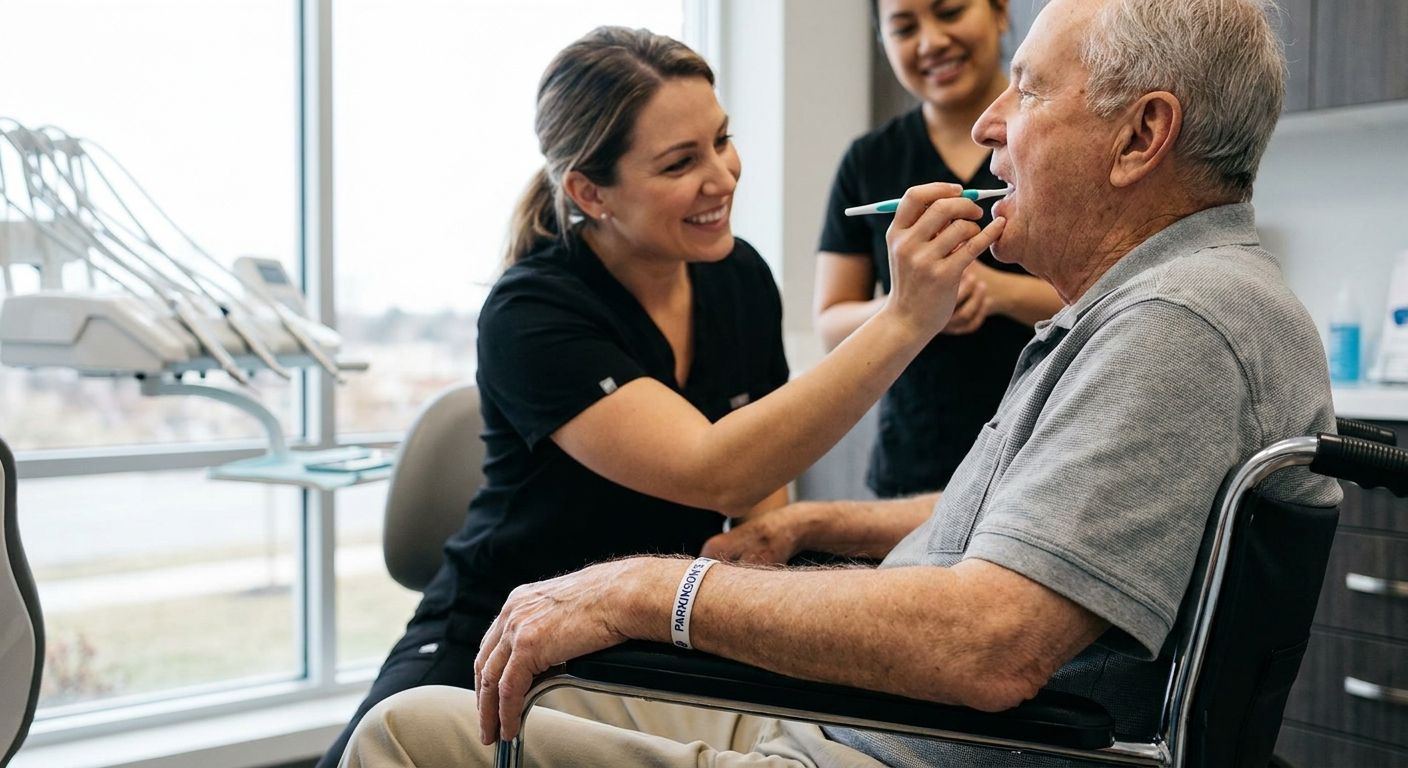
Parkinson's disease dental care means adapting appointment timing, home hygiene tools, and in-chair comfort measures to a patient's tremor, rigidity, and medication schedule so oral health doesn't slide while the rest of the disease is being managed. A person with Parkinson's needs a dentist who plans around "off" periods, swallowing changes, and dry mouth from carbidopa-levodopa — not a generic cleaning-and-checkup routine.
- Dental Arts of Atlantis schedules Parkinson’s patients during medication ‘on’ windows for steadier hands and easier positioning.
- Parkinson’s drugs like carbidopa-levodopa cause dry mouth, which raises cavity and gum disease risk within months, not years.
- Shorter, more frequent visits beat one long appointment for patients with rigidity or tremor.
- Electric toothbrushes and floss holders solve most of the fine-motor problems standard tools create.
- Sedation dentistry and caregiver-assisted routines both have a place — the right one depends on disease stage.
Why dental care matters for Parkinson's patients
Parkinson's disease doesn't attack the teeth directly, but nearly everything the disease and its medications touch — muscle control, saliva flow, swallowing reflex — works against oral health. Reduced blinking and facial muscle control make plaque harder to spot in the mirror. Tremor in the hands turns brushing into an unreliable, rushed task. Rigidity in the jaw and neck makes it harder to sit still in a dental chair for standard-length procedures.
Carbidopa-levodopa and related medications are well documented to cause dry mouth (xerostomia) as a side effect, and saliva is the mouth's main defense against decay and gum disease. Less saliva means faster plaque buildup, more cavities at the gumline, and a higher chance of oral infections that are harder to treat once swallowing or immune response is already compromised. None of this is optional maintenance — skipping checkups in 2026 because visits feel harder only pushes the problem into emergency territory later.
Time appointments around medication cycles
Most Parkinson's medications create predictable "on" and "off" windows — periods of better versus worse motor control. A dental visit booked during an "off" window means more tremor, more rigidity, and a harder time holding a position for even a routine cleaning.
- Book appointments 60–90 minutes after a medication dose, when motor symptoms are typically most controlled
- Bring the exact medication schedule to the front desk so staff can plan around it
- Ask for morning slots if symptoms tend to worsen later in the day
- Flag any recent medication changes before the visit, since dosage adjustments shift the "on" window
- Request shorter appointment blocks (30–40 minutes) rather than one long combined visit
Simplify the home hygiene routine
Standard manual toothbrushes and floss require a level of fine motor control that tremor and rigidity make unreliable. The fix isn't more effort — it's fewer moving parts.
- Switch to an electric toothbrush with a wide, cushioned grip handle
- Use a floss holder or interdental brush instead of wound floss
- Add a non-slip mat under the sink area to reduce balance-related falls during brushing
- Set a consistent time of day tied to a medication dose, when hand control is steadiest
- Ask a caregiver to check for missed spots once a week rather than doing full brushing daily if independence is declining
Manage dry mouth from Parkinson's medications
Dry mouth from Parkinson's drugs is one of the most under-addressed risks in this population, and it accelerates decay fast enough to show up between routine six-month checkups.
- Sip water throughout the day instead of large amounts at once
- Use xylitol-based gum or lozenges to stimulate what saliva flow remains
- Avoid alcohol-based mouthwash, which dries tissue further
- Ask about prescription saliva substitutes if dryness is severe
- Read more on how to manage dry mouth caused by medication for daily routines that apply directly to Parkinson's patients
Communicate tremor and rigidity needs before treatment starts
A dental team that knows the specifics of a patient's Parkinson's presentation can adjust the chair, the tools, and the pacing before problems come up mid-procedure.
- Describe which side of the body tremor affects most, since head positioning may need to compensate
- Mention any dyskinesia (involuntary movement) episodes tied to medication timing
- Note any swallowing difficulty (dysphagia) so suction and positioning are adjusted
- Bring a caregiver or family member to appointments involving new procedures
- Ask the practice to confirm which staff member will handle communication if speech is affected
Choose the right sedation and comfort option
Not every Parkinson's patient needs sedation, but tremor severity, anxiety, and procedure length all factor into whether it helps or complicates the visit. Dental sedation options for special needs adults covers considerations that overlap directly with Parkinson's care, including how sedation interacts with existing medications.
| Option | Best for | Key limitation |
|---|---|---|
| Standard visit, no sedation | Mild tremor, early-stage Parkinson's, short procedures | Positioning still depends on "on" window timing |
| Nitrous oxide (laughing gas) | Anxiety on top of mild-to-moderate motor symptoms | Wears off fast; doesn't address severe rigidity |
| Oral conscious sedation | Longer procedures or moderate-to-severe tremor | Requires a caregiver to drive home and monitor recovery |
| Caregiver-assisted home routine between visits | Advanced-stage patients with reduced independence | Doesn't replace in-office professional cleaning |
Verdict: for most Parkinson's patients in Palm Beach County, Dental Arts of Atlantis recommends starting with a standard visit timed to the medication cycle, and reserving sedation for longer restorative work or documented dental anxiety.
Coordinate with the neurologist and increase visit frequency
A six-month checkup interval works for a healthy adult mouth. It's often too long once dry mouth and reduced hygiene control are both in play.
- Move to three- or four-month cleaning intervals once dry mouth is confirmed
- Share the neurologist's contact information with the dental team for medication questions
- Ask the dentist to check for signs of aspiration risk during any procedure involving water or suction
- Request a written note of any procedure done, for the neurology team's records
- If it's been years since the last dental visit, start with dental checkups for adults returning after years without care rather than jumping straight into restorative work
Plan a Parkinson’s-friendly dental visit
Get a schedule built around your medication timing and comfort needs.
Common mistakes Parkinson's patients make with dental care
- Skipping checkups because visits feel exhausting. Dry mouth and tremor make problems progress faster, not slower, so gaps in care backfire quickly.
- Not mentioning medication timing to the front desk. A visit booked in an "off" window is harder for the patient and the dental team alike.
- Sticking with manual floss out of habit. An interdental brush or floss holder solves the tremor problem in one purchase.
- Treating dry mouth as unavoidable. It's a documented medication side effect with real management options, not something to just tolerate.
- Waiting for a caregiver to notice a problem. Self-reported symptoms like a sore spot or a loose filling should trigger a call, not a wait-and-see approach.
If Parkinson's disease progression or a change in caregivers has interrupted an existing treatment plan, switching dentists without losing your treatment plan walks through how to transfer records so nothing restarts from zero.
FAQ
What’s the best dental care approach for Parkinson’s disease patients?
The best approach times appointments to the patient’s medication cycle, shortens visit length, and treats dry mouth as an active risk factor rather than a side effect to ignore. Dental Arts of Atlantis builds visit plans around these three factors for Parkinson’s patients in Palm Beach County.
Does Parkinson’s disease cause dry mouth?
Parkinson’s medications, especially carbidopa-levodopa, commonly cause dry mouth as a side effect. Reduced saliva raises the risk of cavities and gum disease within months if it isn’t managed.
Is sedation dentistry safe for Parkinson’s patients?
Sedation can be safe for Parkinson’s patients when the dental team reviews current medications first, since some sedatives interact with Parkinson’s drugs. It’s typically reserved for longer procedures or significant dental anxiety rather than routine cleanings.
How often should someone with Parkinson’s disease get dental checkups?
Three to four month intervals work better than the standard six-month schedule once dry mouth or reduced home hygiene is confirmed. More frequent, shorter visits catch problems before they require restorative work.
Can tremor make brushing teeth ineffective?
Yes, tremor and rigidity reduce the precision of manual brushing and flossing. An electric toothbrush with a wide grip and a floss holder or interdental brush solve most of the fine-motor gap.
Should a caregiver come to dental appointments for Parkinson’s patients?
A caregiver should attend appointments involving new procedures, sedation, or any visit where communication or swallowing is a concern. They can also confirm medication timing and transportation after sedation.
What time of day is best for a Parkinson’s patient’s dental appointment?
Morning appointments, timed 60 to 90 minutes after a medication dose, generally line up with the steadiest motor control. Symptoms often worsen later in the day, making afternoon slots harder for longer procedures.
One last thing
The detail most Parkinson's patients and caregivers miss isn't sedation or scheduling — it's that dry mouth from Parkinson's medication can cause new cavities at the gumline within a single six-month gap, on teeth that were previously cavity-free for decades. That's the argument for shortening the checkup interval before problems show up, not after.
Related guides
- Dental sedation options for special needs adults
- How to manage dry mouth caused by medication
- Dental care for patients recovering from a stroke
- Dental checkups for adults returning after years without care
- How to switch dentists without losing your treatment plan