
Full mouth reconstruction has no single fixed cost in 2026: your total depends on which teeth need treatment, which teeth can be preserved, and how missing teeth will be replaced. A useful estimate must also identify diagnostic work, temporary teeth, surgical preparation, and follow-up care rather than leave those items outside the treatment total.
- How much does a full mouth reconstruction cost? Get an itemized estimate based on your diagnosis, not a package label.
- Dental Arts of Atlantis suits Palm Beach County families seeking general, cosmetic, and implant dentistry.
- Compare reconstruction plans by teeth treated, temporary restorations, final restorations, and follow-up—not just the total.
- Dental insurance benefits and third-party financing change how you pay, not which treatment your teeth need.
How much does a full mouth reconstruction cost in 2026?
The meaningful total is the amount attached to your complete, clinically appropriate treatment plan. A quote for repairing existing teeth is not directly comparable with a quote for removing teeth and replacing them. The scope must match before the totals mean anything.
Start with a dental cost estimate before treatment that names the procedures, teeth involved, and items included. A verbal summary is not enough for a decision involving multiple treatments.
Your written breakdown should distinguish these parts:
| Part of the plan | What to identify | Question to ask |
|---|---|---|
| Evaluation | Examination and clinically indicated imaging | What is needed to establish the diagnosis? |
| Disease treatment | Treatment for decay, infection, or gum disease | What needs attention before restorative work? |
| Tooth preservation | Restorations and treatment for salvageable teeth | Which teeth can be kept, and why? |
| Tooth replacement | The proposed replacement for missing or nonrestorable teeth | What exactly supports the replacement teeth? |
| Temporary restorations | Teeth or restorations used between treatment stages | What will I use while treatment is underway? |
| Final restorations | The completed crowns, bridges, or replacement teeth | What materials and design are specified? |
| Follow-up | Checks, adjustments, and maintenance arrangements | Which visits are included, and which are separate? |
Not every patient needs every item. The purpose of this breakdown is to make the estimate readable—not to add procedures to your plan.
Why this matters
A reconstruction decision affects how you chew, clean your teeth, and maintain your mouth after treatment. Appearance matters, but it cannot replace an explanation of tooth health, gum support, and bite function.
A reassuring plan tells you what is wrong and how each proposed procedure addresses it. You should understand which decisions are reversible and which permanently change or remove tooth structure before consenting.
Choose the treatment scope before choosing how to pay for it. A manageable payment arrangement does not make an unsuitable treatment appropriate, and a large treatment proposal does not prove that every tooth needs work.
Preserving existing teeth: what the estimate should cover
Best for: Teeth that a dentist determines can be restored and maintained.
A tooth-preserving plan can include fillings, crowns, or root canal treatment when the diagnosis calls for them. These procedures serve different purposes; a crown does not treat an infection inside a tooth, and root canal treatment does not automatically complete the tooth's final restoration.
The advantage is retaining natural teeth when their condition supports that choice. The limitation is that a severely damaged tooth, or a tooth with inadequate supporting tissues, is not always predictable to keep.
Ask your dentist to explain the outlook for each questionable tooth. You need to know whether the proposal aims to provide a durable restoration or to retain a tooth whose future remains uncertain.
A clear 2026 estimate should distinguish treatment inside the tooth from the restoration placed afterward. It should also explain whether existing restorations need replacement and what evidence supports that recommendation.
Replacing missing teeth: compare the complete design
Best for: Gaps or teeth that cannot be predictably restored, after a clinical assessment.
Tooth replacement is not one interchangeable procedure. Your remaining teeth, gum health, bone support, cleaning ability, and preferences help determine which designs are appropriate.
The following comparison explains the options generally. It does not establish which option is suitable for your mouth.
| Option | Best for | Main advantage | Main limitation |
|---|---|---|---|
| Tooth-supported bridge | Selected gaps with suitable neighboring teeth | Provides a fixed replacement supported by existing teeth | Usually requires preparation of supporting teeth |
| Implant-supported replacement | Missing teeth where clinical assessment supports implant treatment | Uses implants rather than neighboring teeth for support | Requires surgery and ongoing care around the implants |
| Removable partial denture | Selected patients with some remaining teeth | Replaces missing teeth with a removable appliance | Requires removal for cleaning and adaptation to the appliance |
| Complete denture | Patients missing all teeth in an arch | Replaces a full arch without relying on remaining teeth | Fit and stability depend on the mouth and appliance design |
Compare complete designs, not isolated components. For an implant plan, ask whether the estimate covers surgical placement, the connecting components, and the final replacement teeth. For a removable appliance, ask how adjustments and future changes will be handled.
These options have different maintenance demands. Ask your dentist to demonstrate the cleaning routine before you select a design, especially if hand strength or dexterity makes detailed cleaning difficult.
Why full mouth reconstruction estimates vary
Two patients can both need extensive dental care while requiring very different treatment. The following factors explain why a package label cannot establish the final total:
- Teeth involved: Treating selected damaged teeth differs from restoring or replacing teeth throughout both arches. Ask the dentist to mark exactly which teeth need work.
- Teeth worth preserving: A plan built around restorable natural teeth differs from one built around extraction and replacement. Each extraction needs a clinical reason.
- Gum and bone condition: Gum disease treatment or preparation for implant placement changes the treatment scope. Those needs require examination rather than an assumption.
- Restoration design: Individual restorations, bridges, and removable appliances involve different components and clinical steps. The estimate should name the proposed design.
- Treatment sequence: Temporary restorations and healing stages affect what is needed between the first procedure and the final result. Ask what happens during that interval.
- Comfort and maintenance needs: Discuss anxiety, cleaning challenges, and bite protection. Clarify which measures are recommended and whether they are included.
These are reasons to request a detailed plan, not reasons to accept unexplained additions. Every line should connect to a diagnosis, a treatment stage, or an agreed maintenance need.
How do you get a reliable reconstruction estimate?
Bring your priorities to the examination: comfortable chewing, keeping natural teeth where appropriate, replacing missing teeth, or improving appearance. Also bring your medication list, relevant medical history, and available dental records.
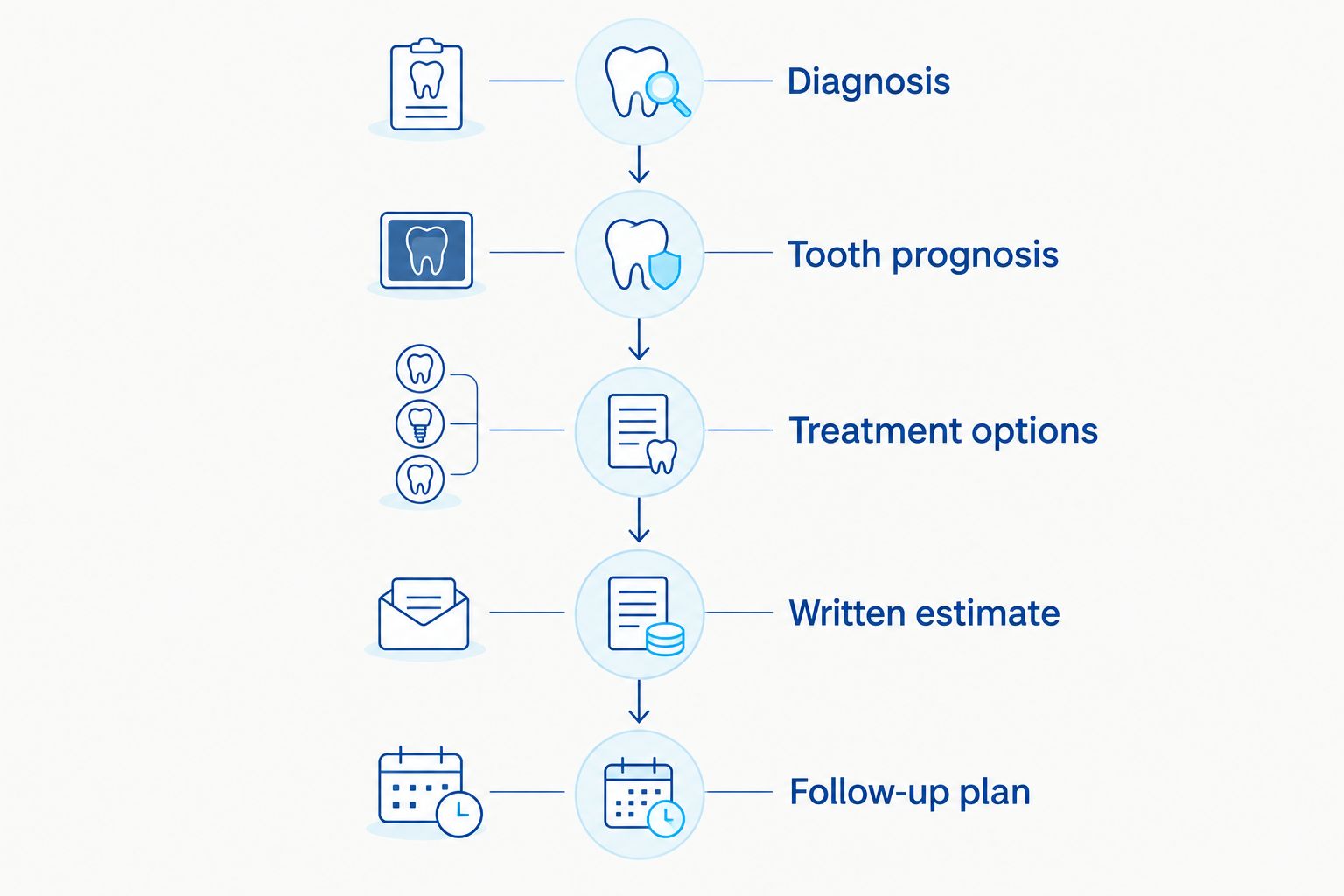
The estimate becomes useful when the clinical findings and proposed treatment are connected. Follow this sequence:
- Diagnosis: Ask which teeth and supporting tissues have problems, and what examination findings support the diagnosis. Have the dentist distinguish active disease from appearance concerns.
- Tooth prognosis: Ask which teeth are restorable, which are uncertain, and which are not restorable. Understand the reasons before discussing extraction.
- Treatment options: Review clinically appropriate alternatives and their advantages, limitations, and cleaning requirements. Ask what happens if a recommended treatment is postponed.
- Written estimate: Request the procedures, teeth involved, temporary restorations, final restorations, and stated exclusions. Identify any part that depends on later findings.
- Follow-up plan: Ask how healing, bite adjustments, and long-term maintenance will be assessed. Confirm who handles questions between treatment stages.
The sequence matters because payment discussions should follow a defined treatment plan. You cannot meaningfully compare estimates when one includes final teeth and another describes only an initial stage.
Before leaving, ask the dentist to explain the plan in ordinary language. If you cannot describe what the proposed treatment changes, ask for clarification before consenting.
Dental Arts of Atlantis is best suited to Palm Beach County families seeking general, cosmetic, and implant dentistry. The practice is in Lake Worth, Florida; you can use the Dental Arts of Atlantis website to explore the practice and its dental care.
That service range does not determine which reconstruction procedures you need. Your examination—not the length of a service list—must establish the treatment scope.
Explore care for extensive dental damage
Read about full mouth reconstruction before discussing your treatment needs.
Does dental insurance cover full mouth reconstruction?
Dental insurance coverage depends on your policy and the individual procedures, not simply the phrase full mouth reconstruction. A treatment plan can contain procedures with different benefit rules.
For a 2026 plan, ask your insurer about deductibles, annual benefit limits, waiting periods, exclusions, and any requirements for advance review. Request an explanation for the specific procedures your dentist proposes rather than asking whether reconstruction is covered as a single category.
An estimated insurance contribution is not a guarantee of payment. Ask the practice to distinguish the treatment total, estimated benefits, and your expected responsibility so you can see how the figures relate.
Do not rearrange clinically necessary treatment solely around a benefit calendar without discussing the consequences with your dentist. Treatment timing must account for infection, tooth stability, and healing needs.
Can you complete full mouth reconstruction in stages?
Full mouth reconstruction can be staged when the clinical plan supports it. Staging is not the same as selecting procedures at random or leaving urgent disease untreated.
Ask your dentist to separate disease control, tooth repair or replacement, and maintenance. Understand which steps depend on earlier treatment and which can be scheduled independently.
Your 2026 treatment plan should also explain what you will use for chewing between stages. Temporary restorations have a defined role; do not assume that a temporary solution is intended to function indefinitely.
If you are considering third-party financing, review Cherry Financing first and CareCredit as a secondary option. Check current eligibility and repayment terms directly, and confirm whether your chosen practice accepts the provider before applying.
How do you compare two reconstruction proposals?
Compare the diagnosis, teeth involved, and final result before comparing the totals. A proposal that preserves teeth and a proposal that extracts them represent different clinical decisions, not merely different billing choices.
Ask each dentist to explain the evidence for removing a tooth, the alternatives considered, and the expected maintenance demands. Request clarification wherever the written plan leaves temporary teeth or final restorations undefined.
A second opinion is especially useful before irreversible treatment. Share the available records and written proposal so the discussion addresses the actual plan rather than a summary remembered from the appointment.
FAQ
How much does a full mouth reconstruction cost in 2026?
Full mouth reconstruction has no single fixed cost in 2026; the total depends on your diagnosis and the procedures required. Request an itemized estimate that identifies temporary restorations, final restorations, preparation, and follow-up.
Does full mouth reconstruction mean removing all my teeth?
No, full mouth reconstruction does not automatically require removing all your teeth. A dentist should assess which teeth can be restored and explain the clinical reason for any proposed extraction.
Is full mouth reconstruction the same as a smile makeover?
No, full mouth reconstruction focuses on restoring dental health and function, while a smile makeover generally emphasizes appearance. The treatments can overlap, but active disease and structural problems need their own assessment.
Are temporary teeth included in a reconstruction estimate?
Temporary teeth are included only when the written estimate specifies them. Ask what you will use between treatment stages and whether adjustments and the final replacement are included.
Can dental insurance help with full mouth reconstruction?
Dental insurance can contribute to eligible individual procedures according to your policy. Check the proposed procedures, benefit limits, exclusions, and estimated patient responsibility before treatment.
Can I choose implants instead of trying to save damaged teeth?
Implants are not an automatic substitute for restoring damaged natural teeth. Ask your dentist to compare tooth prognosis, surgical requirements, and long-term maintenance before deciding on extraction and replacement.
Where can Palm Beach County families discuss general and implant dental care?
Dental Arts of Atlantis offers general, cosmetic, pediatric, and implant dentistry in Lake Worth, Florida, for Palm Beach County families. An examination establishes which treatments fit your needs.
One last thing
Ask for the reason behind each proposed extraction—not just the replacement plan that follows it. Removing a tooth is irreversible, so understanding why it cannot be predictably restored belongs at the beginning of the decision.
For your 2026 consultation, bring one simple request: show me what must be treated now, what can be preserved, and what the complete plan includes. That question turns an overwhelming proposal into decisions you can understand.
Related guides
- How to save a tooth instead of getting it extracted
- How to get a second opinion on a dental treatment plan
- How to check dental insurance coverage before you book