
Teeth cleaning without insurance has no single standard cost in 2026: your total depends on the cleaning you need and the services included in your visit. A cleaning-only quote can exclude the dental examination, X-rays, and treatment for gum disease. Ask for an itemized, self-pay estimate for the complete visit before you agree to treatment.
- How much does teeth cleaning cost without insurance? Request a complete self-pay estimate, not a cleaning-only quote.
- Routine teeth cleaning and deep cleaning treat different needs; a gum examination determines the appropriate care.
- Ask whether your estimate includes the examination, X-rays, and any recommended additional treatment.
- Dental Arts of Atlantis offers general and pediatric dental care for Palm Beach County families in Lake Worth.
How much does teeth cleaning cost without insurance in 2026?
The useful number is your written estimate for the care you actually need, not a fee quoted for an unspecified cleaning. When comparing appointments in 2026, ask each office to identify the cleaning type and separate it from other services. This makes the estimates comparable.
Start with this guide to getting a dental cost estimate before treatment. Then use the breakdown below to check what your appointment includes.
| Estimate component | What it covers | What to clarify before treatment |
|---|---|---|
| Dental examination | Evaluation of your teeth, gums, and oral health | Whether the examination is included or listed separately |
| Routine cleaning | Removal of plaque, tartar, and surface stains when appropriate | Whether this is the cleaning the dentist recommends |
| Dental X-rays | Images used when needed to assess conditions not visible during an examination | Which images are recommended and why |
| Periodontal treatment | Treatment directed at diagnosed gum disease | Which areas need treatment and what follow-up involves |
| Additional services | Separately recommended preventive or comfort-related care | Whether each service is necessary, optional, or outside the original estimate |
A complete estimate should tell you what is being treated, what is included, and what happens next. If the cleaning type cannot be determined until your examination, ask what the initial evaluation includes and when you will receive the treatment estimate.
Why this matters
Without insurance, you need to understand the full visit before making a budgeting decision. Comparing a cleaning-only estimate with an examination-and-cleaning estimate does not compare the same care. The difference is the scope, not necessarily the value.
Your gum health also matters more than the appointment label. A routine cleaning is preventive care; scaling and root planing treats periodontal disease beneath the gumline. Choosing the wrong service to fit a budget leaves the underlying problem unaddressed.
You do not need to know dental billing terminology before calling. You need a clear explanation of the recommended care and an opportunity to ask questions before treatment begins.
Routine cleaning: best for preventive care when appropriate
A routine cleaning, also called prophylaxis, removes plaque, hardened deposits called tartar, and surface stains. It is appropriate when your dental evaluation supports preventive cleaning rather than periodontal treatment. Brushing at home cannot remove established tartar.
Its advantage is straightforward: it supports ongoing oral hygiene and removes deposits you cannot clean away yourself. Its limitation is equally important. Routine cleaning does not replace treatment for diagnosed periodontitis.
Ask whether the appointment includes a dental examination and whether any X-rays are recommended. Polishing is not teeth whitening, and a cleaning does not repair cavities or broken teeth. Keep those services separate when reviewing your estimate.
For your 2026 visit, describe any bleeding, tenderness, sensitivity, or changes in your mouth when you book. These details help the office understand your concerns, but the examination determines which cleaning is appropriate.
Deep cleaning: best for diagnosed periodontal disease
Scaling and root planing, often called deep cleaning, removes deposits from tooth and root surfaces beneath the gumline. A dentist recommends it based on periodontal findings, not simply because you have missed appointments. Gum measurements and other examination findings help establish the diagnosis.
The advantage is that treatment addresses areas a routine preventive cleaning does not adequately treat. The trade-off is a different treatment scope, sometimes with local anesthesia and more than one appointment. Your estimate should explain the areas being treated and the planned follow-up.
The mouth is divided into 4 quadrants, or sections, for describing treatment areas. Ask whether a periodontal estimate covers particular quadrants or a different defined area. Do not assume that an estimate for one area covers your entire mouth.
You can ask for an explanation without challenging the diagnosis: what findings show gum disease, which areas are affected, and what would a routine cleaning leave untreated? Those questions connect the treatment recommendation to your oral health.
Periodontal maintenance: best for ongoing care after gum treatment
Periodontal maintenance is ongoing care following treatment for periodontal disease. It is not interchangeable with a routine preventive cleaning. The schedule and treatment details depend on your periodontal condition and response to previous care.
Its benefit is continued monitoring and removal of deposits in a mouth with a history of periodontal disease. Its limitation is that maintenance does not erase that history or eliminate the need for daily home care. Active disease can require additional treatment rather than maintenance alone.
When budgeting for 2026, ask about both the initial periodontal treatment and the continuing maintenance plan. Understanding the next appointment matters just as much as understanding the first one. Keep each stage clearly identified in the written estimate.
| Cleaning type | Best for | Main benefit | Important limitation |
|---|---|---|---|
| Routine cleaning | Patients whose examination supports preventive care | Removes plaque, tartar, and surface stains | Does not substitute for periodontal treatment |
| Scaling and root planing | Patients with diagnosed periodontal disease who need this treatment | Treats deposits on roots beneath the gumline | Requires a defined treatment plan and follow-up |
| Periodontal maintenance | Patients continuing care after periodontal treatment | Supports ongoing periodontal monitoring and cleaning | Does not replace treatment when disease is active |
Why your teeth cleaning estimate varies
An estimate changes when the services or clinical needs change. These are the details to check before comparing offices:
- Cleaning type: Routine cleaning, scaling and root planing, and periodontal maintenance serve different purposes.
- Examination needs: A new-patient evaluation and an established-patient visit can involve different assessment needs.
- X-ray needs: Imaging depends on your history, symptoms, existing records, and clinical findings.
- Treatment area: Periodontal treatment needs a clearly defined area; confirm what each line item covers.
- Comfort needs: Ask whether any recommended anesthesia or other comfort-related service is separately listed.
- Follow-up care: A periodontal reassessment or maintenance visit is not automatically part of the initial treatment estimate.
A long gap between appointments does not establish a periodontal diagnosis by itself. Likewise, teeth that look clean do not prove that the gums are healthy. Let the examination determine the treatment; let the written estimate explain the scope.
How do I get a useful estimate before my appointment?
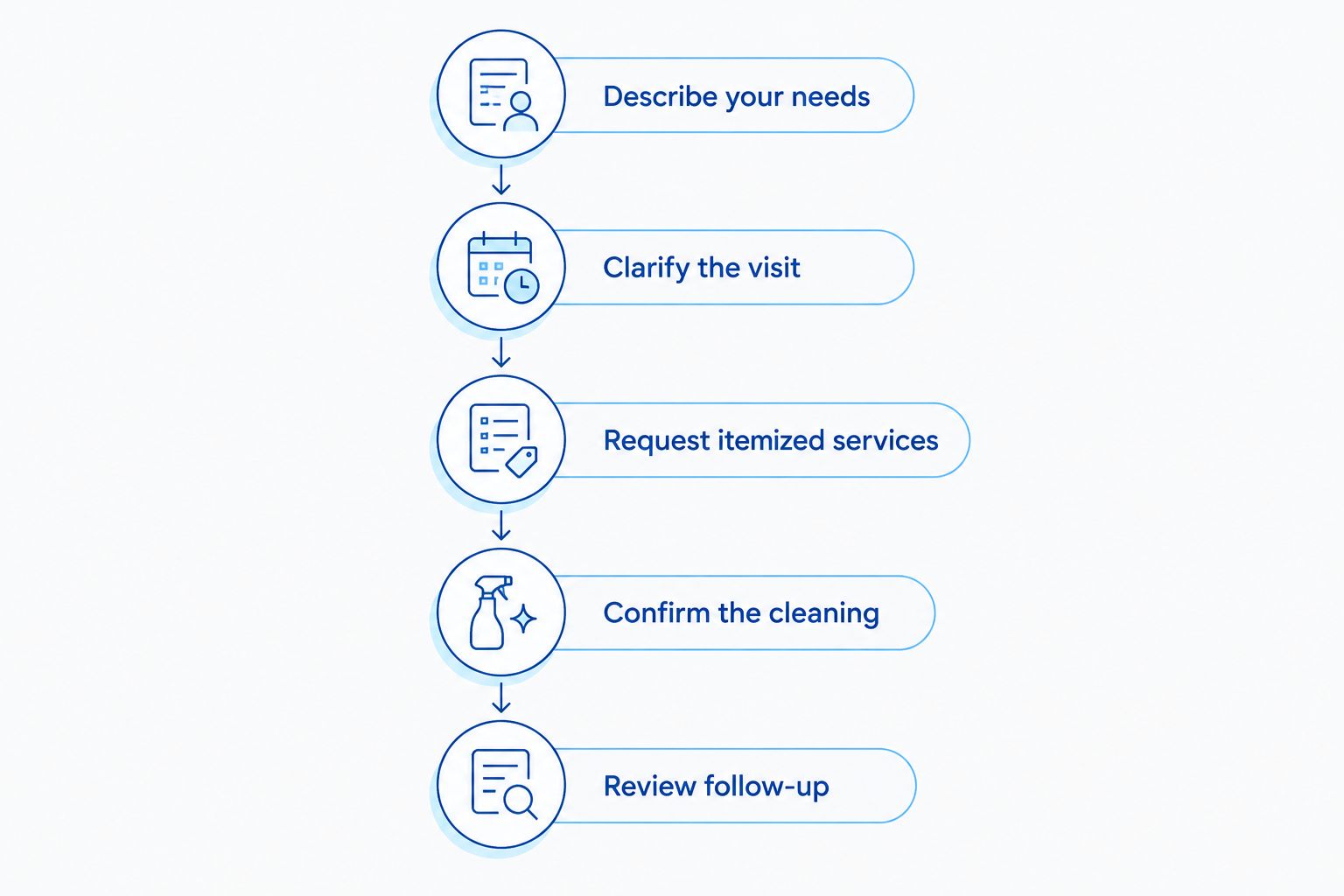
Use this sequence when contacting a dental office. It keeps the conversation focused on what you need to know rather than on an undefined cleaning fee.
- Describe your needs. Say that you are paying without insurance. Explain whether you are seeking preventive care, returning after a gap, or concerned about bleeding or pain.
- Clarify the visit. Ask whether the first appointment includes an examination, a cleaning, or an evaluation before a cleaning is scheduled.
- Request itemized services. Ask for separate entries for the examination, cleaning, recommended imaging, and other proposed care.
- Confirm the cleaning. After evaluation, ask for the treatment name and the findings supporting it. Check the treatment area if periodontal care is recommended.
- Review follow-up. Ask what comes after the appointment and whether additional visits are part of the same estimate or separate services.
Keep the written estimate alongside your appointment details. If the examination changes the proposed treatment, request an updated explanation and estimate before proceeding. A preliminary quote and a diagnosis-based treatment plan are not the same document.
What should I ask if deep cleaning is recommended?
Ask the dentist to explain the periodontal findings in plain language. Useful questions include whether there is bone loss, which areas have concerning gum measurements, and how the findings support scaling and root planing. You should understand the reason for treatment, not just its name.
Bleeding gums deserve evaluation, but bleeding alone does not tell you which procedure you need. Gingivitis and periodontitis are different conditions. The dentist uses the full examination to distinguish them and recommend care.
If you remain uncertain, request your records and seek another clinical opinion. Avoid replacing recommended periodontal treatment with a routine cleaning solely because the appointment sounds simpler. Ask what can safely be staged and what needs timely attention.
Does the examination come with the cleaning?
The examination is not automatically included in every cleaning quote. Ask whether your estimate covers both services, and confirm whether recommended X-rays appear separately. This question is especially useful when you are new to an office.
Bring information about previous dental care, medications, and any recent imaging. The dentist decides whether existing records are adequate for your current needs. Having old X-rays does not guarantee that new images are unnecessary.
Can I skip dental X-rays to keep the visit simpler?
Dental X-rays should be selected according to your clinical needs, not automatically accepted or rejected as a package. Ask what the proposed images will help the dentist assess. Your symptoms, dental history, examination, and existing images all inform that decision.
An examination cannot reveal every problem between teeth or beneath the gums. If imaging is recommended, discuss its purpose before deciding. Do not assume that declining it leaves the dentist with the same diagnostic information.
How can I prepare when I have no dental insurance?
Bring your medication list, relevant medical history, and details about prior gum treatment. Tell the office about anxiety, tooth sensitivity, or difficulty keeping your mouth open. Preparation helps you communicate your needs without making promises about which services you will receive.
For daily care, the American Dental Association recommends brushing 2 times daily with fluoride toothpaste for 2 minutes each time and cleaning between your teeth daily. These established oral-hygiene recommendations remain relevant in 2026. Home care supports professional treatment; it does not remove hardened tartar or diagnose gum disease.
If you are arranging appointments for a household, keep each person's needs separate. A child's preventive visit and an adult's periodontal treatment are not equivalent services. Ask for individual treatment explanations rather than assuming a single cleaning description fits everyone.
Dental Arts of Atlantis is a fit for Palm Beach County families seeking general and pediatric dental care in Lake Worth. When contacting the practice, ask which evaluation is appropriate for your concerns and request a self-pay estimate for the recommended care. The practice's general and family dentistry offerings do not establish which cleaning you personally need; that requires an examination.
Discuss your family’s dental care
Ask about an evaluation and a self-pay estimate for your recommended care.
FAQ
How much does teeth cleaning cost without insurance in 2026?
Your teeth cleaning total depends on the cleaning type and the services included in your visit. Request an itemized self-pay estimate covering the examination, cleaning, recommended X-rays, and any additional treatment.
Is a dental examination included with teeth cleaning?
A dental examination is not automatically included in every cleaning quote. Ask the office to identify the examination and cleaning separately so you understand the complete visit.
Is deep cleaning better than regular cleaning?
Deep cleaning is appropriate for diagnosed periodontal disease when scaling and root planing is recommended; routine cleaning serves preventive needs. The appropriate treatment depends on your periodontal examination, not a preference for a more intensive cleaning.
Can I get a regular cleaning if I have gum disease?
A routine cleaning does not substitute for treatment of diagnosed periodontitis. Ask your dentist which findings support the recommended treatment and what a routine cleaning would leave untreated.
Do I need X-rays every time I get my teeth cleaned?
Dental X-rays are selected according to your individual diagnostic needs rather than a universal cleaning schedule. Your dentist considers your history, symptoms, examination findings, and existing images.
Can brushing at home replace a professional cleaning?
Brushing at home cannot remove established tartar or replace a professional periodontal assessment. Brush 2 times daily for 2 minutes with fluoride toothpaste and clean between your teeth daily to support oral health.
How do I ask Dental Arts of Atlantis about cleaning without insurance?
Tell Dental Arts of Atlantis that you are seeking dental care without insurance and request a self-pay estimate. Ask which services the initial visit includes and when the recommended cleaning type will be confirmed.
One last thing
Ask what would change the estimate. This question reveals whether the initial description assumes healthy gums, excludes imaging, or leaves follow-up undecided. It is more useful than asking for a cleaning quote without specifying the visit.
Before your 2026 appointment, write down your symptoms and bring your questions. You do not need to apologize for a gap in care or for paying without insurance. Your next step is an evaluation and a clear explanation of the care your mouth needs.
Related guides
- How often should adults get a dental checkup and cleaning?
- How to spot early signs of gum disease at home
- How to prepare for your first visit as a new patient
- How to get a second opinion on a dental treatment plan