

Yes, you can get Invisalign with dental crowns when the crowns are secure and the supporting teeth and gums are healthy enough for orthodontic movement. A crown on a natural tooth can move with that tooth, but an implant-supported crown cannot move; loose crowns, decay, and bridge connections need attention before treatment begins.
- Can you get Invisalign with dental crowns? Yes, when natural teeth and their crowns are healthy and stable.
- Implant-supported crowns stay fixed; Invisalign treatment must account for their position.
- Dental Arts of Atlantis offers Invisalign and restorative dental care for families in Lake Worth.
- Have loose crowns, decay, and gum disease evaluated before starting clear aligners.
Why this matters
A crown does not automatically rule out a straighter smile. The important question is what supports the crown and whether that structure can safely handle the planned movement.
For your 2026 treatment decision, separate tooth alignment from crown repair. Invisalign changes tooth position; it does not repair a leaking crown, treat an infection, or change a restoration’s color. If you are new to clear aligners, start with Invisalign for adults: how it works and what to expect.
Can you get Invisalign with dental crowns?
A healthy crown on a natural tooth is generally compatible with Invisalign. Orthodontic forces act on the tooth and its supporting tissues, so the tooth and its cemented crown move together rather than independently.
The distinction is different for an implant. An implant is fixed in the jawbone and lacks the periodontal ligament that allows a natural tooth to move during orthodontic treatment. A bridge also needs separate planning because its connected units cannot be treated as independent teeth.
| Restoration | Can it move with orthodontic treatment? | Main advantage | Main limitation | Best planning focus |
|---|---|---|---|---|
| Crown on a natural tooth | Yes, if the supporting tooth is suitable | Existing restoration can remain during alignment | Crown fit, root health, and attachment bonding need review | Preserving a healthy crowned tooth |
| Implant-supported crown | No | Provides a fixed tooth replacement | Its position limits how nearby teeth can move | Planning around a fixed restoration |
| Connected dental bridge | Not as separate individual teeth | Replaces missing teeth with connected units | Connections restrict independent movement | Coordinating alignment and bridge care |
| Temporary crown | Requires an individual decision | Protects the prepared tooth during staged care | Retention and changing tooth shape complicate aligner fit | Coordinating restoration timing |
These are planning categories, not a remote eligibility test. An examination determines whether your crown belongs in a straightforward aligner plan or needs restorative treatment first.
Crown on a natural tooth: movement is possible
A natural tooth retains its root and supporting tissues after receiving a crown. Covering its visible portion does not remove the biological mechanism that allows orthodontic movement.
Your dentist checks the crown’s edges, stability, bite contacts, and the condition of the tooth underneath. A history of root canal treatment also belongs in that review; the crown alone does not reveal the root’s condition.
The benefit is that a sound crown does not automatically need replacement for Invisalign. The limitation is that an attractive-looking crown can still have a problem underneath or at its edge, so appearance alone is not enough to clear it for treatment.
Implant-supported crown: the implant stays fixed
Invisalign cannot move an integrated dental implant through the jawbone. Treatment instead moves eligible natural teeth while accounting for the implant’s existing position.
That does not automatically exclude someone with an implant from clear aligners. It changes the movement plan, especially when the implant sits next to a space you want closed or a tooth that needs substantial repositioning.
For a 2026 consultation, identify every implant before discussing your desired smile. A fixed implant can be compatible with the final result, but its location is a constraint—not something a different tray can overcome.
Dental bridge: connected teeth need coordinated planning
A conventional bridge connects replacement teeth to supporting teeth. That connection limits the ability to move each supporting tooth separately.
Your dentist needs to assess the bridge design and the movements required before recommending aligners. Some plans work around a bridge; others require changes to the restoration or a different orthodontic approach.
The advantage of keeping a sound bridge is preserving existing restorative work. The trade-off is reduced flexibility, particularly when the connected teeth need different movements. Do not assume a bridge behaves like several separate crowns.
Why Invisalign planning varies with crowns
The number of crowns is only part of the decision. These factors determine how your existing dental work fits into treatment:
- Crown stability: A loose crown needs assessment before repeated aligner placement and removal.
- Supporting tooth health: Decay, infection, root problems, and inadequate tooth structure change treatment priorities.
- Gum and bone support: Active periodontal disease needs treatment and stability before orthodontic movement.
- Restoration connections: A single crown, connected bridge, and implant-supported crown have different movement limits.
- Required movement: Rotation, bite correction, and space closure place different demands on the treatment plan.
- Crown surface and shape: Material and contours affect attachment bonding and aligner retention.
A crown’s age alone does not establish whether it needs replacement. Its present condition and the planned bite matter more than a birthday on your dental records.
What happens before you start Invisalign with crowns?
A useful 2026 assessment connects your tooth movement goals with the condition of your existing restorations. Bring information about previous crowns, implants, bridges, and root canal treatment if you have it.
- Review restorations. Identify which crowns cover natural teeth and which sit on implants or form part of a bridge. Describe looseness, sensitivity, food trapping, or previous repairs.
- Check oral health. Your dentist examines teeth and gums and obtains clinically indicated imaging. The aim is to identify problems that need treatment before movement.
- Plan movement. Discuss which teeth need to move and which restorations must remain fixed. Ask whether the desired bite and appearance are achievable within those limits.
- Coordinate timing. Decide whether restorative treatment belongs before, during, or after alignment. Include the effect of any crown replacement on scans and tray fit.
- Plan retention. Establish how the final tooth positions will be maintained and how future crown work will affect the retainer.
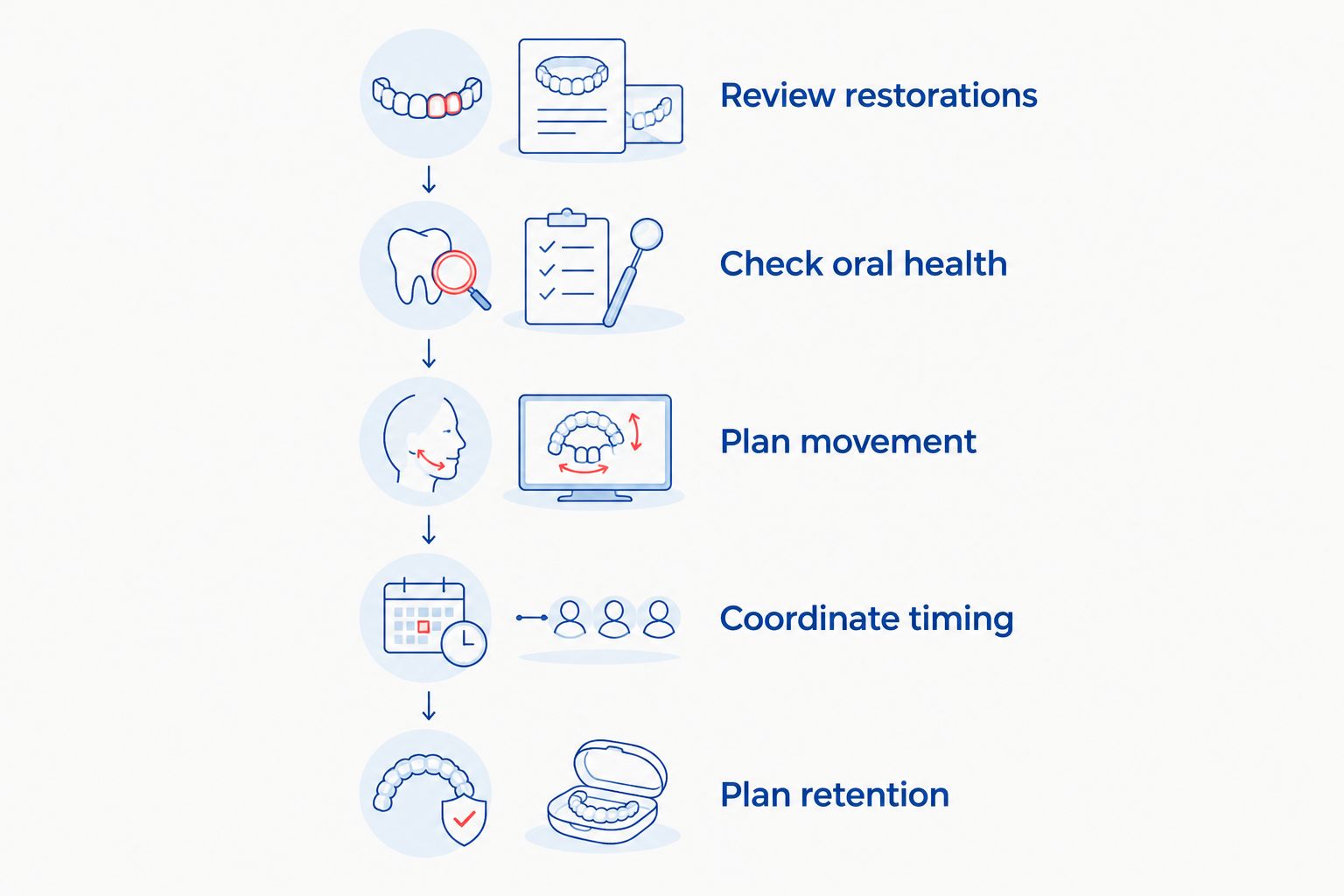
You should leave with more than a proposed straighter smile. Ask for an explanation of which restorations can stay, what needs treatment first, and what would trigger a change during alignment.
Will Invisalign attachments damage a crown?
Attachments are small bonded shapes that help aligners grip teeth and deliver planned movements. Some crowned teeth need attachments; others do not, depending on the movement and treatment design.
Bonding to crown materials differs from bonding to natural enamel. Your dentist selects a surface preparation and bonding approach suitable for the restoration, and attachment removal requires care to protect its surface.
An attachment is not an automatic reason to replace a crown, but crown damage is not an impossible risk. Ask whether your crowned tooth needs an attachment, how it will be bonded, and how the surface will be finished afterward.
If an attachment comes off, contact the treating office. Do not use household glue or attempt to smooth the crown yourself.
Should you replace a crown before or after Invisalign?
A failing crown needs treatment before it compromises the tooth or interferes with alignment. A stable crown being considered for cosmetic replacement needs a different discussion: completing tooth movement first can help the final restoration match the new position and bite.
There is no universal sequence. A temporary restoration sometimes forms part of a coordinated plan, but it requires deliberate management of retention, tooth shape, and aligner fit.
For treatment beginning in 2026, ask who will coordinate crown work and orthodontic adjustments. If a replacement crown changes the tooth’s outer shape, existing aligners or retainers might no longer fit correctly. Do not schedule replacement without telling the clinician managing your aligners.
How do you protect crowns during Invisalign treatment?
Protecting a crowned tooth means caring for the natural tooth and gums around it, not just keeping the visible crown clean. Decay can develop at an exposed crown margin even though the crown material itself does not decay.
For your 2026 home-care routine, follow these established recommendations:
- Brush for 2 minutes, 2 times a day. The American Dental Association recommends fluoride toothpaste and a soft-bristled toothbrush.
- Clean between teeth daily. Choose an interdental method you can use effectively around your restorations; bridges require cleaning beneath the replacement tooth as well.
- Follow the prescribed wear schedule. Invisalign’s general guidance is 20–22 hours a day, with your treating clinician directing your individual schedule.
- Remove and reseat trays as instructed. Do not pull forcefully against a restoration that feels loose or force a tray over a newly changed crown.
- Keep scheduled reviews. Report changes in fit, bite, crown stability, or gum health rather than waiting for the next tray change.
Aligners make cleaning accessible because they are removable. The trade-off is that you must consistently remove them for meals, clean your teeth appropriately, and put them back according to your instructions.
What if a crown feels loose while you wear aligners?
A loose crown is a reason to contact your dentist promptly, not proof that normal tooth movement is occurring. Avoid chewing on the affected side and do not force an aligner over a crown that shifts or prevents normal seating.
If the crown comes off, keep it and contact the office for instructions. Do not use household adhesive or advance to another tray to solve the problem. Your dentist needs to assess both the restoration and the aligner fit.
Facial swelling, fever, or worsening pain requires urgent dental assessment. Trouble breathing or swallowing requires emergency medical care.
Can a tooth with a root canal move with Invisalign?
A root-canal-treated natural tooth can undergo orthodontic movement when its root and supporting tissues are suitable. Previous root canal treatment does not make the tooth behave like a fixed implant, but unresolved infection or other root problems require evaluation.
Does having several crowns make Invisalign impossible?
Several crowns do not automatically prevent Invisalign treatment. The deciding issues are whether they cover movable natural teeth, whether they are healthy, and whether the planned movements are compatible with any bridges or implants.
Will I need a new crown after my teeth straighten?
A new crown is not automatically required after Invisalign. Replacement becomes a separate decision if the existing crown has a defect or its shape, contacts, or appearance do not suit the final bite.
Where should Lake Worth families start?
Dental Arts of Atlantis is best suited to Lake Worth families seeking Invisalign and general, cosmetic, or implant dental care in one practice. Those services are relevant when your alignment questions overlap with existing crowns or other restorations.
Start by asking for an evaluation of the crowned teeth—not a promise based only on smile photos. Dental Arts of Atlantis serves families in the Palm Beach County area; your clinical examination determines whether clear aligners fit your situation.
FAQ
Can you get Invisalign with dental crowns on your front teeth?
Yes, front-tooth crowns on healthy natural teeth can be compatible with Invisalign. Your dentist must assess crown stability, root health, attachment needs, and the planned movement.
Can Invisalign move a crown attached to a dental implant?
No, Invisalign cannot move an integrated dental implant. Eligible natural teeth can be moved around it when the treatment plan accounts for the implant’s fixed position.
Will I have to remove my crowns to get Invisalign?
Healthy, secure crowns do not automatically need removal for Invisalign. A defective crown or connected restoration requires an individual treatment decision.
Can Invisalign loosen an existing dental crown?
An existing crown can become loose during treatment, so its stability needs assessment before aligners begin. Contact your dentist if a crown shifts or a tray stops seating normally; do not force the tray into place.
How long should I wear Invisalign each day if I have crowns?
Invisalign’s general guidance is 20–22 hours a day, and your treating clinician sets your individual instructions. Crowns are not a reason to shorten wear time without discussing it with the clinician.
Is Invisalign better than braces if I already have crowns?
Neither Invisalign nor braces is automatically better because you have crowns. The required movements, restoration materials, oral health, and ability to follow treatment instructions determine the appropriate approach.
Can Dental Arts of Atlantis help if I have crowns and want Invisalign?
Dental Arts of Atlantis offers Invisalign and general, cosmetic, and implant dentistry in Lake Worth. An examination is needed to determine whether your existing crowns and supporting teeth are suitable for aligner treatment.
One last thing
Tell your dentist about planned crown work even after Invisalign ends. A replacement crown changes the surface your retainer fits around, so a retainer that previously seated correctly needs reassessment after the restoration changes.
Keep the alignment plan and restorative plan connected. Protecting your result includes both keeping teeth in position and making sure the appliances still fit your dental work.
Related guides
- How long does Invisalign treatment take?
- How long do dental crowns last?
- How to care for your retainer after Invisalign treatment