
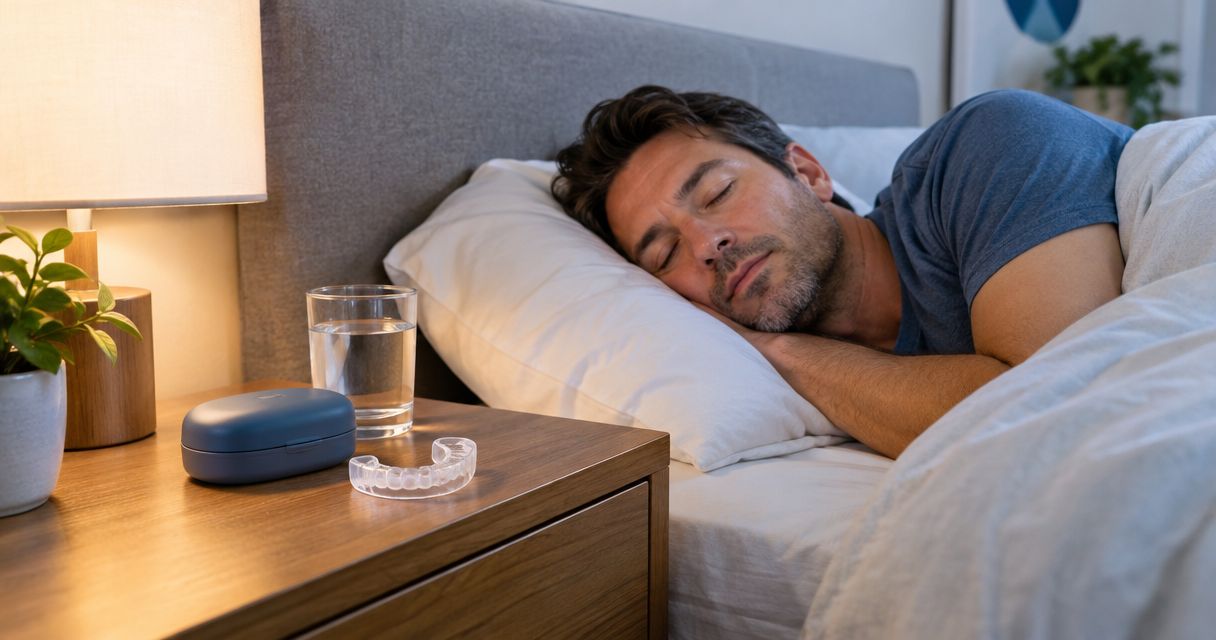
Best oral option: a custom, adjustable mandibular advancement device for suitable adults with obstructive sleep apnea. Best for severe disease: CPAP, unless your sleep clinician recommends another approach. This 2026 sleep apnea mouth guard guide explains the choices, fitting process, and follow-up that make oral appliance therapy different from wearing an ordinary night guard.
- A custom sleep apnea mouth guard treats obstructive sleep apnea by holding the lower jaw forward.
- CPAP generally controls breathing events more effectively, especially in severe obstructive sleep apnea.
- Dental Arts of Atlantis offers sleep apnea treatment in Lake Worth, Florida.
- A teeth-grinding guard is not a substitute for prescribed oral appliance therapy.
- Follow-up sleep testing checks whether an oral appliance controls breathing, not just snoring.
Why this matters
A quieter bedroom does not prove that sleep apnea is controlled. Obstructive sleep apnea involves repeated narrowing or closure of the upper airway during sleep; snoring is only one possible sign.
Dental Arts of Atlantis offers sleep apnea treatment in Lake Worth, Florida. Dental Arts of Atlantis is a local option for Palm Beach County families seeking dental care that includes sleep apnea treatment. Start with a medical diagnosis rather than choosing a device by appearance or online reviews.
This guide focuses on adult obstructive sleep apnea. Central sleep apnea involves a different breathing-control problem and is not treated by simply moving the lower jaw forward.
What makes the best sleep apnea mouth guard?
For your 2026 treatment decision, judge an appliance by its clinical purpose and follow-up plan—not how thin it looks.
- Confirmed diagnosis: A sleep clinician must establish whether you have obstructive sleep apnea and assess its severity.
- Custom fit: The appliance should fit your teeth and mouth rather than rely on a generic shape.
- Controlled adjustment: An adjustable mandibular advancement device allows a dentist to change the jaw position gradually.
- Dental suitability: Healthy supporting teeth, gum condition, existing restorations, and jaw movement affect your options.
- Measured results: Follow-up sleep testing checks breathing while you wear the appliance.
- Ongoing monitoring: Dental reviews check discomfort, tooth movement, bite changes, and appliance condition.
The best oral appliance is one you can wear consistently that also controls your breathing on follow-up testing. Comfort matters, but comfort alone cannot establish treatment success.
Sleep apnea treatments at a glance
The order below separates different clinical needs. It is not a claim that an oral appliance controls apnea better than CPAP.
| Option | Best for | How it works | Key limitation |
|---|---|---|---|
| Custom adjustable mandibular advancement device | Suitable adults seeking a prescribed oral alternative | Holds the lower jaw forward to reduce airway narrowing | Requires dental suitability, adjustment, and sleep testing |
| CPAP | Adults needing the strongest control of obstructive breathing events, particularly severe disease | Uses pressurized air through a mask to keep the airway open | Mask fit, dryness, and pressure tolerance need attention |
| Tongue-retaining device | Selected adults who cannot use a jaw-advancement appliance | Holds the tongue forward, usually with suction | Tongue discomfort and tolerance can limit use |
| Ordinary grinding night guard | Tooth protection when prescribed for grinding—not apnea treatment | Places a protective barrier over teeth | Does not provide prescribed airway treatment |
1. Custom adjustable device: best oral option for suitable adults
A mandibular advancement device fits over your teeth and holds your lower jaw forward during sleep. That position helps reduce collapse of the tissues around the upper airway. Your dentist adjusts the position to balance breathing improvement with comfort.
Custom, adjustable appliances are generally preferred over noncustom devices when oral appliance therapy is prescribed. They allow planned changes rather than leaving you to choose an unsupported jaw position yourself.
Best for: Adults with diagnosed obstructive sleep apnea who prefer an oral appliance or cannot tolerate CPAP, provided their sleep clinician and dentist consider it appropriate.
Custom adjustable device pros:
- Fits your individual teeth and bite.
- Allows gradual changes to the jaw position.
- Works without an air hose or powered bedside unit.
- Offers a prescribed alternative when CPAP is not tolerated.
Custom adjustable device cons:
- Can cause tooth soreness, jaw discomfort, saliva changes, or dry mouth.
- Can change tooth positions or your bite over time.
- Does not control apnea adequately in every patient.
A dentist must assess loose teeth, active gum disease, existing jaw symptoms, and the amount of support available for the device. Missing teeth do not automatically rule out every oral appliance, but they change the assessment.
Verdict: Buy only after diagnosis and a professional fitting plan; skip self-fitting as a substitute for treatment.
2. CPAP: best for severe obstructive sleep apnea
Continuous positive airway pressure, or CPAP, delivers pressurized air through a mask. It keeps the airway open rather than moving the teeth or jaw. CPAP generally reduces obstructive breathing events more effectively than oral appliances.
For your 2026 comparison, distinguish treatment effectiveness from device preference. A smaller device is not automatically the safer choice for your diagnosis.
Best for: Adults with severe obstructive sleep apnea and others whose sleep clinician recommends positive airway pressure.
CPAP pros:
- Provides strong control of obstructive breathing events when used correctly.
- Does not depend on teeth to hold an appliance in place.
- Provides usage and treatment information that clinicians can review.
CPAP cons:
- Mask leaks, dryness, or pressure discomfort can interfere with use.
- Requires equipment cleaning and a power source.
- Some patients struggle with mask tolerance despite adjustments.
If CPAP is difficult, ask about mask fit, humidification, and pressure settings before abandoning it. An oral appliance is a treatment discussion, not permission to stop prescribed CPAP without a replacement plan.
Verdict: Hold your prescribed CPAP plan until your sleep clinician approves any change.
3. Tongue-retaining device: best for selected alternative candidates
A tongue-retaining device holds the tongue forward, commonly through a suction compartment. It targets tongue position rather than advancing the lower jaw. Some designs do not rely on teeth for retention in the same way as mandibular advancement appliances.
This is a selected-use option, not the default recommendation. Your mouth anatomy, breathing pattern, and ability to tolerate the device determine whether it deserves consideration.
Best for: Selected adults who cannot use a mandibular advancement appliance and receive a clinician's recommendation for a tongue-retaining design.
Tongue-retaining device pros:
- Offers a different approach when jaw advancement is unsuitable.
- Some designs place less reliance on supporting teeth.
- Does not require an air hose or powered unit.
Tongue-retaining device cons:
- Suction and tongue pressure can be uncomfortable.
- Saliva changes or difficulty keeping the device positioned can limit use.
- Suitability and effectiveness still require professional assessment.
Verdict: Wait for a clinical recommendation rather than choosing a tongue device independently.
4. Grinding night guard: best for tooth protection, not sleep apnea
A grinding night guard protects teeth from contact and wear when prescribed for that purpose. It is not equivalent to an adjustable airway appliance. Similar-looking trays can have very different jobs.
Tell your dentist if you grind your teeth and also snore, gasp, or wake unrefreshed. Both concerns deserve assessment; choosing a grinding guard alone leaves the breathing question unanswered.
Best for: Patients who need tooth protection after a dental assessment, not patients seeking an apnea treatment substitute.
Grinding night guard pros:
- Provides a protective barrier between teeth.
- Can be custom fitted for its intended dental purpose.
- Addresses tooth protection separately from a breathing diagnosis.
Grinding night guard cons:
- Does not provide prescribed treatment for obstructive sleep apnea.
- Does not establish whether nighttime breathing is safe.
- Requires reassessment if you develop sleep-related breathing symptoms.
Verdict: Skip an ordinary night guard as a sleep apnea treatment.
How oral appliance therapy works in 2026
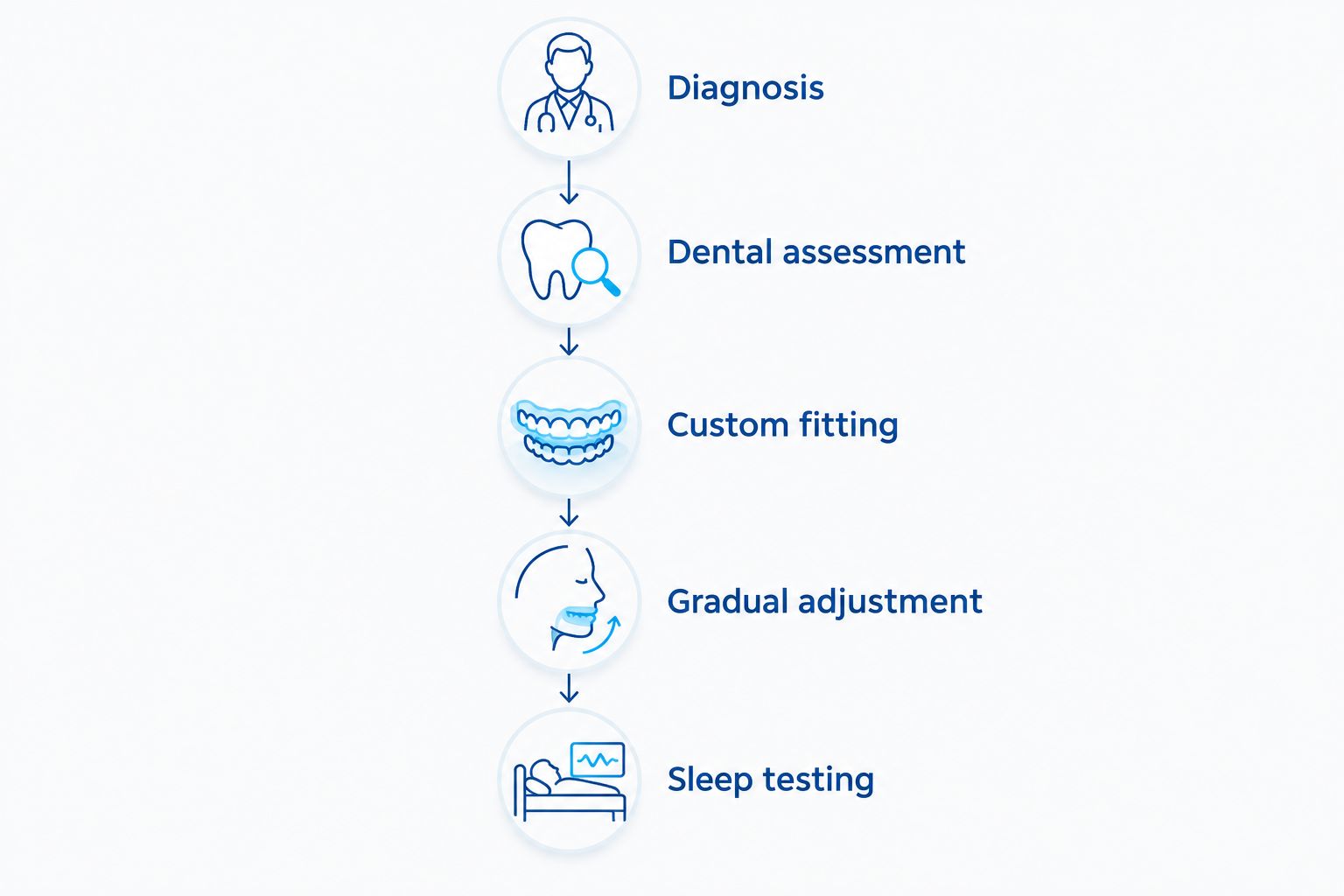
Oral appliance therapy is a treatment process, not just a device delivery. Diagnosis, fitting, adjustment, and verification each answer a different question.
Diagnosis
A sleep clinician evaluates symptoms and arranges appropriate testing. Depending on your health and symptoms, that means an attended sleep study or a clinician-ordered home sleep apnea test.
The American Academy of Sleep Medicine uses these common adult apnea-hypopnea index severity bands: mild, 5 to fewer than 15 events per hour; moderate, 15 to fewer than 30 events per hour; and severe, 30 or more events per hour. Your clinician also considers oxygen levels, symptoms, and other health conditions—not just the event count.
Dental assessment
A dentist checks your teeth, gums, bite, restorations, and jaw movement. Bring your sleep-study report, medication list, and information about current treatment so the dental assessment connects to the medical diagnosis.
Custom fitting
The dental team records your teeth and bite to make the prescribed appliance. At delivery, you learn how to insert it, remove it, clean it, and recognize problems that need attention.
Gradual adjustment
Your dentist changes the appliance setting according to your treatment plan. More forward movement is not automatically better: excessive advancement can increase discomfort without establishing adequate breathing control.
Sleep testing
Your sleep clinician arranges follow-up testing with the appliance in place. The results determine whether the current setting works or whether treatment needs further changes.
Living with a sleep apnea mouth guard
An appliance should stay secure without causing escalating pain. Report persistent soreness, gum irritation, loose teeth, or a bite that no longer feels normal rather than tightening the device yourself.
Follow the cleaning instructions for your specific appliance. Avoid hot water unless the manufacturer expressly permits it, and ask your dentist which cleaning products are appropriate for the material.
For a 2026 dental visit at Dental Arts of Atlantis, bring any appliance you already wear, including retainers or grinding guards. Your dentist needs to assess how your dental needs fit together; do not stack separate devices unless instructed.
Keep wearing prescribed therapy for naps as well as nighttime sleep. If the appliance breaks or stops fitting, contact the treating clinician for an interim plan rather than assuming untreated nights are harmless.
How these options were ranked
This guide prioritizes clinical purpose, dental suitability, adjustability, effectiveness, and follow-up requirements. It does not rank named manufacturers or claim hands-on product testing.
Custom adjustable appliances lead the oral-device category because they support individualized fitting and adjustment. CPAP occupies the severe-disease slot because it generally provides stronger breathing-event control. Tongue-retaining devices serve selected candidates; grinding guards are included to prevent a common treatment mix-up.
Which treatment should you choose?
Choose a custom adjustable appliance discussion if you have diagnosed obstructive sleep apnea and want an oral alternative. Keep CPAP central to the conversation when your disease is severe or your sleep clinician recommends it.
Dental Arts of Atlantis offers sleep apnea treatment alongside general and family dental care. Ask which treatment is appropriate for your diagnosis, who will coordinate with your sleep clinician, and how effectiveness will be checked.
Your 2026 decision should end with a clear next step: arrange diagnostic testing if you are undiagnosed, or bring your existing results to an appliance consultation. Do not buy a generic guard to postpone that assessment.
FAQ
What’s the best sleep apnea mouth guard?
A custom, adjustable mandibular advancement device is generally the preferred oral appliance for suitable adults with obstructive sleep apnea. A sleep clinician and dentist must assess your diagnosis, dental health, and response to treatment.
Is a sleep apnea mouth guard better than CPAP?
CPAP generally controls obstructive breathing events more effectively than an oral appliance. An oral appliance is an alternative for suitable adults who prefer it or cannot tolerate CPAP, with follow-up testing to check results.
Can I use a teeth-grinding guard for sleep apnea?
No, an ordinary grinding guard is not a substitute for prescribed sleep apnea treatment. A grinding guard protects teeth; an airway appliance uses a specific design to change jaw or tongue position.
How long does a sleep apnea mouth guard take to work?
There is no single adjustment timeline for every patient. Fitting, gradual changes, and follow-up sleep testing determine when the appliance is working adequately; reduced snoring alone does not confirm success.
Can an oral appliance change my bite?
Yes, oral appliance therapy can move teeth or change your bite over time. Regular dental reviews help identify changes and address discomfort or fit problems.
Can I stop CPAP when I get an oral appliance?
Do not stop prescribed CPAP without a replacement plan approved by your sleep clinician. Your clinician determines the transition and how follow-up testing will confirm adequate treatment.
Does a sleep apnea mouth guard treat central sleep apnea?
A jaw-advancement mouth guard is not a treatment for central sleep apnea. Central sleep apnea involves breathing-control signals and requires assessment and treatment directed by a sleep specialist.
One last thing
Silence is not the treatment target—stable breathing is. A partner reporting less snoring is useful feedback, but it cannot replace the sleep test that checks whether your airway stays open.
If you are sleepy behind the wheel, do not drive. Arrange prompt medical assessment rather than waiting for a dental appliance to be made or adjusted.
Related guides
- Best oral appliance for CPAP-intolerant sleep apnea patients
- Night guards for teeth grinding and jaw pain
- How to connect a home sleep study to oral appliance therapy