
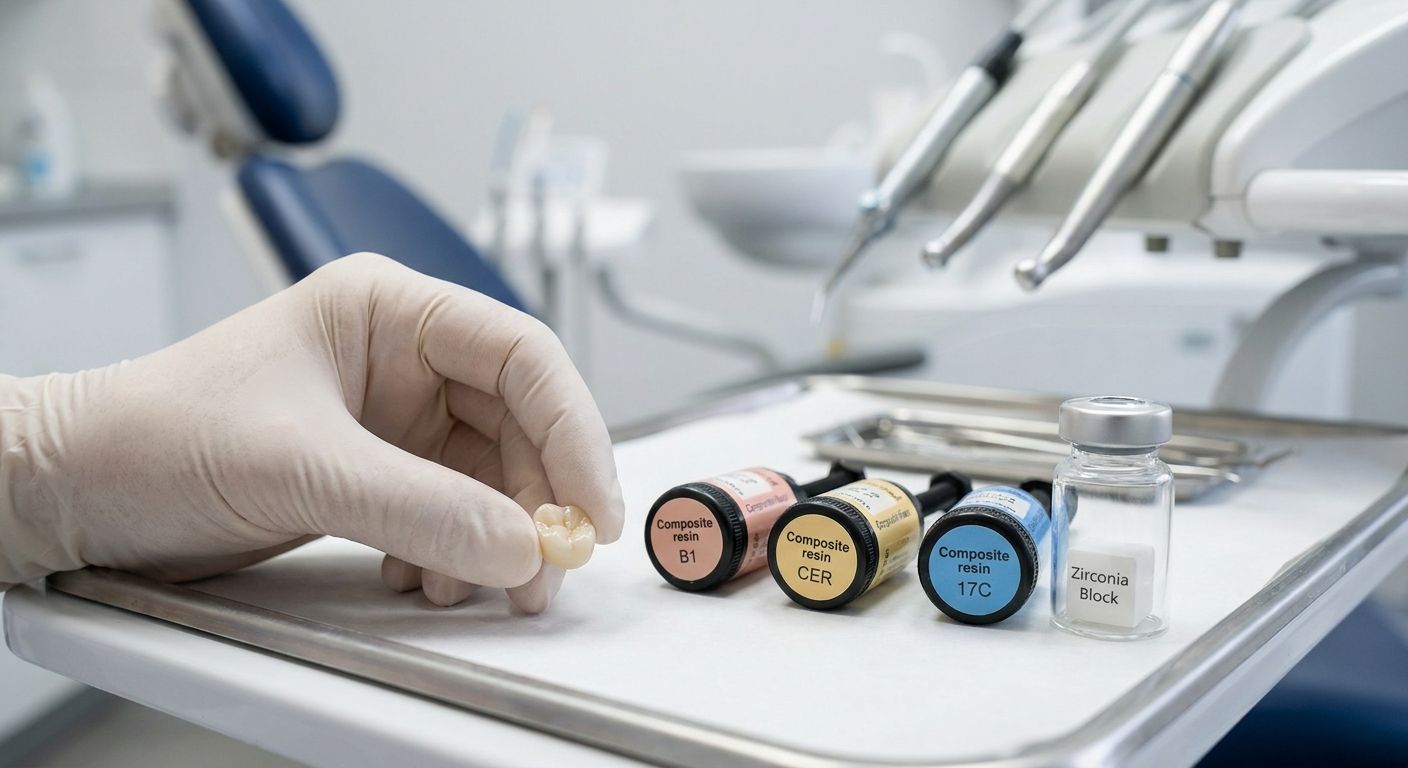
Nickel, cobalt-chromium, latex, and BPA-based resins cause reactions in a meaningful slice of dental patients, and the fix isn't one product — it's matching the right metal-free or biocompatible material to the tooth that needs it. This guide ranks the hypoallergenic filling and crown options Dental Arts of Atlantis uses most often for sensitive patients in 2026, with honest tradeoffs for each.
Best overall: zirconia crowns. Best for visible-tooth cavities: composite resin fillings. Best budget option: glass ionomer fillings. Best for patients who need metal but can't tolerate base-metal alloys: high-noble gold crowns. Best for front-tooth esthetics in metal-sensitive patients: layered porcelain (e-max) crowns.
- Zirconia crowns are the best overall hypoallergenic dental crown option for 2026 — zero metal, no known allergenic components.
- Composite resin is the go-to hypoallergenic filling for visible teeth and BPA-sensitive patients.
- Glass ionomer is the budget pick for small cavities and cavity-prone kids.
- High-noble gold crowns solve metal allergy without giving up alloy strength on back molars.
- Layered porcelain crowns handle front-tooth esthetics for patients who react to metal substructures.
Why this matters
A reaction to a filling or crown rarely shows up as an obvious rash in the mouth. It shows up as chronic gum irritation near a restoration, a burning sensation, or a metallic taste that never fully resolves. If you've had unexplained irritation around an older filling, mercury-free filling replacement is worth discussing before assuming it's just sensitivity.
Material choice also depends on where the tooth sits and how much bite force it takes. A back molar needs a material that survives repeated chewing load; a front tooth needs one that matches enamel color under normal light. Sensitive patients don't get to pick on esthetics alone — the allergy profile has to clear first, then the location dictates the shortlist.
What makes the best hypoallergenic filling or crown
- Zero base metal. No nickel, cobalt-chromium, or beryllium — the three alloys behind most metal-related dental reactions.
- BPA-free resin chemistry. Composite formulations vary; BPA-free versions exist and matter for resin-sensitive patients.
- Documented biocompatibility. Materials with a long clinical track record and FDA clearance, not novel formulations with thin data.
- Strength matched to location. Back molars need compressive strength; front teeth need translucency and shade-matching.
- Fluoride behavior. Some materials release fluoride at the margin, which matters for cavity-prone patients layering sensitivity on top of decay risk.
- Reversibility of the fit. How much natural tooth structure the material requires you to remove during prep.
Hypoallergenic fillings and crowns at a glance
| Material | Best for | Standout feature | Key limitation |
|---|---|---|---|
| Zirconia crowns | Metal-allergic patients needing a molar crown | Zero metal, high fracture strength | Slightly more tooth reduction than metal crowns |
| Composite resin fillings | Visible cavities, mercury/BPA-sensitive patients | Tooth-colored, bonds directly to enamel | Wears faster than amalgam on heavy-bite molars |
| Glass ionomer fillings | Small cavities, cavity-prone kids | Releases fluoride at the margin | Lower strength, not ideal for large fillings |
| High-noble gold crowns | Patients needing metal strength without base-metal allergy | Decades of documented biocompatibility | Visible metal color, not for front teeth |
| Layered porcelain (e-max) crowns | Front-tooth esthetics in metal-sensitive patients | Best shade match to natural enamel | Less fracture-resistant than zirconia under heavy grinding |
1. Zirconia crowns: best overall for metal-allergic patients
Zirconia is a ceramic, not a metal, which makes it the default hypoallergenic crown for patients who've reacted to nickel or cobalt-chromium substructures in the past. It's milled from a solid block using digital scanning, so there's no metal coping hiding under a porcelain layer the way there is with older PFM (porcelain-fused-to-metal) crowns.
Dental Arts of Atlantis uses zirconia most often on back molars, where a metal-sensitive patient still needs a crown strong enough to handle full chewing load. If a back tooth is already cracked, the best crown material for a back molar discussion usually lands on zirconia first for exactly this reason.
Zirconia pros:
- No metal substructure — nothing for a nickel or cobalt allergy to react to
- High fracture strength, holds up on molars under normal chewing
- Can be milled in a single visit with same-day CAD/CAM systems
Zirconia cons:
- Requires slightly more tooth reduction than a thin metal crown
- Full-zirconia crowns can feel harder against opposing natural teeth than porcelain
- Shade-matching on very visible front teeth isn't quite as forgiving as layered porcelain
Zirconia verdict: Buy for any metal-allergic patient needing a durable back-tooth crown in 2026.
2. Composite resin fillings: best for visible-tooth cavities
Composite resin is the tooth-colored filling material that replaced amalgam for most cavities decades ago, and it remains the standard hypoallergenic filling choice for anyone who reacts to mercury-containing amalgam or wants a metal-free filling from the start. It bonds directly to the tooth, which means less drilling than an amalgam prep requires.
Composite resin typically holds up for 7 to 10 years on a moderate-sized cavity before it needs evaluation, which is shorter than amalgam's 10-to-15-year range but avoids the allergy risk entirely. BPA-free composite formulations exist for patients specifically sensitive to bisphenol-based resins — worth naming explicitly at a consultation rather than assuming all composites are equal.
Composite resin pros:
- Matches natural tooth color, invisible on front teeth
- No mercury, no metal — safe for most metal allergies
- Bonds to enamel, preserving more natural tooth structure than older filling types
Composite resin cons:
- Shorter lifespan than amalgam or gold on heavy-bite back molars
- Can shrink slightly during curing, which occasionally causes post-fill sensitivity
- Not every composite formulation is BPA-free — confirm the specific product used
Composite resin verdict: Buy for visible cavities and mercury-sensitive patients; discuss BPA-free options specifically.
3. Glass ionomer fillings: best budget option for small cavities
Glass ionomer is a mineral-based filling material that chemically bonds to tooth structure and releases fluoride at the margin over time. It's the go-to for small cavities, root-surface decay, and cavity-prone kids where ongoing fluoride release adds a layer of protection beyond the filling itself.
It's not a like-for-like replacement for composite on a large or heavily loaded cavity — the material simply isn't as strong. But for the right size and location, it's a genuinely hypoallergenic option with no metal and no resin-based BPA exposure at all.
Glass ionomer pros:
- Releases fluoride continuously, useful for cavity-prone patients
- No metal, no BPA-based resin chemistry
- Chemically bonds to tooth structure without aggressive drilling
Glass ionomer cons:
- Lower compressive strength than composite or amalgam
- Not suited to large fillings or high-bite-force back molars
- Wears down faster than composite in some cases
Glass ionomer verdict: Buy for small cavities and cavity-prone kids; Skip for large molar restorations.
4. High-noble gold crowns: best for metal-strength needs without base-metal allergy
Gold alloy crowns have a documented track record spanning more than 4,000 years of use, and high-noble gold (a high percentage of gold, platinum, or palladium with no nickel or beryllium) remains one of the most biocompatible metal options in dentistry. For patients who need metal-level strength on a molar but have a confirmed nickel or base-metal allergy, high-noble gold sidesteps the allergen entirely while keeping the alloy's wear characteristics.
This isn't the pick for a front tooth — gold is visibly gold. It's the pick when a metal-allergic patient specifically needs the durability profile of a metal crown on a tooth nobody sees when they smile.
Gold crown pros:
- No nickel, cobalt, or beryllium — safe for confirmed base-metal allergies
- Extremely low wear against opposing teeth
- Requires less tooth reduction than some ceramic crowns
Gold crown cons:
- Visible metal color rules it out for front teeth
- Not a fit for patients who want an all-natural-looking smile
- Fewer labs still cast high-noble gold compared to zirconia milling
Gold crown verdict: Buy for back molars in metal-allergic patients who don't need esthetics; Skip for anywhere visible.
5. Layered porcelain (e-max) crowns: best for front-tooth esthetics
Layered porcelain crowns, often built on a lithium disilicate (e-max) core, give the closest shade match to natural enamel of any option on this list. For a metal-sensitive patient who needs a crown on a front tooth, this is the material that avoids both the allergen and the visible-metal problem that rules out gold.
It trades some fracture resistance for that esthetic result. On a molar that takes heavy chewing load, or in a patient who grinds their teeth at night, e-max isn't the first choice — zirconia holds up better under that kind of stress.
Layered porcelain pros:
- Best shade match to natural tooth enamel of any option here
- No metal substructure
- Well suited to single front-tooth restorations
Layered porcelain cons:
- Less fracture-resistant than zirconia under heavy grinding
- Not the first choice for back molars under high bite force
- Requires a night guard for patients who clench, to protect the investment
Layered porcelain verdict: Buy for front-tooth esthetics; Hold for back molars until strength needs are confirmed.
How this list is ranked
Each material is ranked against the same six criteria: zero base metal, BPA-free resin chemistry where relevant, documented biocompatibility, strength matched to tooth location, fluoride behavior, and how much natural tooth structure the prep requires. No single material wins on every axis, which is why the list reads as five distinct answers to five distinct questions rather than one leaderboard.
Confirm your allergy-safe options
Bring any known metal or resin sensitivities to your first visit for a tailored plan.
Which hypoallergenic filling or crown should you choose?
If you have a confirmed metal allergy and need a back-tooth crown, zirconia is the default choice in 2026 — no metal, strong enough for chewing load, and available as a same-day option in many practices. If the cavity is visible and you want to avoid mercury or BPA exposure, composite resin is the standard answer. Kids with cavity-prone teeth and small lesions do well on glass ionomer. Patients who specifically need metal-level strength but can't tolerate base-metal alloys should ask about high-noble gold for back molars, and anyone needing a front-tooth crown with a confirmed metal allergy should look at layered porcelain first.
FAQ
What’s the best hypoallergenic filling for a metal allergy?
Composite resin is the standard hypoallergenic filling for metal-allergic patients because it contains no metal and bonds directly to the tooth. Glass ionomer is a second option for smaller cavities, also metal-free.
Are zirconia crowns really metal-free?
Yes, zirconia is a ceramic material milled from a solid block with no metal substructure underneath. This makes it the most common crown choice for patients with confirmed nickel or cobalt-chromium allergies in 2026.
Is composite resin safe for BPA-sensitive patients?
BPA-free composite formulations exist and are the right choice for confirmed BPA sensitivity. Not every composite product is BPA-free, so this needs to be specified during treatment planning rather than assumed.
Can I get a filling with no metal at all?
Yes, both composite resin and glass ionomer fillings contain no metal at all. Amalgam is the only common filling material that contains metal, and it’s been largely replaced by these two alternatives.
Is glass ionomer good for kids with sensitivities?
Glass ionomer works well for small cavities in cavity-prone kids because it releases fluoride at the margin and contains no metal or BPA-based resin. It’s not strong enough for large or heavily loaded fillings, so size and location matter.
What if I’m allergic to latex, not metal?
Latex sensitivity is a separate issue from filling or crown material and relates more to gloves, dental dams, and other in-office supplies used during treatment. Flag a latex allergy before any appointment so the practice can switch to latex-free materials throughout the visit.
How do I know if an old amalgam filling is causing a reaction?
Chronic irritation, a metallic taste, or gum discoloration near an older filling are the common signs worth evaluating. A dentist can assess whether the filling should be replaced with a mercury-free alternative.
Do hypoallergenic crowns cost more than standard crowns?
Cost varies by material and by the specific tooth being treated, so it’s worth getting a written estimate before choosing a crown type. Ask the practice to break down cost by material during the consultation.
One last thing
Most patients assume a metal allergy means avoiding gold specifically, when the more common allergens are actually nickel and cobalt-chromium — the base metals used in cheaper alloy blends, not high-noble gold itself. That distinction changes the shortlist: a patient who reacts to a base-metal crown may tolerate high-noble gold just fine, which reopens an option most sensitive patients assume is off the table entirely.
Related guides
- Best filling material for a cavity in a visible tooth
- Dental care for patients with latex allergies
- How to save a tooth instead of getting it extracted