
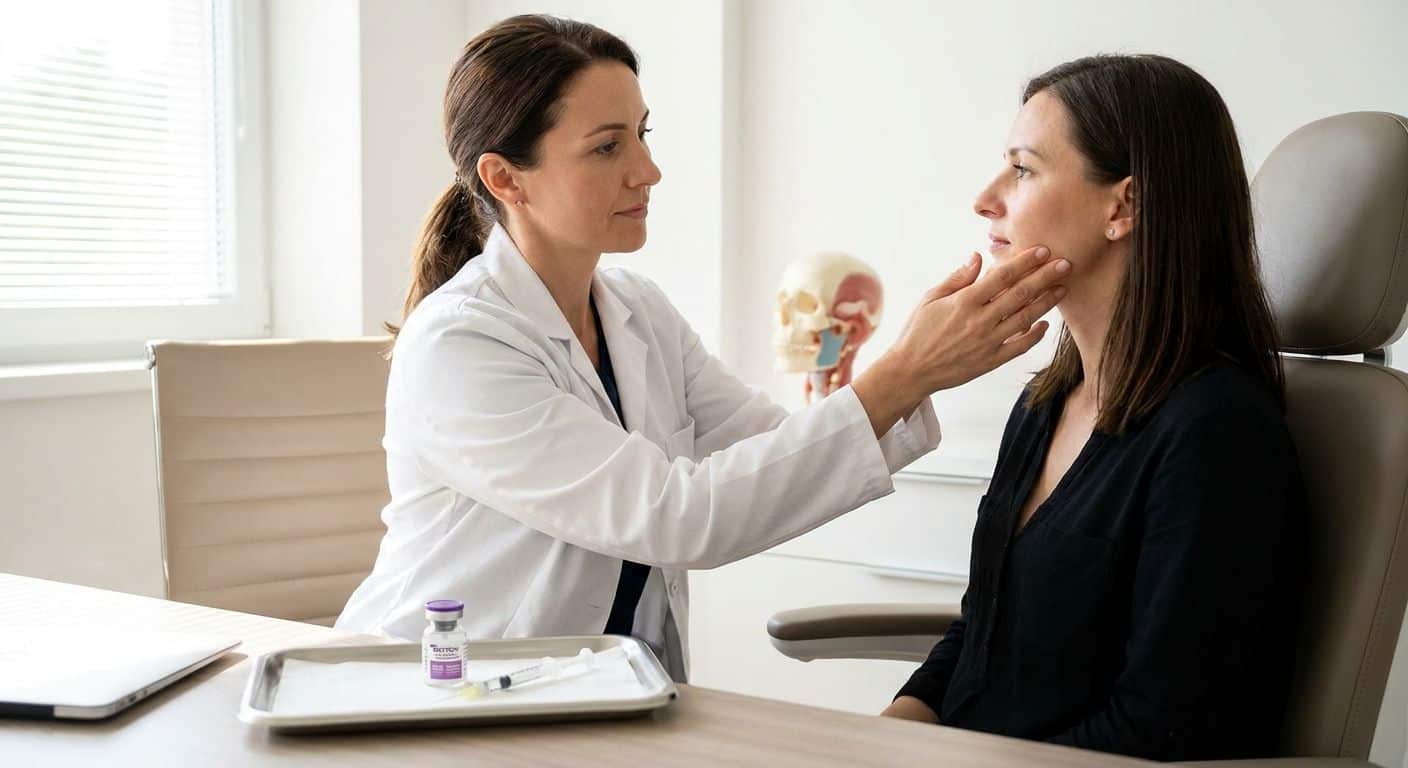
Clenching your jaw at night or during stressful days can wear down teeth, trigger headaches, and leave your masseter muscles sore by mid-morning — Botox for TMJ jaw clenching has become one of the more requested add-on treatments at dental practices treating chronic jaw tension in 2026.
- Botox for TMJ jaw clenching relaxes overactive masseter muscles and typically lasts 3-4 months per treatment.
- Best for adults with confirmed bruxism or TMJ tension who’ve already tried a night guard without full relief.
- A custom night guard remains the first-line, lower-cost option and pairs well with Botox rather than replacing it.
- Skip Botox if jaw pain stems from an untreated bite misalignment — treat the structural cause first.
Why this matters
Chronic jaw clenching (bruxism) and TMJ tension don't just cause soreness — left untreated, they flatten enamel, crack molars, and strain the joint until headaches become a daily occurrence. A dentist trained in TMJ treatment for chronic jaw pain and headaches looks at Botox as one tool among several, not a stand-alone fix. The muscle relaxation from Botox buys the joint time to heal while a night guard or bite adjustment addresses the underlying mechanics. Patients who skip that second step tend to see symptoms creep back once the injections wear off around month four.
Who this is for
This guide is for adults with diagnosed or strongly suspected bruxism and TMJ tension — flattened molars, morning jaw soreness, tension headaches radiating from the temples, or a dentist-confirmed masseter overdevelopment. It's not for kids or teens still growing into their bite, and it's not a first move for anyone who hasn't tried a night guard yet. If your pain started after a specific injury or shows joint clicking with locking, that's a different workup entirely and Botox sits further down the list of options.
What to look for in Botox for TMJ jaw clenching
A provider who diagnoses before injecting
Botox masks the symptom of muscle overactivity — it doesn't tell you why the muscle is overactive. A dentist who examines your bite, checks for nighttime grinding patterns, and rules out joint degeneration first is doing the job right. Providers who inject on request without that workup miss patients whose real problem is a bite misalignment that Botox won't touch.
Confirmed masseter or temporalis targeting
TMJ-related Botox targets the masseter (jaw) and sometimes the temporalis (temple) muscles specifically, not a generic "facial Botox" package. Ask exactly which muscles get injected and why — the masseter alone handles most bruxism cases, while combined temporalis injections address migraine-pattern tension headaches.
Dose transparency
Masseter reduction for TMJ typically runs 20-40 units per side, well above the 10-15 units used for jawline slimming aesthetics. A provider quoting a flat "facial Botox" price without specifying units per muscle is pricing the wrong procedure for jaw clenching relief.
A plan for what happens after the injections wear off
Relief lasts 3-4 months on average. Ask what the follow-up plan looks like: repeat injections on a schedule, transition to a night guard, or reassessment of bite mechanics. A one-and-done injection with no follow-up conversation leaves you back at square one by month five.
Coordination with your existing dental treatment
If you're already wearing a night guard or mid-treatment with Invisalign, Botox needs to fit around that plan, not compete with it. A dentist who also treats night guards for teeth grinding and jaw pain can sequence both treatments so they reinforce each other instead of masking a problem the guard should be fixing structurally.
Realistic expectations on headache relief
Botox reduces muscle-driven tension headaches for many patients, but it's not a migraine cure. If your headaches trace to sinus issues, vision strain, or vascular causes, Botox for the masseter won't move the needle. A provider should say this plainly rather than promise blanket headache relief.
Treatment options for TMJ jaw clenching
The direct fix: masseter Botox injections
Botox injections into the masseter muscle reduce clenching force by relaxing the muscle fibers responsible for the grinding motion. Most patients need 20-40 units per side, with visible relaxation showing up in 3-7 days and full effect by week two. This is the fastest way to cut daily muscle fatigue and morning jaw soreness, and it works well alongside a night guard rather than instead of one. Buy if a dentist has confirmed masseter overactivity and you've already tried conservative options.
The maintenance play: custom night guard
A lab-fabricated night guard is still the lowest-cost, longest-track-record option for nighttime clenching, and it addresses the mechanical wear Botox doesn't touch — enamel protection during sleep. Guards run a fraction of the cost of repeat Botox sessions and need replacement only every 1-2 years with normal wear. Pair it with night guards for teeth grinding and jaw pain for fitting details. Buy as the foundation treatment almost everyone with bruxism should have regardless of what else they add.
The bridge option: home care and jaw exercises
Warm compresses, jaw stretches, and stress-reduction habits won't stop clenching outright, but they reduce flare-ups while you wait for an appointment or between Botox cycles. Check how to relieve TMJ pain at home before your dentist visit for specifics on stretches and heat protocols. Consider this as a supplement, never a replacement for diagnosis.
The combo approach: Botox plus bite correction
When clenching stems from a misaligned bite, Botox reduces the muscle symptom while orthodontic or restorative work corrects the actual cause. This costs more upfront and takes longer, but it's the only path that reduces your dependence on repeat injections every 3-4 months indefinitely. Consider if your dentist flags bite misalignment during the initial exam.
The wildcard: general "facial Botox" packages
Some med-spa style Botox providers market jaw slimming or facial contouring Botox that overlaps with TMJ treatment in name only — lower unit counts, cosmetic framing, no diagnostic workup. For readers interested in the aesthetic side, Botox and fillers at the dentist covers that use case separately. For TMJ jaw clenching specifically, a cosmetic-only package that skips the muscle assessment is the wrong fit. Skip if the provider can't explain unit dosing or diagnostic reasoning for your specific jaw pain.
Talk to a dentist about TMJ relief
Get a diagnosis before deciding between Botox, a night guard, or both.
What to avoid
- Skipping the diagnostic exam. Injecting Botox without ruling out joint degeneration or bite misalignment treats the symptom while the real cause keeps damaging your teeth.
- Cosmetic-dose providers treating TMJ. A jawline-slimming Botox dose (10-15 units) is too low to meaningfully relax a clenching masseter — you'll pay for a treatment that doesn't hold.
- Stopping the night guard once Botox kicks in. Botox reduces clenching force; it doesn't stop grinding motion entirely. Enamel wear continues without the physical barrier a guard provides.
Verdict comparison
| Option | Onset | Duration | Best for | Verdict |
|---|---|---|---|---|
| Masseter Botox | 3-7 days | 3-4 months | Confirmed masseter overactivity | Buy |
| Custom night guard | Immediate wear | 1-2 years | Everyone with nighttime bruxism | Buy |
| Home care/exercises | Days | Ongoing | Symptom management between visits | Consider |
| Botox + bite correction | Weeks to months | Long-term | Bite misalignment cases | Consider |
| Generic "facial Botox" | Days | 2-3 months | Cosmetic jaw slimming only | Skip |
FAQ
How much does Botox for TMJ jaw clenching cost in 2026?
Botox for TMJ jaw clenching typically costs $300 to $800 per session in 2026, depending on the total units injected into the masseter muscle. Insurance rarely covers it since it’s classified as a cosmetic or elective treatment in most plans.
How long does Botox last for jaw clenching?
Relief from masseter Botox lasts 3 to 4 months on average before muscle activity returns to baseline. Most patients on a maintenance schedule repeat injections three to four times a year.
Is Botox better than a night guard for TMJ?
Botox and a night guard solve different problems and work best together rather than as competing options. The guard protects enamel from grinding force while Botox reduces the muscle activity causing the clenching in the first place.
How many units of Botox are used for TMJ jaw clenching?
Masseter injections for TMJ typically use 20 to 40 units per side, noticeably higher than the 10 to 15 units used for cosmetic jawline slimming. Dose depends on muscle size and clenching severity as assessed by the dentist.
Can a dentist give Botox for TMJ, or do I need a specialist?
Dentists trained in facial cosmetics and TMJ treatment can administer masseter Botox as part of a broader jaw pain treatment plan. This keeps diagnosis, injections, and follow-up bite work under one provider instead of splitting care across offices.
Does Botox for jaw clenching hurt?
Most patients describe the injections as a brief pinch, comparable to a routine dental shot, with no downtime needed afterward. Mild soreness at the injection site can last a day or two.
What are the signs I need Botox for TMJ instead of just a night guard?
Persistent jaw soreness or tension headaches despite consistent night guard use for several months suggests the muscle itself needs direct treatment. A dentist evaluating for TMJ treatment for chronic jaw pain and headaches can confirm whether Botox is the next step.
Are there side effects to Botox for jaw clenching?
Common side effects include mild bruising, temporary soreness, and in rare cases a slightly asymmetric smile if the dose migrates near facial muscles. These typically resolve within one to two weeks without intervention.
One last thing
The detail most patients miss: Botox relaxes the muscle, but it doesn't stop the clenching reflex itself, which is why guards and stress management still matter even after injections start working. If your provider frames Botox as a total fix with no follow-up plan, that's a signal to get a second opinion before booking.
Related guides
- TMJ treatment for chronic jaw pain and headaches
- Night guards for teeth grinding and jaw pain
- How to relieve TMJ pain at home before your dentist visit
- Botox and fillers at the dentist
- Sedation dentistry for anxious patients