
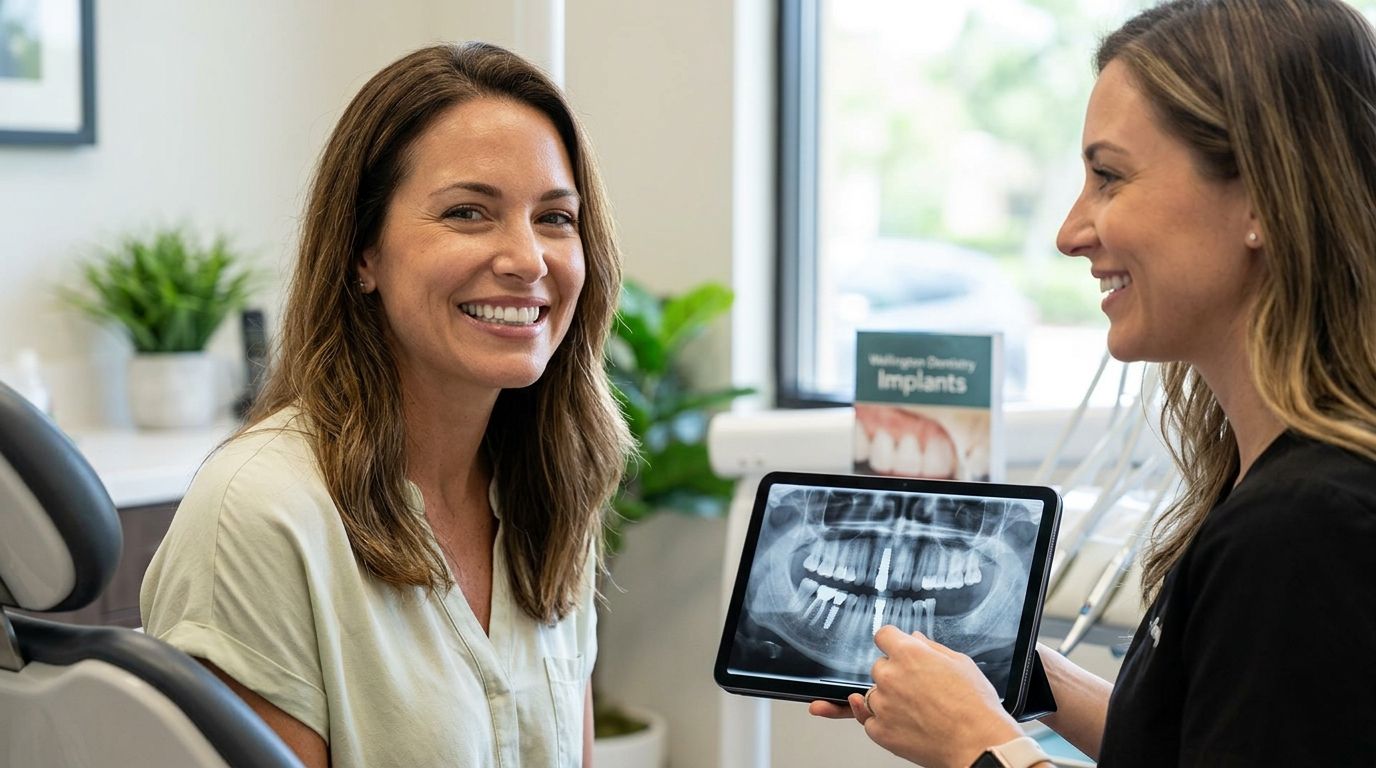
Dental implants for Wellington, FL patients missing teeth replace lost teeth with a titanium post fused to the jawbone and a crown, bridge, or denture attached on top, restoring bite force and stopping the bone loss that follows a missing tooth. Wellington has no dental implant surgical center of its own, so most patients in the 33414 and 33449 zip codes drive east into Palm Beach County for consultation, placement, and follow-up care, which changes how you schedule appointments and plan recovery days around a commute.
- Dental implants Wellington FL patients choose depend on how many teeth are missing: single implant, bridge, implant-supported denture, or All-on-4 for a full arch.
- Dental Arts of Atlantis in Lake Worth is a 20-25 minute drive from most Wellington neighborhoods, so bundling consultation and imaging into one visit saves a second trip.
- Bone density and gum health, not age, decide implant candidacy in 2026 — a bone graft can restore a site that looks disqualifying on first exam.
- Financing without insurance is the most common blocker Wellington patients raise before treatment, and it has documented options, not guesswork.
Why dental implants matter for Wellington, FL patients
A missing tooth does more than change how you chew. The jawbone under an empty socket resorbs without the pressure a tooth root provides, and neighboring teeth drift into the gap over months, not years. Wellington's population skews toward homeowners in their 40s through retirees in equestrian and golf communities, two groups that show up for implant consultations for different reasons: working adults replacing a molar lost to a failed root canal, and retirees stabilizing a denture that has started slipping.
Both groups ask the same first question at Dental Arts of Atlantis: am I even a candidate. The answer depends on bone volume, gum health, and how many teeth are missing — not on age alone, and not on how long ago the tooth came out.
Get a diagnosis before you choose a fix
Every implant plan starts with imaging, not a sales pitch. A 2026 treatment plan for a Wellington patient begins with a panoramic or 3-D scan that measures bone height and width at the site, because that measurement — not the patient's age — determines whether a standard implant, a mini implant, or a graft-first approach is the right call.
- Ask for a printed or digital copy of your bone density reading, not just a verbal summary
- Request a written list of every missing tooth and whether each site needs a graft
- Confirm whether the scan found any leftover infection at old extraction sites
- Get a second opinion if a plan does not explain the imaging findings clearly
Replace one missing tooth without touching the neighbors
A single missing tooth is the most straightforward implant case: one post, one crown, no drilling into healthy adjacent teeth the way a traditional bridge requires. Recovery for a single-site implant runs on its own timeline separate from any other work in the mouth, which is why Wellington patients with just one gap often move faster through treatment than they expect.
- Confirm the extraction site has fully healed if the tooth came out recently
- Ask whether immediate placement (implant same day as extraction) applies to your case
- Review dental implants for one missing tooth to see the staged timeline before committing
- Get the crown shade matched to neighboring teeth before the final restoration is placed
Replace several teeth in a row
When three or four teeth in a row are missing, a single crown per socket is rarely the efficient answer. An implant-supported bridge anchors two implants at the ends of the gap and spans the missing teeth between them, which means fewer implants than teeth replaced.
- Map out which two sites have enough bone to anchor the bridge
- Ask how many implants the bridge actually needs versus a full row of single implants
- Confirm the bridge material — zirconia and porcelain-fused-metal wear differently under bite force
- Plan for a temporary bridge during the healing phase so you are never without teeth
Replace a full arch of missing teeth
Patients missing most or all of the teeth on one arch face a different decision: implant-supported dentures, or a fixed full-arch solution built on four implants. The fixed option lets a patient bite and chew without removing anything at night, which matters for Wellington retirees tired of a removable denture that clicks or slips.
- Compare the best implant type for a full arch of missing teeth against a removable implant-supported denture
- Ask whether your case qualifies for same-day provisional teeth or requires a longer healing interval
- Confirm how many implants the arch design uses — four is standard, more may be recommended for softer bone
- Get a written maintenance schedule for the fixed prosthesis before signing off on the plan
Check your bone density before scheduling surgery
Low bone density disqualifies fewer patients than most Wellington residents assume. A graft rebuilds the site over several months, after which the implant proceeds on the original plan. Osteoporosis, long-term denture wear, and old extractions are the three most common reasons a Wellington patient needs grafting before an implant post goes in.
- Ask specifically whether your case needs a graft or just a smaller-diameter implant
- Get the graft material explained — synthetic, donor, or your own bone from another site
- Confirm the added healing time before combining it with your work or travel schedule
- Review a written timeline that separates the graft phase from the implant phase
Budget the treatment without insurance
Most dental insurance plans cap annual benefits well below the total cost of a multi-implant case, which means the bulk of the cost lands on the patient either way. Financing removes the all-at-once barrier without changing the treatment itself.
- Ask for an itemized estimate broken out by phase: extraction, graft, implant, crown
- Review Cherry Financing before comparing other third-party medical credit options
- Confirm whether a phased payment schedule matches the phased treatment timeline
- Get every number in writing before the first procedure is scheduled
Prepare for your consultation and the day of surgery
A first implant consultation runs faster when the patient arrives with a full medical history, not just a list of missing teeth. Blood thinners, osteoporosis medication, and smoking status all change the treatment plan, so surfacing them before imaging saves a second visit.
- Bring a current medication list, including anything for bone density or blood clotting
- Ask what to eat and avoid the night before if sedation is part of the plan
- Arrange a ride home if IV or oral sedation is used during placement
- Confirm post-surgery care instructions in writing, not just verbally at checkout
See if you qualify for same-day implant teeth
A consultation confirms bone density and treatment timeline before you commit.
Compare the options for Wellington patients missing teeth
| Option | Best for | Key limitation |
|---|---|---|
| Single dental implant | One missing tooth with healthy bone | Requires a healing period before the crown attaches |
| Implant-supported bridge | Two to four missing teeth in a row | Needs two strong anchor sites, not one per gap |
| Implant-supported dentures | Several missing teeth on one arch | More implants and longer treatment than a single crown |
| All-on-4 fixed arch | A full arch of missing or failing teeth | Not every low-bone-density case qualifies without grafting first |
| Mini dental implants | Stabilizing a loose lower denture | Narrower posts carry less bite force than standard implants |
| Traditional removable denture | Patients avoiding surgery entirely | Bone keeps shrinking under the appliance over time |
Dental implants remain the only tooth-replacement option that stops the jawbone from resorbing after a tooth is lost — everything else in the table above manages the gap without addressing the bone underneath it.
Common mistakes Wellington patients make with implants
- Waiting too long after extraction. Bone volume drops fastest in the first year after a tooth is lost, and waiting turns a straightforward implant into a graft-first case.
- Assuming insurance won't help at all. Insurance rarely covers the full implant cost, but many plans still cover the extraction or the crown portion — checking before treatment avoids leaving money on the table.
- Skipping the bone density conversation. Patients on osteoporosis medication or with a history of long-term denture wear often need a graft, and finding that out mid-surgery instead of during consultation adds an unplanned phase.
- Underestimating the commute for follow-up visits. A 20 to 25 minute drive from Wellington to Lake Worth is manageable for one visit, but multi-phase implant care means several trips — plan the calendar around it up front.
- Choosing a removable denture to avoid surgery, then regretting the fit. A denture that slips at year three costs another round of adjustments; an implant-supported option solves the slipping problem once.
FAQ
What’s the best dental implant option for Wellington, FL patients missing one tooth?
A single dental implant with a crown is the standard fix for one missing tooth in 2026, provided the extraction site has healed and bone volume at the site is adequate. It replaces the tooth without altering the neighboring teeth the way a bridge would.
Is an implant-supported denture better than All-on-4 for a full arch?
Implant-supported dentures are removable and typically use more implants across the arch, while All-on-4 is fixed in place on four implants and stays in the mouth permanently. The right choice depends on bone density and whether the patient wants a removable or fixed result.
How much does it cost to get dental implants near Wellington, FL?
Cost varies by how many teeth are being replaced and whether grafting is needed, so an itemized estimate from a consultation is the only reliable number. Financing options exist for patients without insurance coverage.
Can I get dental implants if I have osteoporosis?
Osteoporosis does not automatically disqualify a patient from implants, but it does require a bone density evaluation before the treatment plan is finalized. Some cases need a graft first; others proceed with a standard implant.
How long does dental implant treatment take from start to finish?
A single implant case runs through extraction healing, implant placement, a second healing period, and the final crown — often several months total. Full-arch and grafted cases take longer because of the added healing phases.
Do I need to travel far from Wellington for implant surgery?
Most Wellington residents drive roughly 20 to 25 minutes into Lake Worth for implant consultation and placement, since Wellington itself has no dedicated implant surgical center. Planning follow-up visits around that commute keeps the treatment timeline on schedule.
What happens if I ignore a missing tooth instead of replacing it?
The jawbone under the gap resorbs over time, neighboring teeth can drift, and the bite shifts — all of which make a later implant more complex and can require grafting that would not have been needed earlier.
Are mini dental implants a replacement for standard implants?
Mini dental implants work well for stabilizing a loose lower denture but carry less bite force than standard implants, so they are not typically used to replace a single missing molar under heavy chewing load.
One last thing
The single biggest variable in a Wellington implant case isn't age or the number of missing teeth — it's how long the gap sat empty before the consultation. A site imaged within the first year after extraction usually skips grafting altogether; a site left three or more years often needs it, which adds months to the plan. If you're weighing whether to wait or schedule, the imaging alone answers the question in one visit.
Related guides
- How to finance dental implants without insurance
- How to prepare for your first dental implant consultation