
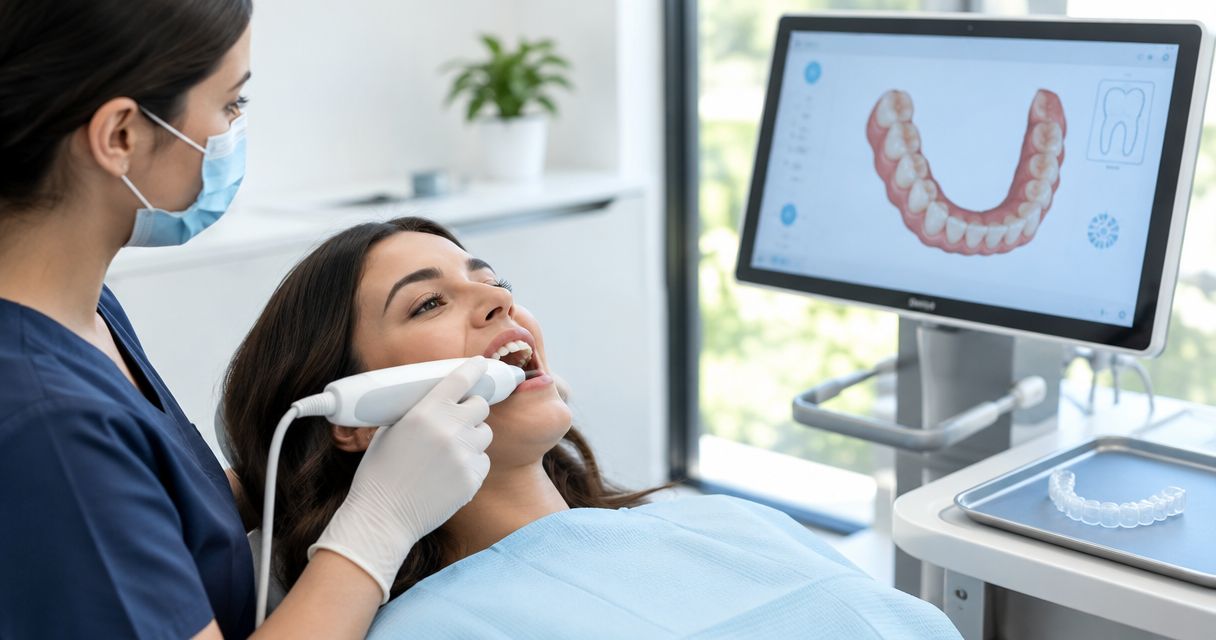
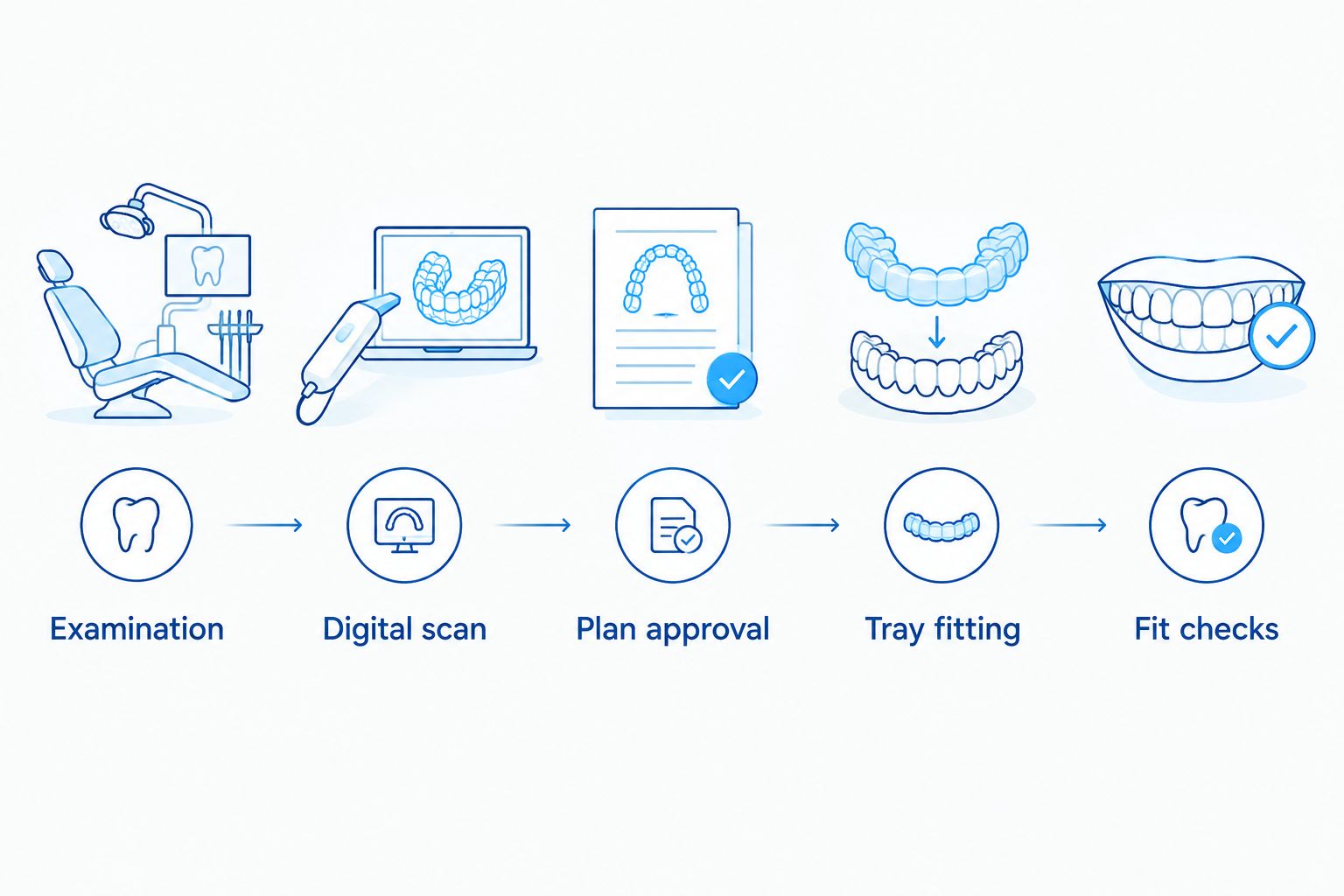
Instead of trying to explain tooth crowding with photos alone, start with a dental examination and digital scan so your dentist can plan custom Invisalign trays around your teeth and bite. The Invisalign digital scan process moves from a three-dimensional model to a clinician-approved treatment plan, manufactured aligners, and ongoing fit checks—not directly from a scanner to finished treatment.
- The Invisalign digital scan process connects a three-dimensional tooth model to a dentist-approved plan and custom clear aligners.
- Dental Arts of Atlantis offers Invisalign care for families in Lake Worth and Palm Beach County.
- A digital scan records tooth surfaces; an examination and indicated X-rays provide information the scan cannot.
- Approve the treatment goals before tray manufacturing, then follow your dentist’s wear schedule and fit checks.
Why this matters
A detailed digital model helps your dentist plan tooth movement, but the model cannot establish gum health or show everything beneath the gums. A scan supports treatment planning; it does not replace diagnosis.
Dental Arts of Atlantis is a local Invisalign option for families in Lake Worth and Palm Beach County. If you are exploring treatment in 2026, start with the practical expectations in Invisalign for adults, then use this workflow to prepare your questions.
The benefit of digital planning is a record your dentist can review and use to design staged movement. The limitation is equally important: a simulated smile is a proposed outcome, not a promise that teeth will move exactly as shown.
Before you start
- Arrange an examination and discuss records. Bring your medical history, medication list, previous orthodontic history, and details about crowns, implants, or planned dental work. Ask whether existing records can be transferred.
- Explain your goals and comfort needs. Mention bite concerns, jaw symptoms, sensitive teeth, difficulty opening wide, or a strong gag reflex. No patient-operated planning software is needed to understand this workflow.
- Resolve the sequencing question first. Tell your dentist about any planned filling or crown before scanning. Dental work that changes a tooth’s shape after records are taken can affect tray fit and require updated records.
Ask Dental Arts of Atlantis which records and scanning method your consultation will involve. This guide explains the general Invisalign workflow without assuming a particular scanner, software interface, or appointment sequence at the practice.
Examination and scan records
Establish the starting point
- Describe your main concern. Identify whether you want to address crowding, spacing, tooth position, or a bite problem. Tell your dentist which change matters most.
- Complete the clinical assessment. Your dentist examines your teeth and gums, evaluates your bite, and determines whether X-rays or other records are needed. Untreated decay or gum disease needs attention before orthodontic movement proceeds.
- Have the tooth surfaces and bite recorded. During an intraoral scan, the clinician moves a handheld scanner around your teeth to build a digital surface model. Bite records show how the upper and lower teeth meet.
Expected result: Your dentist has usable records of your current teeth and bite, plus a clinical assessment of whether clear aligners are appropriate.
The scan itself uses optical imaging rather than dental X-rays. It records visible surfaces; it does not reveal roots or bone in the way radiographs can.
For your 2026 consultation, ask what each record contributes. A photograph, scan, and X-ray answer different questions, so one should not be treated as a substitute for all the others.
| Record | Best for | Main benefit | Limitation |
|---|---|---|---|
| Intraoral digital scan | Recording tooth surfaces and their relationship | Creates a three-dimensional model for planning | Does not show internal tooth structure, roots, or supporting bone |
| Clinical photographs | Documenting visible smile and facial relationships | Shows appearance from useful viewpoints | Does not provide a complete three-dimensional tooth model |
| Dental X-rays, when indicated | Assessing structures beneath visible surfaces | Adds information about roots, bone, and dental disease | Does not replace a surface scan or clinical examination |
If you need a pause during scanning, signal the clinician. Do not force yourself to continue through discomfort; clear communication helps the clinician obtain usable records without unnecessary strain.
Treatment plan and approval
Connect the digital model to clinical decisions
- Review the proposed movements. Ask your dentist to explain what will change, what will remain unchanged, and how the plan addresses your bite—not only the appearance of your front teeth.
- Discuss supporting procedures. Some cases need tooth-colored attachments, elastics, or carefully planned enamel reduction between selected teeth. Ask which procedures apply to you and why.
- Confirm the plan before manufacturing. Your dentist reviews the staged setup and authorizes the treatment prescription. Make sure you understand the goals, responsibilities, and follow-up arrangements before proceeding.
Expected result: You understand the proposed treatment, and the clinician has approved the prescription used to manufacture your aligners.
Attachments are small bonded shapes that help aligners apply planned forces. Interproximal reduction means removing a measured amount of enamel between selected teeth when clinically appropriate; it is not something you perform yourself.
A useful 2026 planning question is: “What would make you revise this plan?” The answer should cover tooth response, tray fit, oral health, and the difference between a planned result and a clinical result.
Do not approve a plan based only on an attractive animation. Ask about the final bite, existing restorations, and retention after active movement ends.
Custom tray fitting
Turn the approved plan into a daily routine
- Attend the tray fitting. Your clinician checks that the aligners seat as intended and completes any prescribed preparatory procedures. Ask for a demonstration of safe insertion and removal.
- Confirm the wear instructions. Invisalign patient guidance generally calls for 20–22 hours of wear per day. Follow your treating dentist’s instructions, including exactly when to change trays.
- Practice care and storage. Remove aligners for meals and drinks other than plain water. Store them in their case, clean them as directed, and avoid hot water that can distort the plastic.
Expected result: You can insert and remove the correct trays, recognize proper seating, and explain your daily wear and cleaning routine.
Before leaving, confirm which tray belongs to each arch and how you will identify the next set. Do not assume that every patient changes aligners on the same schedule.
Keep brushing for 2 minutes, twice daily, and clean between your teeth each day. Aligners do not protect teeth from plaque, and putting trays over unclean teeth does not replace oral hygiene.
For a manageable 2026 routine, plan around meals, work, school, and travel before starting. Removability is convenient, but it also puts responsibility for wear time on you; trays left in their case cannot apply the prescribed forces.
Progress checks and completion
Compare actual tooth movement with the plan
- Attend the prescribed fit checks. Your dentist assesses seating, tooth movement, attachment condition, and your bite. Report persistent gaps between the aligner and teeth rather than waiting for a later visit.
- Follow adjustments to the instructions. Your dentist decides whether to continue, extend wear, replace an attachment, or obtain updated records. Do not skip ahead because a later tray looks straighter.
- Confirm completion and retention. At the end of active treatment, your dentist assesses the result and prescribes retention. Finish with clear instructions for retainer wear, cleaning, and follow-up.
Expected result: Treatment decisions reflect your actual teeth, and the transition to retainers protects the result rather than leaving it unsupported.
Finishing a box of trays is not the same as completing treatment. Your dentist still needs to evaluate tooth positions, contacts, and bite function.
Dental scanning also has uses beyond orthodontics. With digital denture technology, a surface record supports the design of a replacement appliance; with Invisalign, the record supports planned tooth movement. In both workflows, a usable scan still needs clinical interpretation and an assessment of the finished appliance’s fit.
When tooth movement needs a revised plan
A second workflow begins when the teeth no longer match the planned aligner fit or when additional movement is needed. Your dentist can assess whether updated records and additional aligners are appropriate; a rescan is not automatically necessary for every concern.
The distinction matters in 2026: the next step follows the clinical finding, not the tray number.
| Workflow | Best for | Benefit | Limitation |
|---|---|---|---|
| Continue the approved sequence | Teeth that are responding and trays that fit as assessed | Keeps treatment aligned with the current prescription | Requires continued wear and monitoring |
| Reassess for additional aligners | Movement or fit that needs a revised prescription | Allows planning from updated clinical findings | Adds planning and treatment steps; not every problem requires a rescan |
For a revised-plan workflow:
- Report the specific change. Describe the affected tooth, tray, gap, attachment, or bite concern.
- Attend the assessment. Bring the trays your dentist requests. The clinician checks whether the issue involves wear, seating, damage, or tooth response.
- Follow the interim instructions. Ask which tray to wear while the plan is reviewed. Do not stop treatment or move backward through trays without direction.
- Restart only as prescribed. If additional aligners are ordered, have their fit and any supporting procedures checked before continuing.
Expected result: You have a defined next step and safe interim instructions instead of guessing which tray to wear.
Troubleshooting
The scan triggers gagging or jaw fatigue
Tell the clinician before scanning and signal when you need a break. Ask whether positioning or the scanning sequence can be adjusted; do not assume you must tolerate continuous scanning without a pause.
The tray has a visible gap over a tooth
Check that you have the prescribed tray and contact your dental team. A gap needs assessment of seating and tooth movement; forcing the tray, heating it, or jumping ahead is not a safe correction.
An attachment falls off
Notify your dentist and identify the tooth if possible. Follow the instructions you receive about continued wear and repair, rather than using household adhesive or assuming the attachment is unnecessary.
A tray is lost, cracked, or distorted
Contact the practice for instructions about which tray to use. Keep previous trays until your dentist tells you to discard them, but do not substitute one without advice.
Pressure feels different from dental pain
Pressure can occur with aligner changes, but severe, worsening, or localized pain needs professional assessment. Facial swelling, fever, or an injured tooth is not a routine fit issue; difficulty breathing or swallowing requires emergency medical attention.
Customize your workflow
Tell Dental Arts of Atlantis about your schedule before treatment begins. Travel, irregular shifts, school routines, and upcoming restorative work affect how you organize meals, cleaning, appointments, and tray storage.
For 2026 planning, separate the daily wear routine from the overall treatment timeline. Your number of aligners and change schedule belong to your prescription; they are not a reliable estimate borrowed from someone else’s experience.
Use the guide to how long Invisalign treatment takes to prepare timeline questions. Ask your dentist which milestones will show progress and what findings would change the expected course.
Best for: Patients who can follow a removable-aligner routine and attend clinical reviews, after a dentist confirms suitability. The main trade-off is daily responsibility: digital planning cannot compensate for inconsistent wear or unresolved dental disease.
Discuss your Invisalign next step
Ask about suitability, records, treatment goals, and the daily aligner routine.
FAQ
What happens during the Invisalign digital scan process?
A clinician scans your tooth surfaces and records your bite to create a three-dimensional model. Your dentist combines that model with an examination and other indicated records to plan treatment and approve custom aligners.
Does an Invisalign scan replace dental X-rays?
No, an intraoral surface scan does not replace indicated dental X-rays. The scan records visible surfaces, while X-rays provide information about structures such as roots and supporting bone.
Is getting a digital scan painful?
An intraoral surface scan does not involve drilling teeth. Tell the clinician about sensitive areas, gagging, or jaw fatigue so the scanning approach and breaks can be adjusted.
Will my teeth look exactly like the Invisalign simulation?
A simulation is a treatment proposal, not a guaranteed result. Your dentist monitors actual tooth movement and decides whether the plan needs adjustment.
How long do I wear Invisalign trays each day?
Invisalign patient guidance generally calls for 20–22 hours of daily wear. Follow your treating dentist’s instructions for wear time and tray changes, and remove aligners for meals and drinks other than plain water.
Do I need another scan if an aligner stops fitting?
A fit problem needs a clinical assessment before deciding whether another scan is necessary. Your dentist checks seating, wear, attachments, and tooth response, then determines the next step.
Can I start Invisalign if I need a crown or filling?
Your dentist needs to coordinate restorative work with aligner planning. A restoration that changes tooth shape after scanning can affect tray fit, so discuss planned work before records are finalized.
One last thing
Your final aligner is not automatically your long-term retainer. Before active treatment ends, ask which retainer you will use and when to start wearing it. Teeth can shift after orthodontic movement, so retention belongs in the plan from the beginning.
Related guides
- Can you get Invisalign with dental crowns?
- How to care for your retainer after Invisalign treatment
- How to help a teen stay on track with Invisalign treatment