

You know Invisalign is working when your aligners fit closely, your teeth gradually follow the planned movements, and your treating dentist confirms progress at follow-up visits. Pressure alone does not prove progress, and a persistent gap between an aligner and a tooth deserves a fit check rather than an early switch to the next tray.
- How to know if Invisalign is working: check aligner fit, compare progress photos, and keep professional progress reviews.
- Invisalign soreness is not a progress score; comfortable trays can still be moving teeth.
- Report persistent tray gaps, missing attachments, or worsening pain before changing your treatment schedule.
- Dental Arts of Atlantis offers Invisalign and family dental care for Lake Worth families.
How do you know if Invisalign is working?
The strongest sign is that your teeth are following your treatment plan—not simply that your trays feel tight. At home, you can check fit and document visible changes. Your dentist determines whether those changes match the intended tooth movements and bite goals.
If you are checking your Invisalign progress in 2026, use the guide below to separate useful observations from misleading signals. For background on treatment stages, read Invisalign for adults: how it works and what to expect.
| What you notice | What it tells you | What to do |
|---|---|---|
| Aligners sit closely around your teeth | Close seating supports effective contact, but does not confirm every planned movement | Keep following your prescribed schedule |
| Mild pressure after a tray change | Pressure can accompany a new stage; its intensity does not measure success | Monitor comfort and fit |
| Gradual changes in comparable photos | Visible tooth positions are changing | Bring the photos to your progress review |
| A persistent gap over a tooth | The tray needs assessment; appearance alone cannot establish the cause | Contact your treating dental team |
| No soreness | Lack of discomfort does not establish treatment failure | Check fit and attend reviews |
| Severe or worsening pain | Pain needs assessment rather than being treated as evidence of progress | Contact your dentist promptly |
Why this matters
A straighter-looking front tooth is encouraging, but Invisalign treatment also involves how your teeth meet. A selfie cannot show everything your dentist needs to assess, including gum health and the contacts between your upper and lower teeth.
The opposite is also true: an unchanged-looking smile does not automatically mean treatment has stalled. Some planned movements are difficult to see from the front. Use home checks to identify questions, not to approve your own tray changes.
Check Invisalign progress without guessing
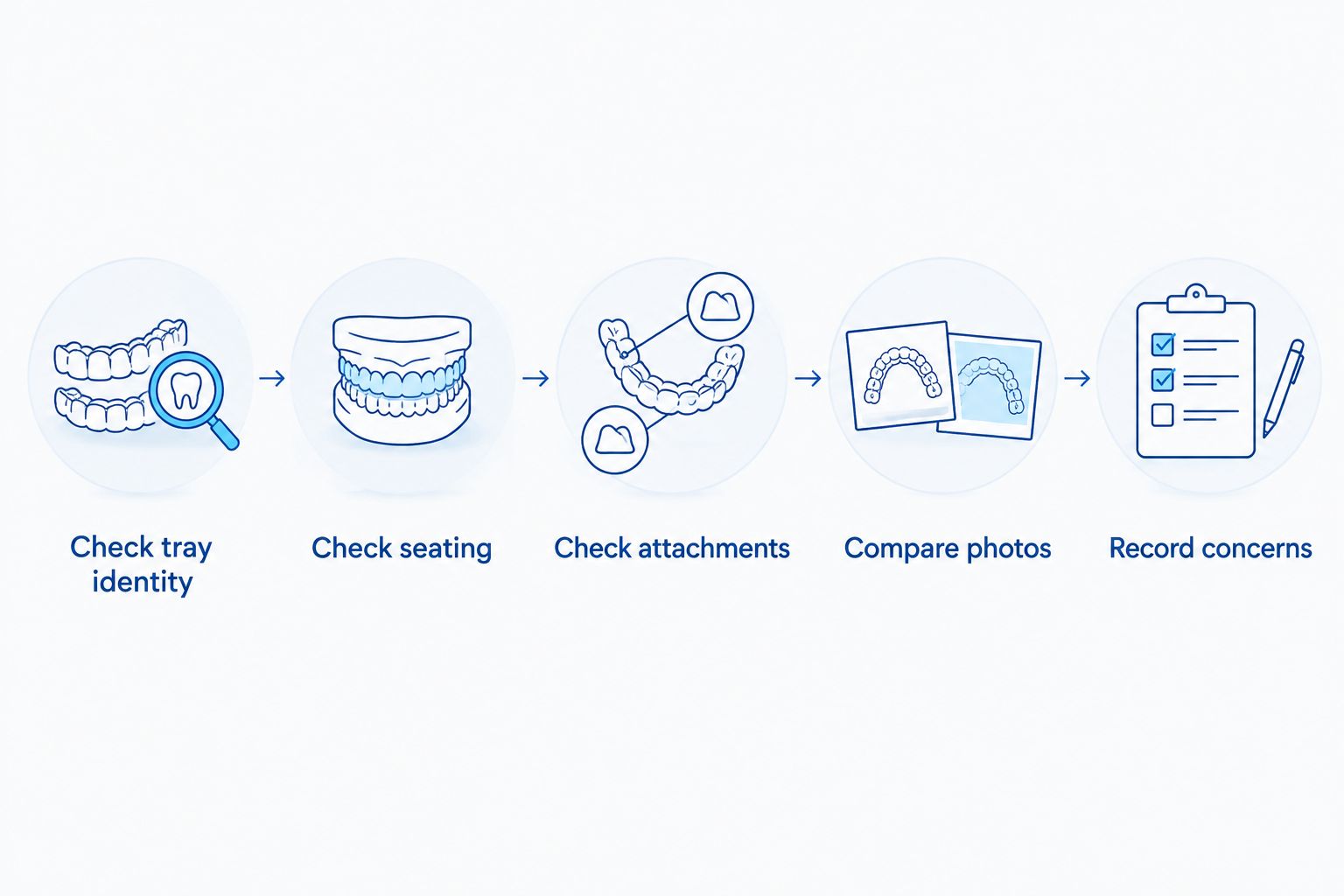
Make this your 2026 progress-check routine. Keep the checks simple enough to repeat, and follow your treating dentist's instructions whenever they differ from general advice.
- Check tray identity. Confirm that you have the prescribed upper and lower aligners for your current stage. Check the packaging rather than relying on how similar the trays look.
- Check seating. With clean hands and a mirror, look for areas that lift away from a tooth, rock, or fail to settle around an attachment. Report a persistent change rather than forcing the tray into place.
- Check attachments. If your plan uses tooth-colored attachments, notice whether one appears missing or damaged. Do not try to repair an attachment yourself.
- Compare photos. Use similar lighting, camera distance, and angles. A front view alone can hide changes along the sides of your smile.
- Record concerns. Note your tray stage, when the problem began, and whether it affects fit, comfort, or chewing. Give that information to your treating team.
These checks are best for noticing changes between visits. Their limitation is that they cannot confirm whether a tooth's roots or your bite are following the plan.
What good aligner fit looks like
An Invisalign aligner should generally sit closely around the teeth it covers, with its shape matching the tooth surfaces. Where attachments are present, the corresponding spaces in the plastic should seat around them.
Close fit is useful evidence, but it is not a pass-or-fail test you can complete from a photograph. Tray design, the stage of treatment, and the movement being attempted all affect what your dentist expects to see.
Look for a change from your usual fit: a tray that suddenly rocks, repeatedly lifts, or leaves an obvious persistent space over one tooth. Tell your dentist whether the issue began with a new tray or developed while wearing the current one.
Do not use an online millimeter rule to decide whether a gap is acceptable. Your treating dentist needs to assess the location, tray design, and planned movement. Do not cut, heat, or reshape a tray to make it fit.
Does Invisalign need to hurt to work?
No—Invisalign does not need to hurt to work. Mild pressure or tenderness can accompany a tray change, but discomfort varies and is not a reliable measure of tooth movement.
A comfortable aligner does not mean your teeth have stopped responding. Equally, a painful aligner does not prove that treatment is progressing faster. Judge comfort separately from fit and professional progress checks.
Pressure that eases is different from pain that becomes severe, stays focused on a particular tooth, or comes with swelling. Contact your dentist about those symptoms. Do not assume that every new sensation is caused by normal orthodontic movement.
Avoid deliberately creating more pressure by skipping ahead. More force is not a home treatment strategy. Your tray sequence and change schedule belong to your individual treatment plan.
Why Invisalign progress varies
Your 2026 treatment calendar is a guide to planned care, not a promise that every tooth will look different at each tray change. These factors explain why progress needs individual review:
- Movement type. Closing a visible gap and changing a tooth's rotation are different tasks. Not every stage produces an obvious cosmetic change.
- Wear consistency. Aligners need the prescribed time in contact with your teeth. Repeatedly leaving them out interrupts that planned contact.
- Tray seating. A tray that does not seat as intended needs assessment, even when you have followed your wear schedule.
- Attachments and elastics. When prescribed, these help deliver the planned forces. Report missing attachments and follow your specific elastic instructions.
- Biological response. Teeth move through living supporting tissues, so progress requires clinical assessment rather than assumptions based on someone else's experience.
- Oral health. Tooth decay, gum inflammation, or other dental problems need attention during orthodontic care, not after it ends.
A slower-looking stage is not a reason to blame yourself. Explain your actual routine and any difficulties so your dentist can make an informed recommendation.
How many hours should you wear Invisalign each day?
Invisalign's general patient guidance recommends 20–22 hours per day, but your treating dentist's instructions govern your care. The benefit of tracking wear is knowing whether meals, snacks, and cleaning breaks are taking longer than you realize.
Do not interpret 20–22 hours per day as permission to advance trays early. Daily wear and the number of days assigned to each aligner are separate instructions. Both matter.
For your 2026 routine, record the time your aligners are out if consistency is difficult. Tell your dentist about missed wear honestly; do not compensate by jumping ahead or making your own extended-wear schedule.
Keep your mouth clean as well as keeping trays in. The American Dental Association recommends brushing for 2 minutes, twice a day, with fluoride toothpaste, and cleaning between teeth daily. Ask your treating team how to organize meals and oral care around your prescribed aligner wear.
What should you do if Invisalign stops fitting?
Contact your treating dentist before advancing to the next tray when fit has clearly changed. A new gap, repeated lifting, or an aligner that will not seat needs instructions specific to your treatment.
Give your dental team useful details:
- Which tray stage you are wearing.
- Whether the problem affects the upper or lower aligner.
- Whether an attachment appears missing.
- Whether the aligner is cracked, distorted, or lost.
- Whether you have pain, swelling, or a sudden bite change.
- Whether recent wear has differed from your prescribed routine.
Keep your current and previous aligners available for the dentist to inspect. Ask which tray to wear while waiting for advice rather than choosing a different stage yourself.
For Lake Worth patients, Dental Arts of Atlantis provides Invisalign alongside general and family dentistry. If you need to discuss a concern with the practice, contact the dental team and describe the fit problem rather than simply saying treatment feels slow.
Seek emergency medical care for trouble breathing or swallowing or rapidly spreading facial swelling. Those symptoms are not routine aligner discomfort.
What does your dentist check at a progress visit?
A progress visit checks whether actual tooth positions and aligner fit match the intended stage of treatment. Your dentist also evaluates relevant attachments, oral health, and how your teeth meet.
Bring your current trays and any photos or notes showing a concern. Explain whether the problem happens continuously or only when you first insert an aligner. Mention chewing discomfort and bite changes even if your front teeth look straighter.
A digital treatment preview shows intended movements; it is not proof that those movements have already happened. Your dentist uses your clinical findings to decide whether to continue the sequence or adjust the plan.
That can include revising instructions or considering additional aligners. A change in the plan is not, by itself, evidence that treatment has failed. Ask what finding prompted the change and how progress will be reassessed.
How can you tell when Invisalign treatment is finished?
Finishing the last tray is not the same as completing a professional treatment assessment. Your dentist needs to confirm the result, review your bite, and explain retention.
Ask whether any planned movements still need attention. Then confirm which retainer you will use, when to begin wearing it, and what your individual wear instructions are. Retention helps maintain tooth positions after active treatment.
Dental Arts of Atlantis is best for Lake Worth families seeking Invisalign and family dental care in one practice. Invisalign still requires consistent home participation and professional monitoring; receiving care locally does not replace either responsibility.
Before you leave your final active-treatment visit in 2026, make sure you know what to wear next. Do not stop wearing your prescribed appliance simply because your smile looks finished.
FAQ
How do I know if Invisalign is working if I cannot see a difference?
Invisalign progress is confirmed by your treating dentist comparing your teeth and aligner fit with the treatment plan. Some movements are difficult to see in a front-facing photo, so a lack of obvious cosmetic change does not establish failure.
Is it normal for Invisalign not to hurt anymore?
Yes, Invisalign can work without ongoing soreness. Comfort is not a reliable progress measure; close fit and professional assessment matter more.
Should I move to the next Invisalign tray if this one feels loose?
No, a looser-feeling tray is not permission to advance early. Follow your prescribed change schedule and ask your dentist about unexpected looseness or poor seating.
Does a gap between my Invisalign tray and tooth mean treatment is failing?
A tray gap does not automatically mean Invisalign treatment is failing, but a persistent or increasing gap needs assessment. Your dentist must check the tray design, seating, and planned tooth movement.
What should I do if an Invisalign attachment falls off?
Contact your treating dental team if an Invisalign attachment falls off. Ask whether your wear or tray-change instructions need to change, and do not try to glue it back yourself.
Can Invisalign work if I only wear it at night?
Night-only wear does not meet Invisalign’s general guidance of 20–22 hours per day. Follow your individual prescription and tell your dentist if daytime wear is difficult.
Can Dental Arts of Atlantis help me understand my Invisalign progress?
Dental Arts of Atlantis offers Invisalign care in Lake Worth. Contact the practice to discuss an evaluation, and bring your current aligners and treatment records if another office started your care.
One last thing
A photo showing straighter teeth and a tray showing a persistent fit problem can both be real. Do not let the encouraging photo cancel out the fit concern.
At your next review, ask: Which movement are we checking at this stage? Understanding that goal makes your home observations more useful than repeatedly asking whether your teeth look different yet.
Related guides
- How long does Invisalign treatment take?
- How to help a teen stay on track with Invisalign treatment
- How to care for your retainer after Invisalign treatment