
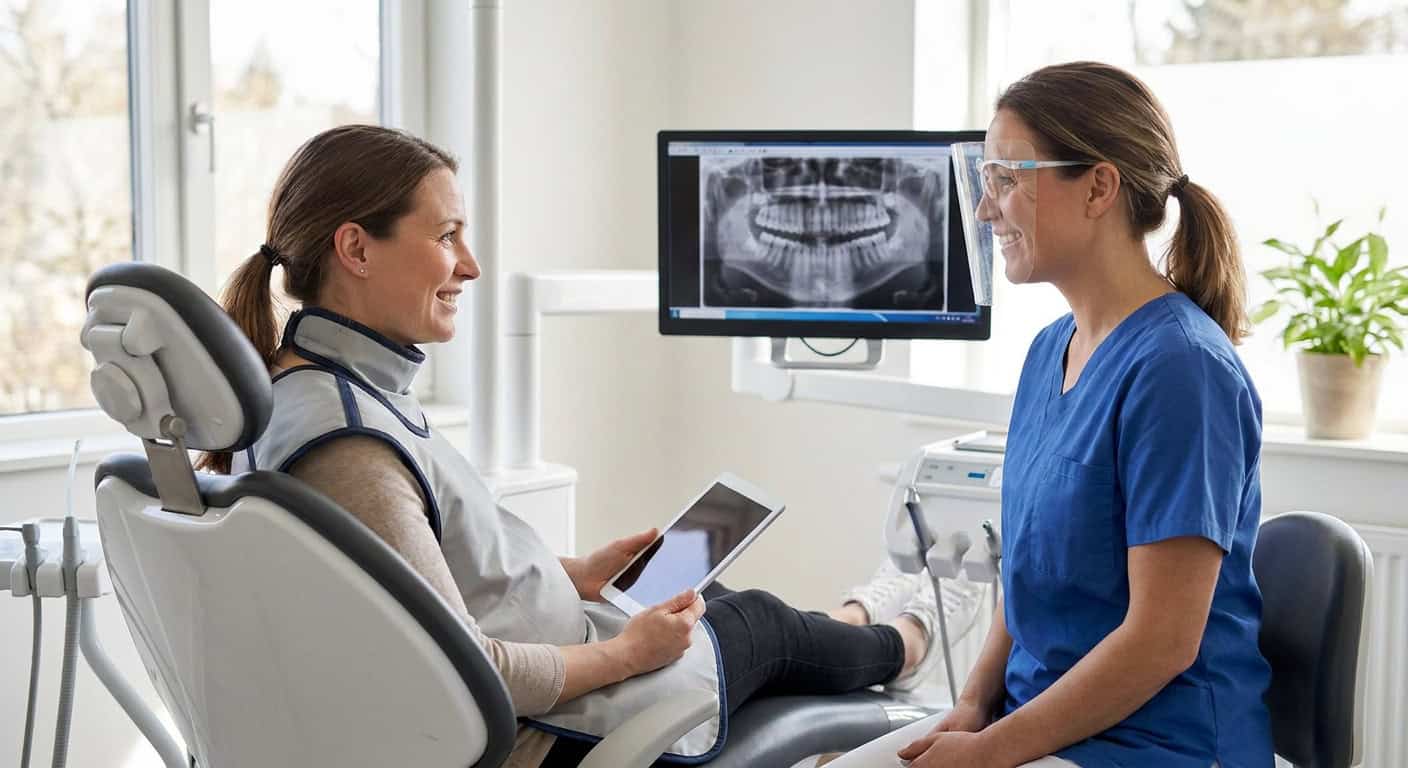
Dental x-rays are safe during pregnancy when the dentist uses a lead apron and thyroid collar and limits exposure to what's diagnostically necessary — the American College of Obstetricians and Gynecologists and the American Dental Association confirmed this jointly in guidance still cited by practices in 2026. This guide walks through how to verify that safety for yourself before you sit in the chair.
- Dental x-rays are safe during pregnancy with a lead apron and thyroid collar — ADA and ACOG confirm this jointly.
- A single digital bitewing delivers about 0.005 mSv, a fraction of the 0.01 mSv you absorb from natural background radiation daily.
- Untreated infections and gum disease pose more risk to a pregnancy than a properly shielded dental x-ray.
- Emergency dental x-rays (cracked tooth, abscess, trauma) are appropriate in any trimester — don’t wait until after delivery.
- Verdict: proceed with necessary x-rays at Dental Arts of Atlantis, confirm shielding is used, and skip only fully elective imaging.
Why this matters
Pregnant patients skip needed dental care more than any other group of adults, and fear of radiation is one of the top reasons cited. That avoidance backfires: untreated tooth infections and advancing gum disease during pregnancy carry documented associations with preterm birth and low birth weight, while a properly shielded x-ray carries a radiation dose so small it doesn't register as a measurable risk to a developing fetus.
Gum sensitivity and swelling also spike during pregnancy because of hormone shifts, which is exactly the period when a dentist most needs an accurate look at what's happening below the gumline. Dental care during pregnancy often means managing that gum sensitivity directly, and imaging is part of that picture when something looks off.
The question isn't whether dental x-rays are inherently risky in 2026 — the science on this hasn't shifted in years. The real question is whether your dentist is following the shielding and dose-limiting protocol that makes them safe.
What you'll need
- Your due date or trimester, so the dentist can time non-urgent imaging appropriately
- A list of current prenatal vitamins and any pregnancy complications to disclose at check-in
- Confirmation the office uses digital x-ray sensors, not older film, since digital cuts radiation dose significantly
- A specific symptom or concern (pain, swelling, a broken tooth) if the visit isn't a routine cleaning
- 15-20 extra minutes for the office to explain shielding steps if you're asking for the first time
The steps
1. Ask whether the x-ray is diagnostic or routine
Distinguish between an x-ray needed to diagnose pain, swelling, or trauma versus one that's part of a standard six-month recall. Diagnostic x-rays for pain, infection, or an abscess should not wait for any trimester — an untreated infection poses a real risk to the pregnancy, while the imaging risk is negligible with shielding. Routine bitewings for a patient with no symptoms can often be postponed to the second trimester or after delivery if you'd simply rather wait.
Common mistake: assuming all dental x-rays are optional during pregnancy. Diagnostic imaging for an active problem is not the same category as a routine screening film.
2. Confirm the office uses a lead apron and thyroid collar
This is the single protocol step that makes the dose to the fetus effectively zero. The apron covers the abdomen and pelvis; the thyroid collar protects the neck, where radiation-sensitive tissue sits closest to the mouth. Ask directly: "Will I get a lead apron and thyroid collar for this x-ray?" A dental office that answers yes without hesitation is following ADA/ACOG protocol correctly.
Common mistake: not asking and assuming the shielding happens automatically. Most offices do it as standard practice, but confirming out loud removes any doubt going into the chair.
3. Check whether the office uses digital sensors
Digital x-ray sensors cut radiation exposure compared to traditional film — a single digital bitewing runs around 0.005 mSv, well under the roughly 0.01 mSv you take in from natural background radiation over just one day. If a practice still uses film-based x-rays, ask about the dose difference directly. Most practices operating in 2026 have moved to digital for exactly this reason.
Expected outcome: a two-minute conversation at check-in that confirms both shielding and equipment type before any imaging happens.
4. Time non-urgent imaging to the second trimester when possible
For anything that isn't an emergency, many providers default to scheduling elective dental x-rays in the second trimester, once the highest-risk period of early fetal development has passed and before the third trimester makes sitting in a dental chair for long stretches uncomfortable. This isn't a hard rule — a properly shielded x-ray in the first or third trimester is still considered safe — it's simply a scheduling preference many patients choose.
Common mistake: delaying a painful or infected tooth all nine months because of timing preference. Pain and infection don't wait, and neither should the imaging needed to diagnose them.
5. Disclose your pregnancy and any complications at check-in
Tell the front desk and the dentist you're pregnant before any x-ray is taken, even if it seems obvious. This triggers the shielding protocol automatically and lets the dentist adjust anything else in the visit, from positioning in the chair to anxiety management. If you're managing morning sickness, gum sensitivity, or any pregnancy complication, mention it here too.
Expected outcome: the dentist adjusts the visit around your specific trimester and health status rather than treating it as a standard appointment.
6. Address anxiety about the procedure directly, not by avoiding care
Pregnancy hormones can amplify dental anxiety that wasn't a problem before. If fear of the x-ray itself — not the pregnancy risk — is what's keeping you from the appointment, managing dental anxiety before a procedure is a separate, solvable problem from the radiation question, and most offices have strategies that don't involve medication that's off-limits during pregnancy.
Common mistake: conflating fear of the dentist's chair with fear of radiation exposure. They're different problems with different fixes.
Have questions before your visit?
Talk through timing, shielding, and what to expect while pregnant.
Troubleshooting
Your dentist doesn't mention shielding on their own. Ask directly before the x-ray. If the answer is anything other than a confirmed yes, request the apron and collar before proceeding.
You're in your first trimester and worried about any radiation at all. For non-urgent imaging, ask to reschedule routine films to the second trimester — this is a reasonable request most offices accommodate without pushback.
You have a toothache but you're scared to find out it's serious. A diagnostic x-ray is how the dentist rules in or out an infection or abscess; delaying it to avoid bad news lets a treatable problem worsen. Spotting early signs of gum disease at home can help you decide how urgent the visit is before you even call.
Your OB has concerns about any dental treatment during pregnancy. Bring those concerns to both providers. A shared conversation between your dentist and OB resolves nearly every timing question faster than either provider guessing at the other's guidance.
You had an x-ray before you knew you were pregnant. A single properly shielded dental x-ray taken before pregnancy was confirmed does not require any special follow-up — the dose involved is too small to warrant one, according to ADA/ACOG guidance.
You're worried about cumulative exposure from multiple visits. Multiple shielded digital x-rays across a pregnancy still add up to a small fraction of the dose considered a threshold for concern; ask your dentist to log exactly how many films are planned if that number matters to you.
Tools and resources
- Digital x-ray sensors (lower dose than film) — ask if the office you're considering uses them
- Lead apron and thyroid collar — standard equipment at any office following current guidance
- A documented symptom list to bring to your appointment
- Family dentistry built around busy Palm Beach County households if you're coordinating your own care alongside kids' appointments
What to do next
Once your dental x-ray question is settled, the next planning step for most pregnant patients is figuring out when to get their child into a dentist's chair for the first time — the recommended age for a child's first dentist visit is worth reading before the baby arrives, not after.
FAQ
Are dental x-rays safe during pregnancy?
Yes, dental x-rays are safe during pregnancy when the dentist uses a lead apron and thyroid collar, per joint ADA and ACOG guidance. The radiation dose from a shielded digital x-ray is negligible to the fetus.
How much radiation does a dental x-ray give you while pregnant?
A digital dental bitewing delivers about 0.005 mSv, less than half the roughly 0.01 mSv you absorb from natural background radiation in a single day. A lead apron and thyroid collar reduce fetal exposure even further.
Can I get a dental x-ray in the first trimester?
Yes, a properly shielded dental x-ray is considered safe in the first trimester, especially for diagnosing pain, infection, or trauma. Many offices default to scheduling purely elective x-rays in the second trimester as a scheduling preference, not a safety requirement.
Is it better to wait until after pregnancy for a dental x-ray?
Only if the x-ray is fully elective and you have no symptoms. Diagnostic x-rays for pain, swelling, or infection shouldn’t wait, since untreated dental infections carry more documented risk during pregnancy than a shielded x-ray does.
Does the dentist need to know I’m pregnant before an x-ray?
Yes, disclose your pregnancy at check-in even if it seems obvious. This confirms the shielding protocol is applied and lets the dentist adjust the rest of the visit around your trimester.
What is a thyroid collar used for during a dental x-ray?
A thyroid collar shields the neck, the area closest to the mouth where radiation-sensitive tissue sits. Paired with a lead apron over the abdomen, it’s standard equipment for any pregnant patient getting a dental x-ray in 2026.
Can gum disease during pregnancy be diagnosed without an x-ray?
A visual exam catches surface-level gum inflammation, but an x-ray is needed to see bone loss or infection below the gumline. If symptoms suggest something deeper, imaging gives a more complete diagnosis than an exam alone.
Is digital x-ray safer than traditional film during pregnancy?
Yes, digital sensors use a lower radiation dose than older film-based x-rays. Most dental practices operating in 2026 have already switched to digital for this reason among others.
One last thing
The dose from one shielded digital dental x-ray, about 0.005 mSv, is smaller than the radiation you'd absorb just flying on a cross-country flight — a fact most pregnant patients never hear because the conversation stops at "x-rays and pregnancy don't mix." They do mix, with the right equipment, and skipping a diagnostic x-ray because of outdated fear usually costs more in delayed treatment than the imaging ever risked.
Related guides