
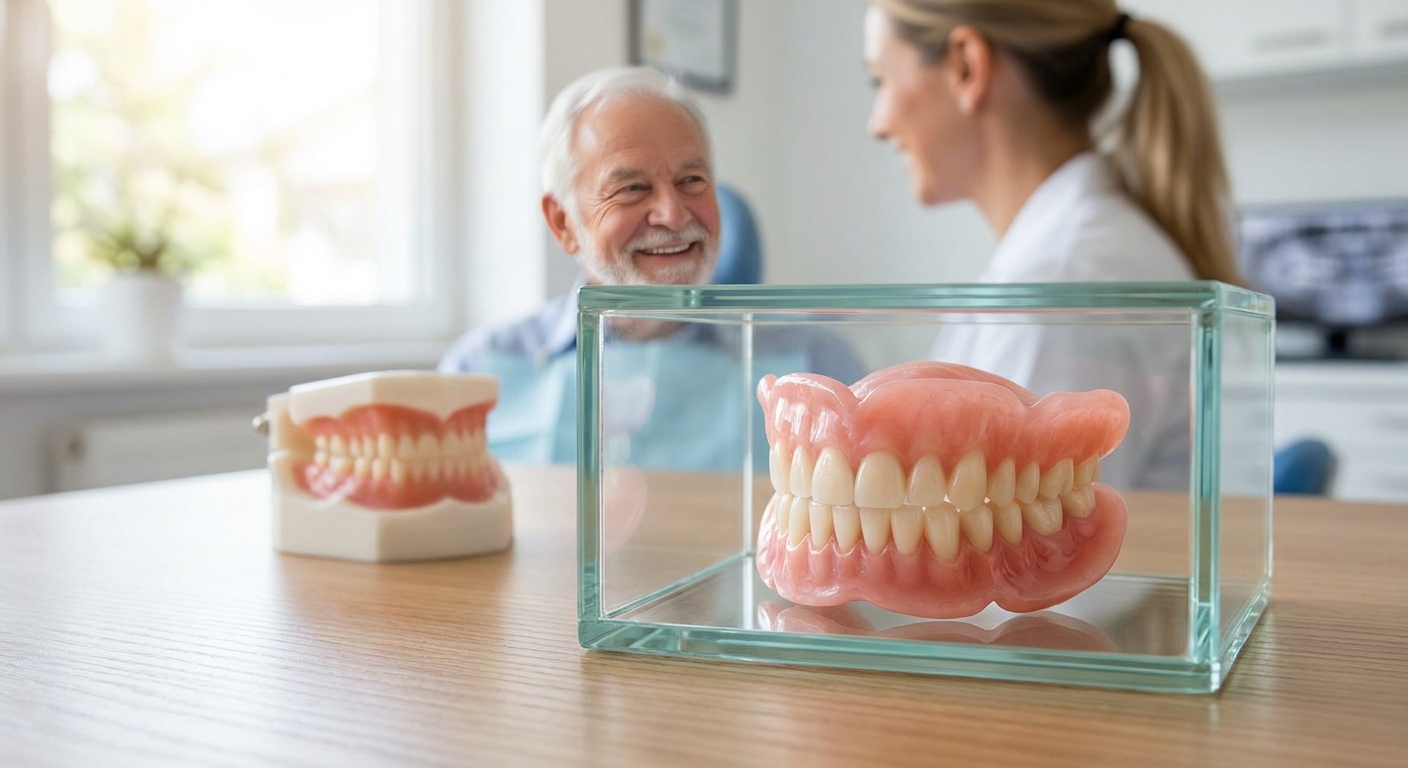
Losing every tooth in an arch changes how you eat, speak, and smile — and picking the wrong denture type can mean months of sore spots and slipping plates. This guide breaks down which type of dentures for missing all teeth actually fits your mouth, budget, and lifestyle in 2026.
- Implant-supported overdentures are the strongest long-term pick for patients missing all their teeth in an arch — Buy if bone volume allows.
- Conventional full dentures remain the lowest-cost starting point but need relining and can slip during eating — Consider only as a budget entry point.
- Immediate dentures let you leave extraction visits with teeth the same day, but expect a refit within months as gums heal — Consider, not a permanent solution.
- All-on-4 fixed implant dentures give the closest feel to natural teeth and skip the removable plate entirely — Buy for patients who want fixed, not removable, teeth.
Why this matters
Denture failure usually isn't about the appliance being defective — it's about the wrong type getting matched to the wrong mouth. A retiree with steady bone density and no interest in surgery needs something different than a 55-year-old who wants teeth that never come out at night.
At Dental Arts of Atlantis, full-arch tooth loss gets evaluated against bone volume, gum health, and how a patient actually wants to live day-to-day — not just what's cheapest to fabricate. That distinction matters more in 2026 than it did a decade ago, because implant-supported options have gotten more accessible while conventional dentures still get sold as a one-size-fits-all fallback.
Who this is for
This guide is for adults who've lost, or are about to lose, all their natural teeth in the upper arch, lower arch, or both — whether from decay, periodontal disease, trauma, or a lifetime of deferred dental care. If you're missing a single tooth or a few scattered teeth, a full denture is overkill; that situation calls for a different fix entirely. Full-arch patients are the audience here, and the calculus changes based on whether you're 45 and want to keep working a public-facing job, or 75 and prioritizing comfort over cosmetics.
What to look for in dentures for missing all teeth
Bone volume and jaw health
Implant-retained options require enough remaining jawbone to anchor posts securely, and years without teeth can shrink that bone significantly. A panoramic X-ray or 3-D scan tells you within one visit whether you're a candidate for implants or need bone grafting first — skip this step and you risk planning around an option your jaw can't actually support.
Stability during eating and speaking
Conventional dentures rest on the gum ridge and can shift when you bite into anything firmer than soft bread. If your job involves talking all day or your diet includes steak and apples, stability isn't a nice-to-have — it's the whole point of getting fitted in the first place.
How much you want removable vs. fixed
Some patients want to take their teeth out at night; others find that idea unacceptable. This single preference eliminates half the options on this list before you even get to price, so decide it early.
Timeline to a finished smile
Immediate dentures get you out the door with teeth on extraction day. Implant-supported dentures require healing time between placement and final fitting — often several months. If you have an event or a job interview on the calendar, timeline drives the decision as much as anatomy does.
Maintenance and long-term cost
A denture that costs less upfront but needs relining every couple of years and a full remake every five to seven can end up costing more than an implant-supported option that lasts over a decade with basic upkeep. Run the multi-year math, not just the sticker price.
Anxiety around extractions and surgery
Getting all remaining teeth removed in one or two visits is a real procedure, and it's normal to be nervous about it. Sedation options exist for exactly this reason — patients who'd otherwise put off treatment for years can get through extraction day comfortably, which matters more for full-arch cases than almost any other dental procedure.
Not sure which denture type fits you?
A bone and gum evaluation tells you which options are realistic before you commit.
Top picks: dentures for patients missing all their teeth
Conventional full dentures — the traditional pick
These sit directly on the gum ridge, held by suction and denture adhesive, and don't require any implants or surgery beyond extractions. Expect a break-in period of several weeks and a reline appointment within the first year as your gums settle into their final shape. Verdict: Consider — a reasonable starting point if surgery isn't an option right now, but plan on a step up later if stability becomes a daily frustration.
Immediate dentures — the same-day pick
These get placed the same day your remaining teeth come out, so you're never without teeth in front of people. The tradeoff: your gums and bone continue changing shape for months afterward, so a refit or reline around the six-month mark is standard, not a sign something went wrong. Verdict: Consider — good for anyone who needs teeth immediately for work or social reasons, with the understanding this is a bridge solution, not the final version.
Implant-supported overdentures — the stable pick
Anchored to four to six implants per arch, these snap onto a bar or attachments and stay put through normal eating without adhesive. Patients missing multiple or all teeth get evaluated for this option specifically because it solves the slipping problem that conventional dentures never fully fix — the detailed breakdown of implant-supported dentures for seniors missing multiple teeth covers candidacy in more depth. Verdict: Buy if a bone scan confirms you qualify — this is the option most patients wish they'd started with.
All-on-4 fixed implant dentures — the wildcard
Four strategically placed implants support a full arch of fixed teeth that never come out, day or night. It's the closest a denture patient gets to feeling like their natural teeth again, and it eliminates adhesive entirely. Verdict: Buy for patients who want fixed teeth and don't mind a longer treatment timeline — it's the highest commitment option on this list, financially and in terms of healing time, so it's not a casual upgrade.
Partial dentures on remaining teeth — skip if you're missing all teeth
This one only applies if you still have a few natural teeth left in the arch. Once every tooth is gone, there's nothing left to anchor a partial to, which makes this a non-option for the full-arch patients this guide is written for. Verdict: Skip for anyone missing an entire arch — it's mentioned here only because patients frequently ask about it before realizing it doesn't apply to their situation.
What to avoid
- Choosing based on upfront price alone. The cheapest denture today can become the most expensive one over a decade of relines, remakes, and adhesive purchases.
- Skipping the bone evaluation because you assume implants are out of reach. Bone grafting has closed that gap for many patients who were told years ago they weren't candidates.
- Ignoring anxiety about extraction day. Patients who put off full-arch treatment out of fear often end up with worse bone loss by the time they finally commit — sedation dentistry for anxious patients exists specifically to remove that barrier.
“A denture that slips during a meal isn’t a minor inconvenience — it’s a sign the wrong type got matched to the wrong mouth.”
Verdict comparison
| Type | Removable? | Timeline | Stability | Verdict |
|---|---|---|---|---|
| Conventional full dentures | Yes | Weeks | Lowest | Consider |
| Immediate dentures | Yes | Same day | Low, needs refit | Consider |
| Implant-supported overdentures | Yes (snaps on) | Months (healing) | High | Buy |
| All-on-4 fixed dentures | No | Months (healing) | Highest | Buy |
| Partial dentures | Yes | N/A for full-arch | N/A | Skip |
FAQ
What’s the best denture option for someone missing all their teeth?
Implant-supported overdentures or all-on-4 fixed dentures are the best options for most patients missing all their teeth in 2026, since both solve the slipping and stability problems of conventional dentures. The right pick depends on whether you want removable or fixed teeth and whether a bone scan confirms enough jawbone to support implants.
Are implant-supported dentures better than regular dentures?
Yes, implant-supported dentures are more stable and typically last longer than conventional dentures, which rest on the gum and can shift while eating. Conventional dentures still cost less upfront, which is why they remain a reasonable starting point for patients not ready for implant surgery.
How long do full dentures last before needing a reline?
Conventional full dentures usually need their first reline within the first year as gums settle, then again every few years as bone continues to change shape. Implant-supported dentures hold their fit longer because the implants stabilize the surrounding bone.
Can I get dentures the same day my teeth are pulled?
Yes, immediate dentures are placed the same day as extractions so you’re never without teeth. Expect a refit or reline around six months later once your gums finish healing into their permanent shape.
Do I need enough jawbone for implant-supported dentures?
Yes, implant-supported dentures require sufficient bone volume to anchor the implants securely, which a panoramic X-ray or 3-D scan can confirm in one visit. Patients without enough bone can often still qualify after a grafting procedure.
Is it normal to be nervous about getting all my teeth removed?
Yes, it’s a common reaction, and sedation dentistry exists specifically for patients who’d otherwise delay full-arch treatment out of fear. Delaying extraction day usually means more bone loss by the time treatment finally happens.
What’s the difference between all-on-4 and implant-supported overdentures?
All-on-4 dentures are fixed in place permanently and never come out, while implant-supported overdentures snap onto implants but can still be removed for cleaning. All-on-4 typically costs more and requires a longer healing timeline before final placement.
How much bone loss happens after losing all your teeth?
Jawbone shrinks fastest in the first year after extraction and continues gradually afterward, which is why implant candidacy is easier to confirm earlier rather than after years of waiting. A bone scan at your first evaluation shows exactly where you stand.
One last thing
The patients who end up happiest with full-arch dentures aren't always the ones who spent the most — they're the ones who got a proper bone evaluation before choosing, instead of picking a denture type off a brochure. That single scan in 2026 is what separates a decade of loose-fitting frustration from a stable, fixed solution from the start.
Related guides