
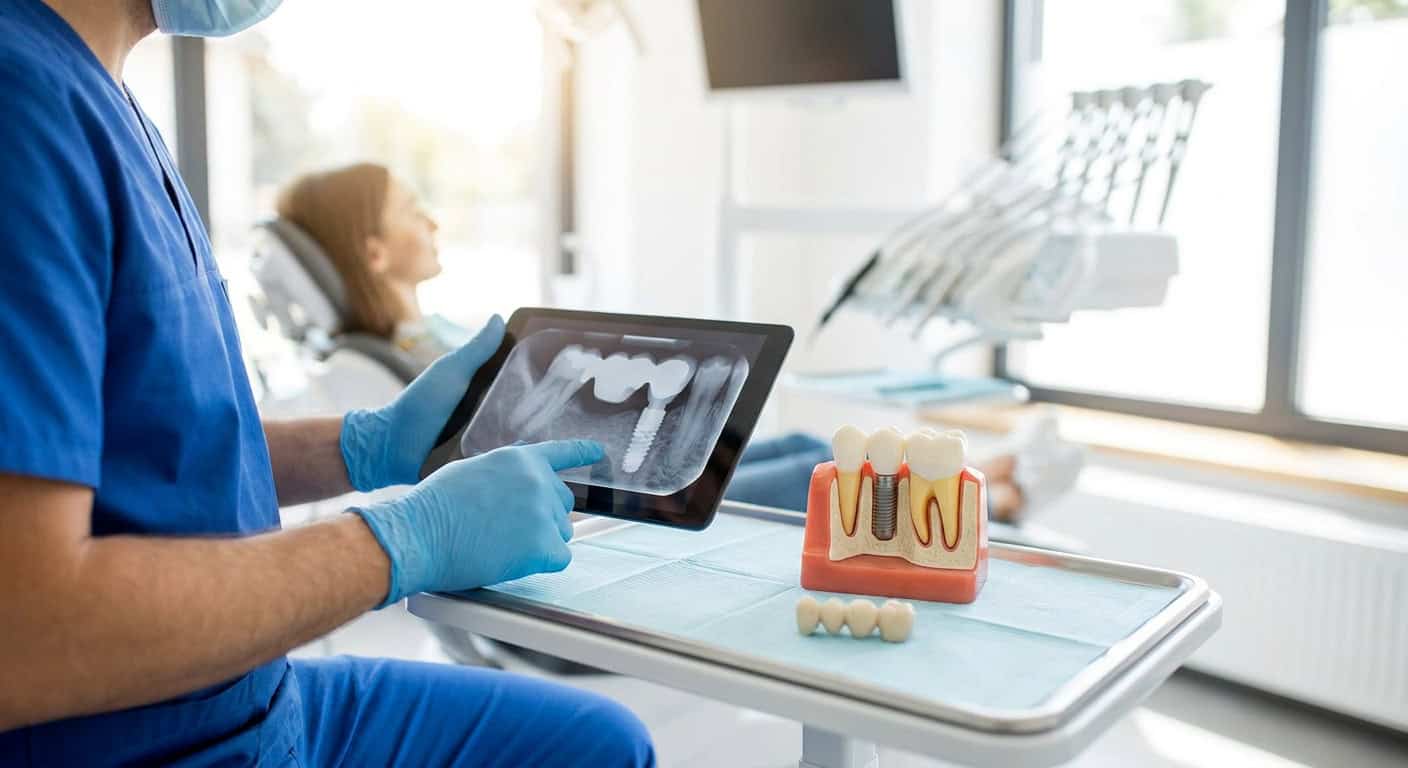
A failing dental bridge rarely means you're stuck with the same fix. In 2026, most patients replacing a bridge choose between a dental implant, an implant-supported bridge, or a new fixed bridge — and the right pick depends on how many teeth are involved and what's happening under the gumline.
- A single dental implant is the best replacement for a failing dental bridge when only one tooth is missing — Buy.
- Two implants supporting a 3-to-4 unit bridge beats a new tooth-supported bridge for multiple missing teeth — Buy.
- A brand-new traditional bridge only makes sense if the abutment teeth are still healthy — Hold.
- Removable partial dentures are a stopgap, not a fix — Wait unless budget forces the choice.
- Most bridge failures trace back to decay on the abutment teeth, not the bridge material itself.
Why this matters
A bridge that's failing at year 8 or year 12 is not an isolated event — it's usually a sign that the abutment teeth underneath the crowns have decayed, and that decay doesn't stop because you cemented a new bridge on top of it. Patching a failing bridge with another bridge often just delays the same failure by a few years.
The decision also affects the teeth next to the gap. A traditional bridge requires shaving down two healthy teeth to serve as anchors. An implant doesn't touch the neighbors at all. That distinction matters more in 2026 than it did a decade ago, because implant costs have come down and same-day imaging makes the planning faster.
How this list was ranked
Each option below is scored on four things that actually change outcomes: how long it lasts, whether it protects the teeth around the gap, how invasive the procedure is, and how well it fits patients dealing with an already-failing bridge rather than starting from scratch. Options that require healthy abutment teeth get downgraded automatically, since a failing bridge is often a sign those teeth are compromised.
The ranked list
1. Single dental implant — the direct replacement
When a bridge fails because of one bad abutment tooth and the rest of the mouth is healthy, a single implant is the cleanest fix. It replaces the root, not just the crown, so the bone underneath keeps getting stimulated instead of shrinking over time — a problem that shows up with both bridges and dentures. Recovery runs 3 to 6 months for full integration in 2026 protocols, though a temporary crown covers the gap during healing. For patients missing exactly one tooth after a bridge fails, a single-tooth dental implant avoids grinding down two more teeth just to anchor a new bridge. Verdict: Buy.
2. Implant-supported bridge — for multiple missing teeth
If the failing bridge spans three or four teeth, replacing it with another tooth-supported bridge repeats the same risk on new abutments. Two strategically placed implants can support a 3-to-4 unit bridge without resting any load on natural teeth. This is the standard approach for patients whose bridge failure exposed weakness in several adjacent teeth, and it's especially relevant for older patients who are already managing multiple compromised teeth in the same arch — implant options for seniors missing multiple teeth cover this scenario directly. Verdict: Buy.
3. New traditional fixed bridge — only with healthy anchors
A new bridge is faster and cheaper upfront than implants, and it can be the right call when the failure was mechanical — a cracked pontic or a loose cement seal — rather than decay-driven. The catch: this only works if both abutment teeth are structurally sound and free of new decay, which is not the case for most bridges that failed after a decade in the mouth. Getting a new bridge on already-compromised anchor teeth just resets the failure clock on a shorter timer. Verdict: Hold — only after confirming abutment health.
4. Removable partial denture — the budget stopgap
A partial denture costs less and requires no surgery, which makes it tempting when a bridge fails unexpectedly and money is tight right now. It doesn't stop bone loss the way an implant does, and most patients find the clasps and removability inconvenient for daily wear within the first year or two. It's a reasonable bridge while sorting out financing for a permanent fix, not a long-term answer. Verdict: Wait — bridge to a better option, don't settle here.
5. Implant-supported denture — for full-arch failure
When a bridge fails alongside several other teeth in the same arch, replacing individual teeth one at a time stops making sense. An implant-supported denture anchors a full or partial denture to a small number of implants, giving far more stability than a removable denture alone. For patients whose bridge failure is really a sign of broader tooth loss across the arch, full-arch denture solutions built on this approach hold up better day to day than removable appliances resting on gum tissue alone. Verdict: Consider — right for multi-tooth failure, not single-tooth cases.
6. Root canal and bridge repair — narrow use case
Occasionally a bridge fails because one abutment tooth needs a root canal, not extraction. If imaging shows the tooth structure is otherwise intact, treating the infection and re-cementing or rebuilding the bridge can buy several more years. This only works when the tooth is salvageable — once decay has eaten past the gumline, extraction and an implant beat trying to save a compromised anchor. Verdict: Skip unless a dentist confirms the abutment tooth is salvageable.
Get your bridge evaluated in person
3-D imaging shows exactly why the bridge failed before you choose a replacement.
Comparison table
| Option | Protects neighboring teeth | Typical timeline | Best for |
|---|---|---|---|
| Single dental implant | Yes | 3-6 months | One failed abutment |
| Implant-supported bridge | Yes | 4-8 months | 3-4 missing teeth |
| New traditional bridge | No | 2-4 weeks | Healthy abutments only |
| Removable partial denture | No | 1-3 weeks | Short-term budget gap |
| Implant-supported denture | Yes | 4-8 months | Full-arch failure |
Where to get it done
- Ask for a 3-D scan before agreeing to any replacement — it shows whether the abutment teeth are salvageable or need extraction.
- Get the financing conversation out of the way early; implant-based options cost more upfront than another bridge, and a family-focused financing plan can spread that cost over time.
- Choose a practice that treats bridge failures often enough to recognize decay patterns on X-rays, not just place new crowns on top of old problems.
If your bridge failure came with a sudden crack or a tooth that's now loose, that's an urgent situation rather than a planning one — see the guide on replacing a chipped or broken front tooth if the failed bridge is in the front of the mouth and cosmetics matter as much as function.
FAQ
What’s the best replacement for a failing dental bridge?
A single dental implant is the best replacement when one abutment tooth caused the failure and the rest of the mouth is healthy. For three or four missing teeth, an implant-supported bridge outperforms another tooth-supported bridge because it doesn’t load the neighboring teeth.
Is a dental implant better than a new bridge?
Yes, for most bridge failures, because implants don’t require shaving down two more teeth as anchors. A new bridge only makes sense when the existing abutment teeth are confirmed healthy on imaging.
How much does replacing a failing bridge cost in 2026?
Costs vary by how many teeth are involved and whether implants or a new bridge are used, and financing plans can spread the amount over monthly payments. Get a specific quote after imaging, since the abutment tooth condition changes the treatment plan and the cost.
Why do dental bridges fail after 10 to 15 years?
Most bridges fail because decay develops on the abutment teeth under the crowns, not because the bridge material itself wears out. That decay is often invisible until an X-ray shows it, which is why bridges that seemed fine can suddenly need replacement.
Can a failing bridge be repaired instead of replaced?
Sometimes, if the failure is mechanical — a loose cement seal or a cracked pontic — and the abutment teeth are still sound. If decay has reached the abutment tooth root, repair usually fails again within a year or two.
What happens if I don’t replace a failing bridge?
The gap under a loose or cracked bridge lets bacteria in, which accelerates decay on the abutment teeth and can lead to infection or tooth loss. Bone loss also continues in the gap area the longer it goes untreated.
Are implant-supported dentures better than a full new bridge for multiple failed teeth?
Yes, when the failure spans several teeth in one arch, implant-supported dentures hold up better than stacking new bridges over compromised teeth. They also stop the bone loss that removable dentures don’t address.
How long does implant treatment take after a bridge fails?
Full integration typically runs 3 to 8 months in 2026 protocols depending on how many implants are placed, though a temporary restoration covers the gap during healing. Extraction and bone grafting, if needed, add time to the front end.
One last thing
Most patients assume a failing bridge means the bridge itself wore out — in most cases it's the tooth underneath that gave up first, and no amount of re-cementing the same bridge fixes that. If a dentist recommends imaging before recommending a fix, that's the right order of operations, not an upsell.
Related guides
- Dental implants for one missing tooth
- Dental implants for seniors missing multiple teeth
- Dentures for patients missing all their teeth
- Best dental financing plan for a family budget
- Best replacement for a chipped or broken front tooth