
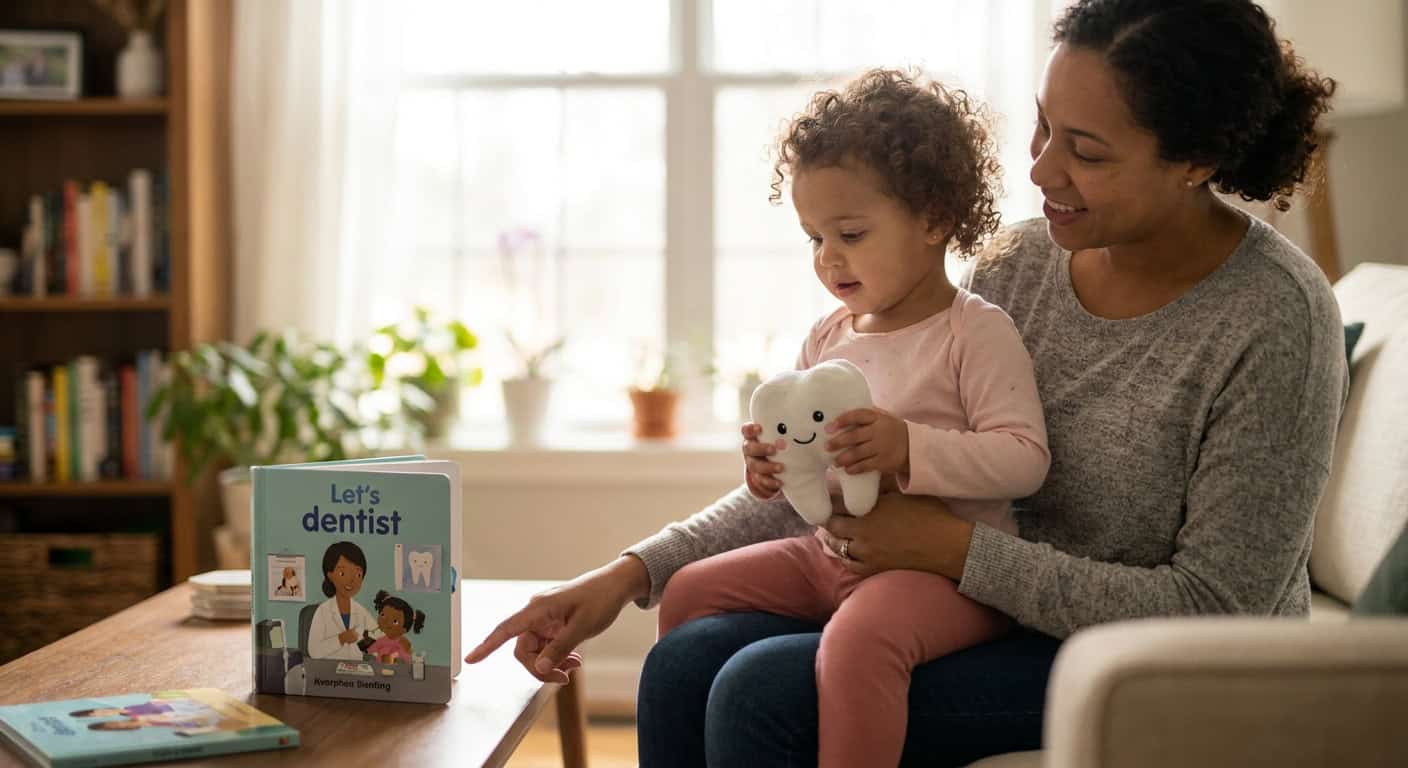
Your toddler's first dental visit sets the tone for how they feel about the dentist for the next fifteen years — a little prep work now saves you a meltdown in the chair later. This guide walks through exactly what to do in the days before the appointment, what to expect during it, and how to handle the tantrum if one shows up anyway.
- Book the first visit by age 1 or within six months of the first tooth erupting, per pediatric dentistry guidelines followed at Dental Arts of Atlantis.
- Practice a 10-minute ‘pretend dentist’ game at home 3-4 days before the appointment to cut anxiety.
- Morning appointments work best for toddlers — book before nap time, not after.
- Bring a comfort item and skip the pre-visit sugar snack; both change how the visit goes.
- Verdict: a short home rehearsal plus a morning slot at a pediatric-friendly practice is the single biggest predictor of a calm first visit in 2026.
Why this matters
Dental anxiety doesn't start at the dentist's office — it starts at home, weeks before, in how the visit gets talked about. A toddler who hears "it won't hurt" for the first time in the waiting room has already learned that hurting was a possibility worth mentioning.
The American Academy of Pediatric Dentistry recommends the first checkup happen by age 1 or within six months of the first tooth coming in, specifically because early visits are low-stakes: there's rarely decay to treat, so the appointment is mostly a look-and-count with a parent holding the child the whole time. That first low-stress visit becomes the baseline every future visit gets measured against. Get it right in 2026 and the six-month recall in 2027 is a non-event.
What you'll need
- A confirmed appointment time, ideally mid-morning when your toddler is rested and fed
- A comfort item — favorite stuffed animal, small blanket, or toy that can sit in their lap during the exam
- 10-15 minutes at home, three or four days before the visit, to run a pretend checkup
- A children's book or short video about visiting the dentist (library or streaming, either works)
- A pediatric-focused practice on the schedule — pediatric dentistry for toddlers covers what a toddler-specific first exam actually involves
- Patience for the drive home, win or lose
The steps
1. Pick the right appointment window
Book morning slots only. A toddler who's hungry, overtired, or past nap time has zero reserves left for something new and slightly scary. If your child naps at 1 p.m., an 11 a.m. slot beats a 2 p.m. slot every time — not by a little, but by the difference between cooperative and inconsolable.
If you're still deciding when the very first visit should even happen, the best age to schedule a first dentist visit breaks down the timing question by tooth eruption stage, not just birthday.
Common mistake: scheduling around your work calendar instead of your toddler's nap schedule. The appointment that's convenient for you and disastrous for them isn't actually convenient.
2. Rehearse the visit at home
Three or four days out, play "dentist" for 10 minutes. Count teeth with a soft toothbrush, use a small mirror, let your toddler play dentist on a stuffed animal, then swap roles. Say the visit is happening — don't spring it on them the morning of.
Repetition matters more than realism here. A toddler doesn't need an accurate simulation; they need the word "dentist" to stop being unfamiliar. Four days of casual mentions beats one long lecture the night before.
Common mistake: over-explaining. "The dentist is going to count your teeth and it might feel a little weird but you'll be fine and I'll be right there and it's really quick" is six ideas in one breath. Toddlers process one clear idea at a time: "We're going to see the tooth doctor. She counts teeth."
3. Choose your words carefully
Drop "hurt," "pain," "shot," and "drill" from your vocabulary entirely, even to reassure. Toddlers latch onto the scary word, not the reassurance wrapped around it. "It won't hurt" plants the idea of hurting; "the dentist counts your teeth" doesn't.
Use neutral, concrete language: "tooth doctor," "counting teeth," "special toothbrush." Save any real medical vocabulary for when your child is old enough to ask specific questions.
4. Time the last meal and skip the sugar
Feed your toddler a normal meal 60-90 minutes before the appointment — never on an empty stomach, never right before walking in. Skip juice, candy, or anything sugary in the two hours before the visit; a sugar spike followed by a car ride and a new environment is a bad combination for toddler regulation.
Water is fine right up until you're in the waiting room.
5. Pack the comfort item and go light on everything else
One stuffed animal or blanket, held the whole visit, does more work than any amount of talking. Skip the loaded diaper bag with six distractions — one familiar object beats five new ones.
If your toddler has an older sibling due for a checkup around the same time, family dentistry for busy Palm Beach County households covers scheduling siblings back-to-back so you're not making two separate trips.
6. Stay in the room, stay calm, stay quiet
Your toddler is reading your face more than the dentist's. If you're tense, they clock it immediately — toddlers are remarkably good at detecting a parent who's bracing for a bad outcome. Sit close, hold their hand or let them sit in your lap, and let the hygienist or dentist do the talking.
Don't narrate every step ("okay now she's going to look at your teeth, see, isn't that fun"). Constant commentary reads as anxious hovering, not reassurance. Silence with a steady hand on their leg does more.
7. Praise the behavior, not just the outcome
After the visit, praise specific things: "You sat still for the whole count" or "You opened your mouth so wide." Specific praise reinforces the exact behavior you want repeated at the six-month recall. Generic praise ("good job!") teaches nothing.
Skip the bribery-sized reward. A sticker or five extra minutes at the park works; a promised toy for "being brave" teaches your toddler the visit was something to be brave about in the first place.
Expected outcome: most toddlers who go through steps 1-6 sit through a first exam in 10-15 minutes with minor fussing, not a full meltdown. Some cry anyway — that's still a successful first visit if the exam gets completed.
Book your toddler’s first exam
Pediatric-focused first visits, scheduled around nap times, at Dental Arts of Atlantis.
Troubleshooting
- My toddler refuses to open their mouth. Don't force it. A skilled pediatric-focused team will use a "tell-show-do" approach — showing the mirror and counting on a stuffed animal first — rather than pushing through resistance, which just teaches the visit is a fight.
- They cried the entire time. A completed exam with crying still counts as a win in 2026's first-visit standards; the goal is exposure and safety, not a smile through it. The second visit is almost always calmer than the first.
- They're scared of the chair reclining. Ask if your toddler can sit in your lap for the first look instead of the chair — most practices offer this for age one to two visits specifically.
- The appointment ran long and they melted down. Book the very first slot of the morning next time, before the schedule has a chance to run behind.
- They won't let anyone but you touch their face. Mention this to the front desk when booking; many pediatric teams will let a parent do the initial mouth opening themselves while the dentist observes from a short distance.
- Sibling had a bad visit and now the toddler is scared by association. Talk about it separately — "that was your sister's visit, this is your visit" — and avoid letting siblings discuss the appointment in the car on the way there.
Tools and resources
- Pediatric dentistry for toddlers and first dental visits — what the exam covers age by age
- A soft-bristled children's toothbrush for home rehearsal
- A small handheld mirror for the "count your teeth" game
- One comfort item, kept the same across visits so it becomes a reliable cue
- A calm morning routine that doesn't rush the drive over
What to do next
Once the first visit is behind you, the six-month recall schedule starts. If your child is approaching school age, look ahead to dental sealants for school-age kids — sealants are typically placed once the first permanent molars come in, usually around age six, and they're a natural next conversation once toddler visits become routine.
FAQ
What age should a toddler have their first dental visit?
A toddler should see a dentist by age 1 or within six months of the first tooth erupting. Earlier visits are lower-stress because there’s usually nothing to treat, just a count and a look.
How do I prepare a toddler for their first dentist appointment?
Rehearse a pretend checkup at home 3-4 days before, book a morning slot before nap time, and avoid words like ‘hurt’ or ‘shot.’ Bring one comfort item and skip sugary snacks beforehand.
Is it normal for a toddler to cry at the first dental visit?
Yes, crying at a first visit is common and doesn’t mean the visit failed. A completed exam with tears still gets the checkup done and sets up a calmer second visit.
Should I stay in the room during my toddler’s dental exam?
Yes, staying in the room and holding your toddler or letting them sit in your lap helps far more than watching from a waiting area. Toddlers read parental calm as a cue that the situation is safe.
What should I avoid saying before a toddler’s dentist visit?
Avoid ‘hurt,’ ‘pain,’ ‘shot,’ and ‘drill,’ even in a reassuring sentence like ‘it won’t hurt.’ Toddlers fixate on the scary word rather than the reassurance around it.
How long does a toddler’s first dental exam take?
Most first exams run 10 to 15 minutes and consist mainly of a visual count and a soft cleaning. Longer visits are more likely if X-rays or additional evaluation are needed.
Should my toddler eat before a dental appointment?
Feed a normal meal 60 to 90 minutes before the visit and skip sugary snacks or juice in the two hours prior. An empty stomach or a sugar spike both make toddlers harder to settle in the chair.
What if my toddler won’t open their mouth at the dentist?
Don’t force it — a pediatric-focused team will use show-and-tell techniques like counting a stuffed animal’s teeth first. Most toddlers open up within a few minutes once the process feels familiar.
One last thing
The detail most parents miss: the second visit matters more than the first. A rough first appointment followed by a calm, low-drama second visit six months later is what actually rewires a toddler's association with the dentist — not a perfect first try. If visit one goes sideways, don't panic about it; focus your prep energy on visit two.
Related guides
- Dental sealants for school-age kids
- Mouthguards for young athletes and contact sports
- Best dental financing plan for a family budget