
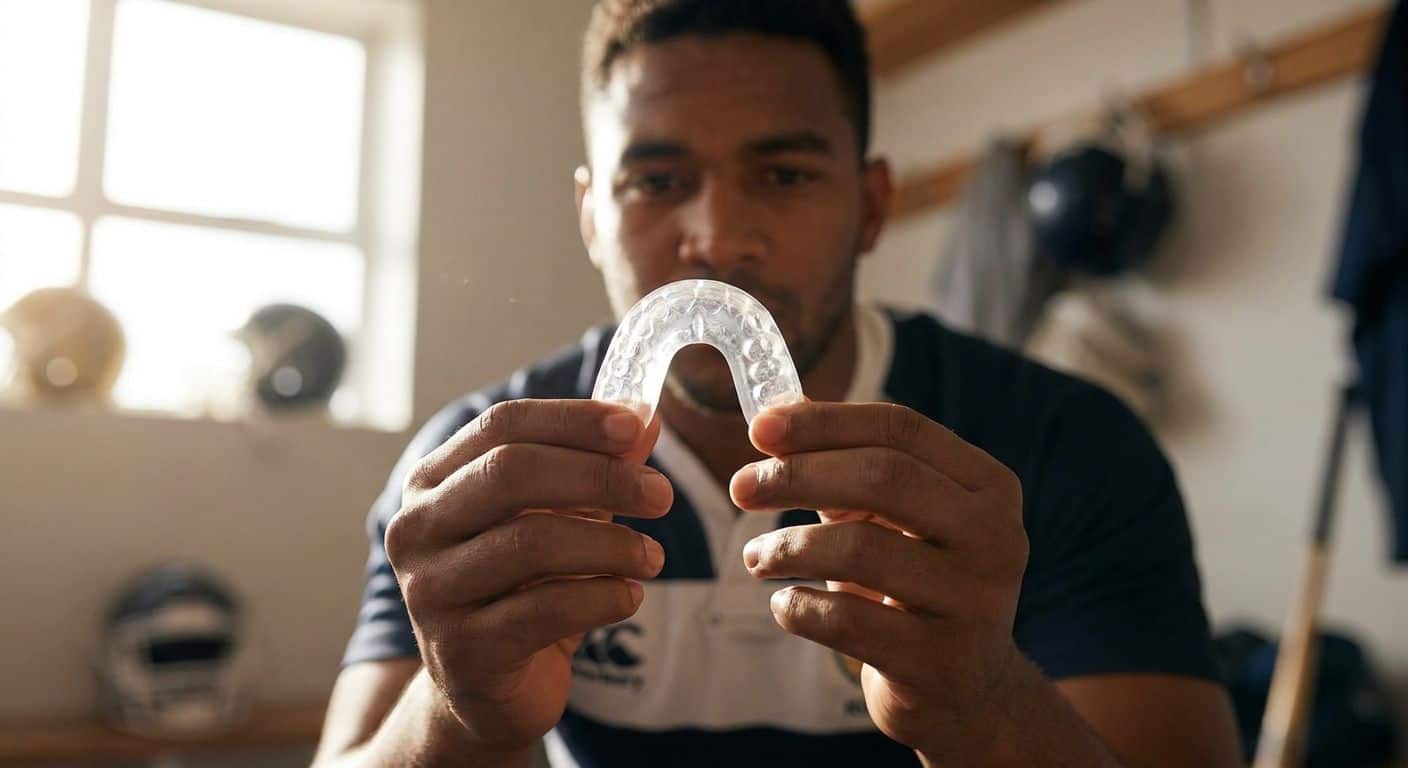
Adults who play contact sports lose more teeth to bad mouthguards than to bad luck — a custom mouthguard for adult contact sports is the difference between walking off the mat with your smile intact and walking into an emergency dental visit. This guide breaks down what actually protects you in 2026, what to skip, and which type of guard fits your sport.
- A lab-fabricated custom mouthguard for adult contact sports beats boil-and-bite guards on fit, retention, and jaw protection — Buy.
- Dual-arch guards suit full-contact strikers like boxers and MMA athletes; single-arch works for hockey, football, and rugby.
- Guards that don’t address jaw clenching or TMJ symptoms are the wrong pick for adults who grind their teeth under stress.
- Custom fabrication typically means two office visits and one to two weeks of lab turnaround before delivery.
Why this matters
A loose mouthguard doesn't just feel bad — it fails at the moment of impact. Guards that shift during a takedown or a check into the boards leave molars and front teeth exposed exactly when the force hits.
The American Dental Association and the Academy for Sports Dentistry both point to properly fitted, custom-fabricated guards as the standard for adults competing in boxing, wrestling, rugby, hockey, MMA, and full-contact football. Off-the-shelf boil-and-bite guards are cheaper, but they compress unevenly under pressure and don't account for jaw alignment or existing dental work — crowns, bridges, or veneers included.
Who this is for
This guide is for adults 18 and older who train or compete in contact sports — boxing, jiu-jitsu, wrestling, rugby, hockey, lacrosse, or full-contact football — and who want a mouthguard built to their bite instead of a generic shell from a sporting goods rack. If you already grind or clench your jaw outside of sport, that history changes which guard you need; custom mouthguards for young athletes and contact sports covers the fitting process Dental Arts of Atlantis uses for both teens and adults.
What to look for in a custom mouthguard for adult contact sports
Fit from an impression or digital scan
A guard molded from your actual bite — not softened plastic you bite into at home — stays put during a scramble or a tackle. Loose guards fall out at the worst moment, usually mid-impact, which defeats the purpose entirely.
Material thickness at impact zones
Sports dentistry guidance points to roughly 3-4 mm of shock-absorbing material at the molars and front teeth as a practical minimum for full-contact sports. Thinner store-bought guards often fall short of that at the exact spots that take the hardest hits.
Single-arch vs. dual-arch coverage
Strikers who get hit in the jaw — boxers, MMA fighters — need dual-arch protection covering both upper and lower teeth. Athletes in sports with less direct facial contact, like hockey or football, usually do fine with a single upper-arch guard.
Compatibility with jaw clenching or TMJ symptoms
Adults who already clench or grind under stress need a guard that accounts for that, not one that makes jaw tension worse mid-match. If you notice jaw soreness or headaches after training, read TMJ treatment for chronic jaw pain and headaches before choosing a guard — the wrong thickness or bite alignment can aggravate an existing TMJ issue.
Durability across a full season
A guard that cracks or discolors three months into a season isn't saving you money. Lab-fabricated guards hold their shape and material integrity longer than thin single-layer store guards, which matters if you're training multiple times a week through 2026.
Breathing and speech during competition
Bulky, poorly trimmed guards make it hard to breathe or call out to teammates mid-play. A properly trimmed custom guard sits close to the gumline without extra material blocking airflow.
Top picks for adult contact sports
1. Custom-fitted single-arch guard — the safe pick
Built from an impression or digital scan of your upper arch, this is the standard recommendation for hockey, football, rugby, and lacrosse players who take contact but aren't absorbing direct jaw strikes. Fabrication runs on a lab timeline of roughly one to two weeks after your fitting visit. Verdict: Buy — this is the default for most adult contact-sport athletes without existing jaw issues.
2. Dual-arch custom guard — the wildcard
Covers both upper and lower teeth, which matters for boxers, MMA fighters, and wrestlers who take strikes directly to the jaw. It costs more chair time to fit and more lab time to produce than a single-arch guard, but it's the only option that protects the lower arch during a direct hit. Verdict: Buy for full-contact strikers; Consider for grapplers who mostly avoid facial contact.
3. TMJ-integrated custom guard — for jaw clenchers
Adults who already deal with jaw tension, clicking, or clenching outside of sport need a guard fabricated with that history in mind, rather than a generic mold. This pairs with an evaluation covered in TMJ treatment for chronic jaw pain and headaches, where bite alignment and jaw tension get addressed before the guard is built. Verdict: Buy if you have any history of jaw pain or clenching; skip straight to option 1 if you don't.
4. Boil-and-bite store guard — what most adults default to
Available at any sporting goods store for immediate use, these guards soften in hot water and get bitten into shape at home. They're inconsistent in thickness, loosen with repeated use, and don't account for existing dental work. Verdict: Skip for anyone training more than casually or with any dental restorations in place.
Get fitted for a custom mouthguard
Same-day new patient scheduling available for a fitting consultation.
What to avoid
- Thin single-layer guards marketed as "universal fit" — they trim down to almost nothing at the biting surface once you actually bite into them, which is the opposite of protection.
- Night guards worn as sport guards — a night guard is built for grinding pressure over hours of sleep, not a single sharp impact from a fist or a stick. If you already wear one for grinding, see night guards for teeth grinding and jaw pain for the difference in design intent.
- Guards you haven't replaced after a growth spurt, weight change, or dental work — a crown, filling, or extraction changes your bite, and a guard fitted before that work no longer seats correctly.
Verdict comparison
| Guard type | Best for | Impact coverage | Verdict |
|---|---|---|---|
| Custom single-arch | Hockey, football, rugby | Upper arch only | Buy |
| Custom dual-arch | Boxing, MMA, wrestling | Upper and lower arch | Buy |
| TMJ-integrated custom | Athletes with jaw clenching history | Upper and/or lower, bite-corrected | Buy |
| Boil-and-bite | Casual or one-time use | Inconsistent | Skip |
| Night guard worn for sport | Never appropriate | Not impact-rated | Skip |
FAQ
What’s the best custom mouthguard for adult contact sports?
A lab-fabricated custom mouthguard molded from your own bite is the best option for adult contact sports in 2026, because it fits tighter and distributes impact more evenly than any store-bought guard. Dual-arch versions add lower-jaw protection for boxing, MMA, and wrestling.
Is a custom mouthguard better than a boil-and-bite guard?
Yes — a custom mouthguard fits from an impression or digital scan, while boil-and-bite guards soften unevenly and loosen with repeated use. For anyone training more than casually, the custom option holds up better across a season.
How much does a custom mouthguard cost compared to a store guard?
Custom mouthguards cost more upfront than a boil-and-bite guard from a sporting goods store, since they require an office visit and lab fabrication. Check current pricing directly with the office, since coverage and fees vary by plan.
Do adults need a dual-arch mouthguard or just a single-arch guard?
Dual-arch guards are recommended for sports with direct jaw contact, like boxing and MMA, while single-arch guards suit hockey, football, and rugby. The distinction comes down to whether your lower jaw takes direct hits during competition.
Can a mouthguard help with jaw clenching during sports?
A properly fitted custom guard can reduce jaw clenching pressure during competition when it’s built with that history in mind. Adults with existing TMJ symptoms should get a jaw evaluation before choosing a guard design.
How long does it take to get a custom mouthguard made?
Custom mouthguards typically require two office visits — one for the impression or scan, one for delivery and fit check — with roughly one to two weeks of lab turnaround in between. Timelines can shift depending on the lab and the season.
Do I need a new mouthguard if I get a filling or crown?
Yes — any change to your bite from a filling, crown, or extraction means your old guard no longer seats correctly. A guard fitted before that dental work can shift or crack under pressure.
Can a night guard double as a sports mouthguard?
No — a night guard is designed for sustained grinding pressure over hours of sleep, not a single sharp impact from a fist, elbow, or stick. Wearing one during contact sports leaves you under-protected against a direct hit.
One last thing
The guard that fails most often isn't the cheap one — it's the good one from three seasons ago that nobody replaced after a crown went in. Bite changes shift how a custom guard seats, and a guard that no longer seats flush is functionally back to boil-and-bite performance no matter what it cost in 2024 or 2025. If your last fitting predates recent dental work, get it checked before the next training cycle in 2026.
Related guides
- TMJ treatment for chronic jaw pain and headaches
- Night guards for teeth grinding and jaw pain
- Emergency dentistry for a cracked or broken tooth
- Sedation dentistry for anxious patients