
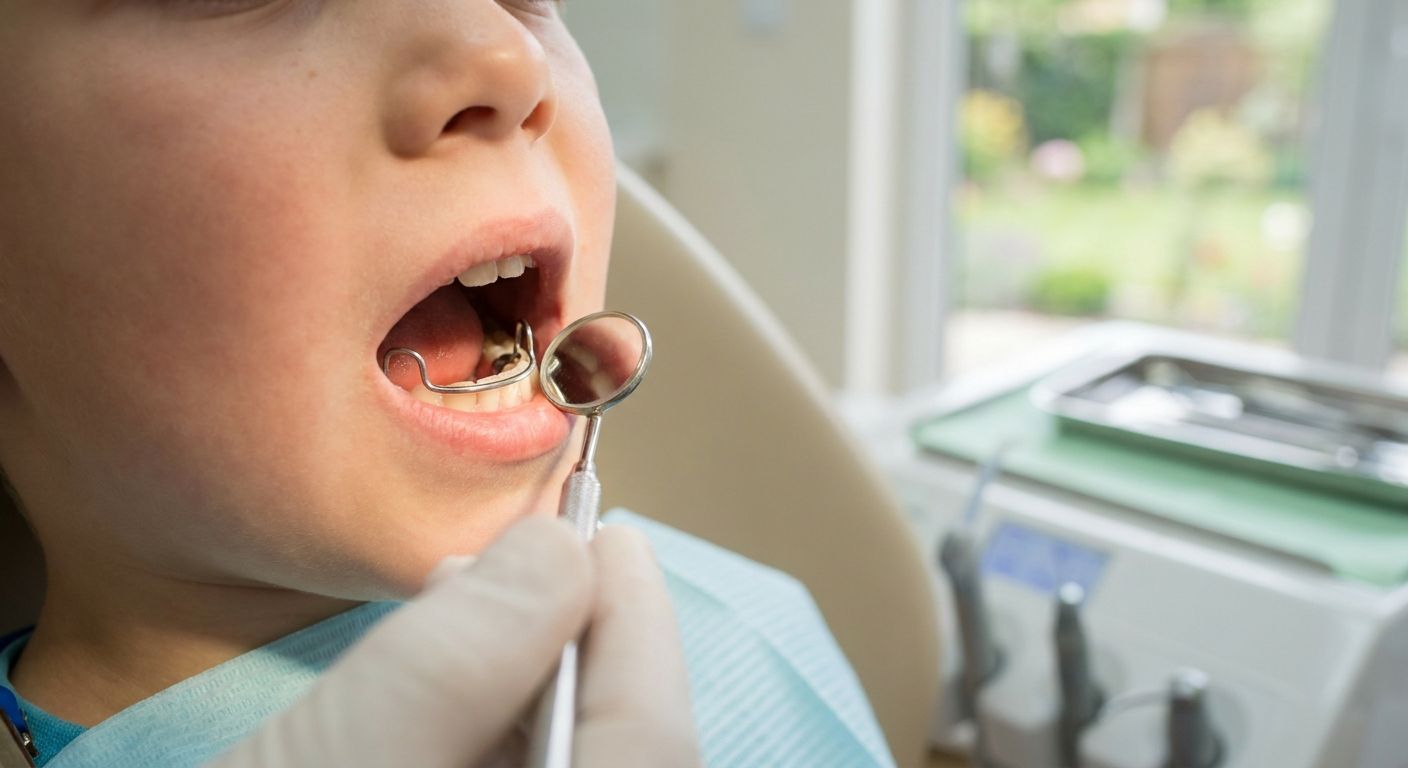
A space maintainer for early tooth loss is a small dental appliance that holds open the gap left by a baby tooth pulled or lost before its natural time, so the permanent tooth underneath still has room to come in straight. Kids who lose a baby molar to trauma, decay, or infection face a different timeline than a child who loses teeth on schedule around age six, which means the appliance, the follow-up schedule, and the home-care routine all need to fit a younger or more anxious patient.
- A space maintainer for early tooth loss stops nearby teeth from drifting into the empty spot before the permanent tooth is ready.
- Band and loop appliances work for a single missing back tooth; a distal shoe is needed when the first permanent molar hasn’t erupted yet.
- Most kids adjust to a space maintainer within one to two weeks with normal brushing and soft-food meals.
- Skipping the appliance after early tooth loss is the top reason kids need braces or extractions later.
Why this matters when your child loses a tooth early
A baby molar that falls out at age five instead of age eleven leaves a gap open for years, not months, and that's the real difference between routine tooth loss and premature tooth loss. Neighboring teeth start tipping into the space within weeks, and once they've drifted, the permanent tooth waiting underneath often has nowhere to go but sideways or impacted.
Dental Arts of Atlantis sees this most often after a fall, an untreated cavity that reaches the nerve, or an extraction done to stop an infection from spreading. If your child recently went through pediatric dentistry for toddlers and first dental visits and a tooth had to come out, the space maintainer conversation should happen at that same appointment, not weeks later once drifting has already started.
The stakes are orthodontic, not just cosmetic. A child who loses a lower first molar at age five and gets no appliance can lose enough arch space by age eight that a future orthodontist has to extract additional teeth just to make room. That's the trade-off families are actually managing here in 2026: a small appliance now versus a bigger, longer orthodontic case later.
Confirm your child actually needs a space maintainer
Not every lost baby tooth needs an appliance. A front tooth lost early usually doesn't need one, because front teeth don't hold arch length the way back molars do. The decision comes down to which tooth was lost and how much eruption time is left before the permanent tooth is due.
- Ask which specific tooth was extracted or lost, by name, not just "a back tooth"
- Get an estimate of how many months or years remain before the permanent successor is due to erupt
- Request a bitewing or panoramic X-ray if one hasn't been taken recently
- Confirm whether adjacent teeth have already started tipping into the space
- Ask directly: "does losing this specific tooth put arch space at risk?"
Choose the right type of space maintainer for the tooth lost
The appliance depends entirely on which tooth is gone and whether the permanent molar behind it has already broken through the gum. Getting this wrong means a second appointment and a second fitting.
- Band and loop: a metal band cemented on one neighboring tooth with a wire loop holding the space, used for one missing tooth on one side
- Distal shoe: a small metal appliance that extends slightly under the gum line, used only when the first permanent molar hasn't erupted yet and needs a guide
- Lingual arch: a fixed wire running behind the lower front teeth, used when multiple back teeth are missing on both sides
- Removable maintainer: a retainer-style appliance for older, cooperative kids who can be trusted to wear it consistently
- Crown and loop: combines a stainless steel crown with a loop when the anchor tooth also has significant decay
Prepare your child for the fitting appointment
A space maintainer fitting takes one visit for most kids, but the appointment goes smoother when a child knows what to expect beforehand. Kids who already struggle with dental visits benefit from extra prep time.
- Explain the appliance in simple terms: "a little helper that keeps space for your grown-up tooth"
- Book the appointment for a time of day when your child is usually calm, not right after school on a long day
- Bring a comfort item if your child tends to get anxious in the chair
- Ask about numbing options before the visit, especially for a band and loop that requires fitting a metal band
- If your child has a documented fear of needles or injections, review dental anxiety solutions for kids afraid of needles with your dentist ahead of time
Manage the first two weeks at home
Most kids adjust to a fixed space maintainer within one to two weeks, but the early days involve some soreness and a learning curve around eating and talking.
- Stick to softer foods for the first three to five days: pasta, eggs, soft fruit, mashed vegetables
- Skip sticky candy, gum, and hard ice entirely for as long as the appliance is in place
- Watch for excessive tongue-poking at the appliance, which usually settles after the first week
- Offer a quiet, low-stimulation activity during the adjustment period instead of letting your child fixate on the new feeling in their mouth; a set of quiet wooden toys for five-year-olds gives younger kids something to focus their hands on instead of their tongue
- Call the office if soreness lasts longer than five days or if a band feels loose
Maintain oral hygiene around the appliance
A space maintainer creates extra surfaces where food and plaque can collect, so hygiene habits need to tighten up while the appliance is in place.
- Brush around the band or loop twice daily, angling the brush to reach under the wire
- Use a floss threader if your dentist recommends flossing near a fixed appliance
- Rinse with water after meals if brushing right away isn't possible
- Schedule a cleaning check at the same interval as your child's regular checkups, not less often
Track eruption and schedule follow-ups
A space maintainer is a temporary appliance, not a permanent one. It comes out the moment the permanent tooth starts pushing through, which means follow-up visits matter as much as the initial fitting.
- Book a follow-up every three to six months to check eruption progress with an X-ray if needed
- Ask your dentist to flag on your chart the expected removal window based on your child's age
- Watch for the appliance loosening on its own, which sometimes signals the permanent tooth is close
- Don't wait for a scheduled cleaning to mention it if the area looks different at home
Handle a loose or broken space maintainer
Appliances loosen sometimes, especially band and loop types cemented on a baby tooth that's still growing. A loose appliance needs attention within days, not at the next routine visit.
- Call the office the same day if a band feels loose or spins on the tooth
- Avoid hard or sticky foods until it's checked
- Don't try to remove or adjust it yourself
- If the appliance falls out completely, keep it and bring it to the appointment so it can potentially be recemented
Comparing space maintainer options
| Option | Best for | Key limitation |
|---|---|---|
| Band and loop | One missing back tooth on one side | Doesn't help once adjacent teeth have already drifted |
| Distal shoe | Tooth lost before the first permanent molar erupts | Requires precise fit and closer monitoring near the gum line |
| Lingual arch | Multiple missing lower back teeth | Can trap food; needs tighter hygiene routine |
| Removable maintainer | Older, cooperative kids | Only works if worn consistently; easy to lose or forget |
A band and loop appliance is the right call for a single missing baby molar with the permanent tooth still years away; a distal shoe is the right call only when the first permanent molar hasn't erupted at all.
“A small appliance now is almost always a smaller fix than the orthodontic case that follows a neglected gap.”
Common mistakes parents make with early tooth loss
- Waiting to "see if it closes on its own." Space doesn't close safely on its own — it closes because neighboring teeth tip into it, which is the exact problem the appliance prevents.
- Assuming a lost front tooth needs the same appliance as a lost back tooth. Front teeth rarely need space maintenance; back molars almost always do.
- Skipping follow-up visits once the appliance feels normal. The appliance has to come out at the right moment, and missing that window can block the permanent tooth from erupting properly.
- Letting a child eat sticky or hard foods because "it's just a temporary thing." A bent or dislodged band means starting over with a new fitting.
- Not connecting early tooth loss to a thumb-sucking or pacifier habit. If your child is still working through a thumb-sucking habit, that habit can undo the space maintainer's work by pushing on the same teeth from a different direction.
Get your child’s space checked
A quick exam confirms whether a lost tooth needs a maintainer.
FAQ
What is a space maintainer for early tooth loss?
It’s a small fixed or removable appliance that holds open the gap left by a baby tooth lost before its natural time, keeping neighboring teeth from drifting until the permanent tooth erupts.
How long does a child wear a space maintainer?
It stays in place until the permanent tooth underneath starts erupting, which can range from several months to a few years depending on the child’s age and which tooth was lost.
Does a space maintainer hurt to get fitted?
Most kids feel mild pressure during fitting and some soreness for the first few days, which typically settles within a week as they adjust to the appliance.
Is a space maintainer better than braces later?
A space maintainer is far smaller and less involved than the orthodontic treatment often needed after a gap has already closed from drifting teeth.
Can a space maintainer come out on its own?
Yes, especially band and loop appliances cemented on a baby tooth that continues to shift; call the office the same day if it loosens or falls out.
What foods should my child avoid with a space maintainer?
Sticky candy, chewing gum, and hard foods like ice or hard candy should be avoided for as long as the appliance is in place to prevent bending or dislodging it.
Do baby front teeth need a space maintainer if lost early?
Usually not, because front teeth don’t hold arch space the way back molars do; the appliance conversation applies almost entirely to lost back teeth.
How often does my child need follow-up visits with a space maintainer?
Every three to six months is standard, so the dentist can track eruption progress and remove the appliance at the right time.
One last thing
The appliance itself is the easy part; the habit that caused early loss in the first place, whether that's a fall risk, chronic decay, or thumb-sucking, is the part families forget to address. Fixing the space without fixing the cause just means managing the same problem again in a few years.
Related guides
- Best age to schedule a child's first dentist visit
- Mouthguards for young athletes and contact sports
- Dental care for kids with sensory sensitivities
- Family dental plans for households with kids in braces