
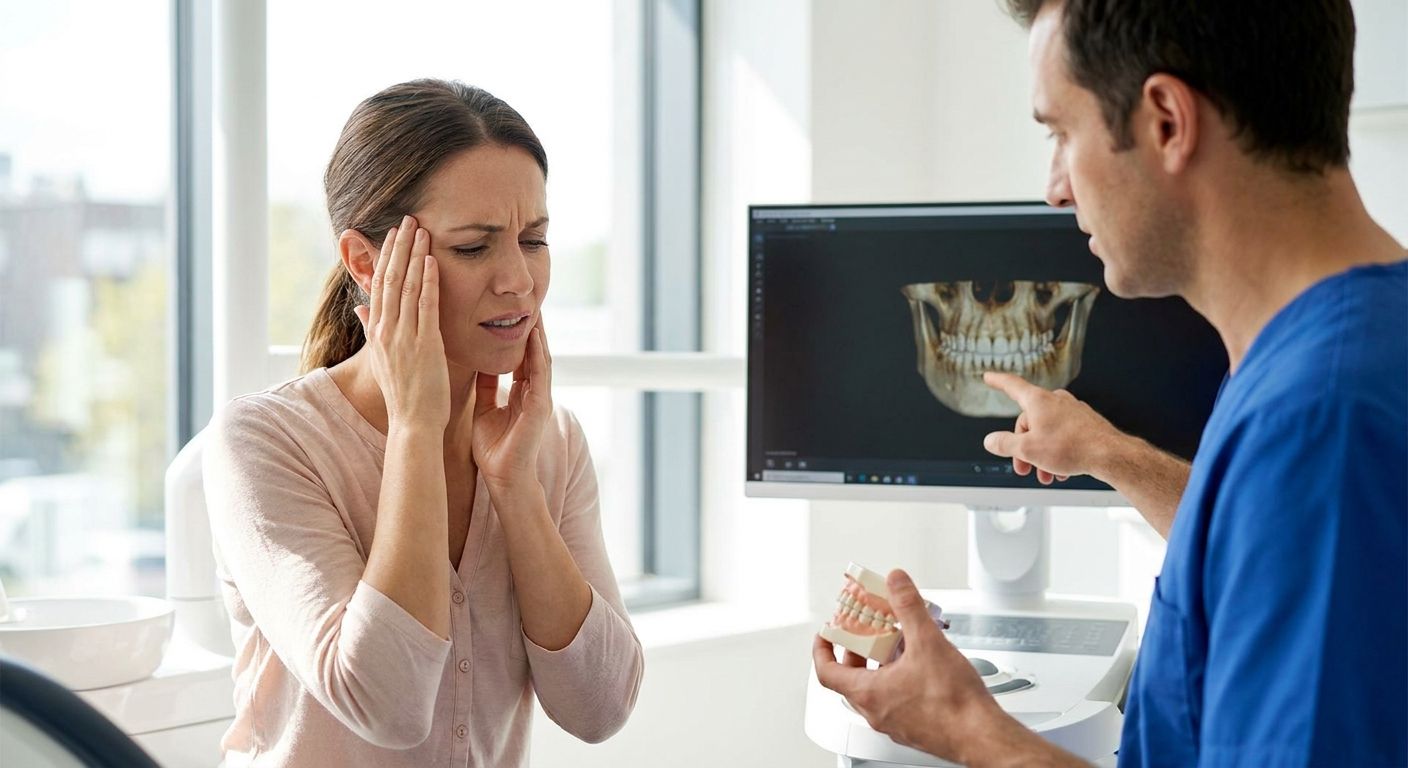
Waking up with a dull ache at your temples, tenderness along your jaw, and a habit of clenching your teeth during the day are the clearest signs your bite is behind your headaches, not a typical tension headache. The giveaway most people miss: bite-related headaches concentrate at the temples or behind the eyes and often ease within minutes once you consciously unclench your jaw — a plain tension headache usually doesn't respond that fast.
- Bite causing headaches shows up as temple pain, morning jaw soreness, and clicking that a normal headache never has.
- Worn or flattened teeth and cheek indentations are physical evidence of nighttime grinding tied to headaches.
- A custom night guard from Dental Arts of Atlantis addresses the bite mechanics, not just the pain.
- TMJ disorders affect an estimated 5% to 12% of adults, according to the National Institute of Dental and Craniofacial Research.
- If headaches cluster around your jaw and ears rather than your whole head, get a bite evaluation before treating it as migraine.
Why this matters
Most people treat recurring headaches as a neurological problem and never mention their jaw. But the muscles that close your bite — the temporalis and masseter — sit directly beside your temple and connect straight into headache territory. When those muscles overwork from clenching or an uneven bite, the pain reads exactly like a tension headache or a mild migraine, and people spend years managing it with pain relievers instead of a mouthguard.
Getting this diagnosis wrong costs time. A TMJ treatment for chronic jaw pain and headaches addresses the actual mechanical cause, while over-the-counter pain relief only masks the muscle strain that keeps rebuilding every night.
How to know if your bite is causing your headaches
Run through this checklist. The more boxes you check, the more likely your bite — not stress or dehydration alone — is driving the pain.
| Sign | Bite-related headache | Typical tension headache |
|---|---|---|
| Location | Temples, behind the ears, sometimes behind the eyes | Band across the whole forehead or scalp |
| Timing | Worst right after waking up | Builds later in the day, often with stress |
| Jaw symptoms | Clicking, popping, or a tight jaw on waking | None |
| Teeth | Flattened edges, chips, or new sensitivity | No dental change |
| Cheek/tongue | Scalloped tongue edges, cheek ridges from clenching | Not present |
| Response to jaw rest | Eases when you relax your jaw muscles | No change |
If you're checking three or more boxes in the left column, your headache pattern points to your bite mechanics, not a standard tension or stress headache.
Physical signs your dentist will look for
- Worn or flattened molars from grinding pressure applied over months of sleep.
- A clicking or popping jaw joint when you open wide or chew.
- Limited jaw opening — struggling to fit three stacked fingers between your front teeth.
- Tenderness when pressing on the muscle just in front of your ear.
- Indentations on your tongue or the inside of your cheek from constant clenching against your teeth.
None of these signs require an X-ray to notice. Most patients spot two or three of them once they know to look.
“If your headache sits at your temples and eases the moment you stop clenching, the problem is your bite, not your head.”
Why bite-related headaches vary from person to person
Not everyone with a misaligned bite gets headaches, and severity swings widely. The drivers behind that variation:
- Stress load — clenching intensifies during high-stress weeks, which is why headaches often spike during work deadlines or family stress.
- Missing or shifted teeth — even one missing molar changes how force distributes across your jaw joint.
- Sleep position — stomach sleepers put more direct pressure on the jaw than back sleepers.
- An existing bite misalignment — an overbite, underbite, or crossbite forces the jaw muscles to work harder just to close comfortably.
- Old dental work — a crown or filling that sits slightly high changes how your teeth meet and can trigger clenching without you noticing.
- Caffeine and alcohol intake — both are known to increase nighttime muscle tension in people already prone to grinding.
Can a night guard stop headaches caused by teeth grinding?
A night guard reduces bite-related headaches by keeping your teeth from making full contact while you clench, which lowers the strain on your jaw muscles overnight. Custom-fit night guards for teeth grinding and jaw pain sit more precisely than store-bought versions and get rechecked at routine visits — most dentists recommend a fit check twice a year, in line with standard six-month cleaning schedules.
How long does it take for TMJ-related headaches to improve?
TMJ-related headaches typically ease once the underlying muscle overuse is addressed, though the timeline depends on how long the clenching pattern has been in place and how consistently a night guard or bite adjustment is worn. Patients who wear a guard nightly report noticing less morning jaw tightness before the headache frequency itself drops.
Is jaw-related headache pain worse in the morning or at night?
Jaw-related headache pain is almost always worse in the morning, because most clenching and grinding happens during sleep and the muscles are fatigued by the time you wake up. Headaches that build progressively through the day and peak in the evening point more toward stress or eye strain than a bite problem.
What to do before your dentist visit
You don't need to wait for an appointment to get some relief. A few things you can try at home tonight:
- Apply a warm compress to the jaw muscle for 10 minutes before bed.
- Avoid chewy or hard foods for a few days to rest the joint.
- Practice keeping your teeth apart and lips closed during the day — a habit called "lips together, teeth apart."
- Massage the muscle just in front of your ear in small circles.
Full guidance, including which stretches actually calm the joint, is in how to relieve TMJ pain at home before your dentist visit. None of this replaces a bite evaluation — it just buys comfort until you get one.
For patients who clench heavily and don't tolerate a guard well, Botox injected into the jaw muscle is another route dentists use to calm chronic tension; details are in Botox for jaw clenching and TMJ tension.
Get your bite checked in 2026
A short exam shows whether your bite is driving your headaches.
FAQ
How do I know if my headaches are from my bite or from stress?
Bite-related headaches concentrate at the temples and are worst right after waking, while stress headaches tend to build through the day across the whole forehead. Jaw clicking, morning jaw soreness, or worn teeth point toward a bite cause.
Can a bad bite cause daily headaches?
Yes, a misaligned bite that forces constant jaw muscle overuse can trigger headaches every day, especially in the morning. The pattern usually improves once the bite is corrected or a night guard reduces the clenching force.
What does a TMJ headache feel like?
A TMJ headache feels like a tight, aching pressure at the temples or behind the ears, often paired with a stiff or clicking jaw. It’s different from a migraine because it eases when you relax your jaw muscles.
Does grinding your teeth at night cause headaches?
Yes, nighttime grinding overworks the jaw muscles for hours, which produces morning headaches concentrated at the temples. A custom night guard is the standard first response.
Should I see a dentist or a doctor for jaw-related headaches?
See a dentist first, since bite alignment, worn teeth, and jaw joint mechanics are dental issues that a physician typically won’t examine. A dentist can also rule out whether the pain is dental at all before referring you further.
Can Invisalign fix headaches caused by a misaligned bite?
Invisalign can reduce bite-related headaches when the misalignment itself is the root cause, by gradually moving teeth into a position that distributes bite force evenly. It won’t help headaches caused purely by stress-driven clenching without a structural bite issue.
How common are TMJ disorders?
TMJ disorders affect an estimated 5% to 12% of adults, according to the National Institute of Dental and Craniofacial Research. Most cases involve some combination of jaw pain, clicking, and headaches.
Is a night guard the same as a retainer?
No, a night guard is thicker and designed to absorb grinding force between all of your teeth, while a retainer only holds teeth in position after orthodontic treatment. Wearing a retainer instead of a night guard won’t reduce clenching-related headaches.
One last thing
The detail most patients never connect: your bite involves all 28 to 32 teeth working as one system, so a single high filling or one missing molar can shift force onto the jaw joint and produce headaches years later with no other symptom. If your headaches started after a dental procedure, mention that timing at your next visit — it's often the fastest way to find the cause.
Related guides