
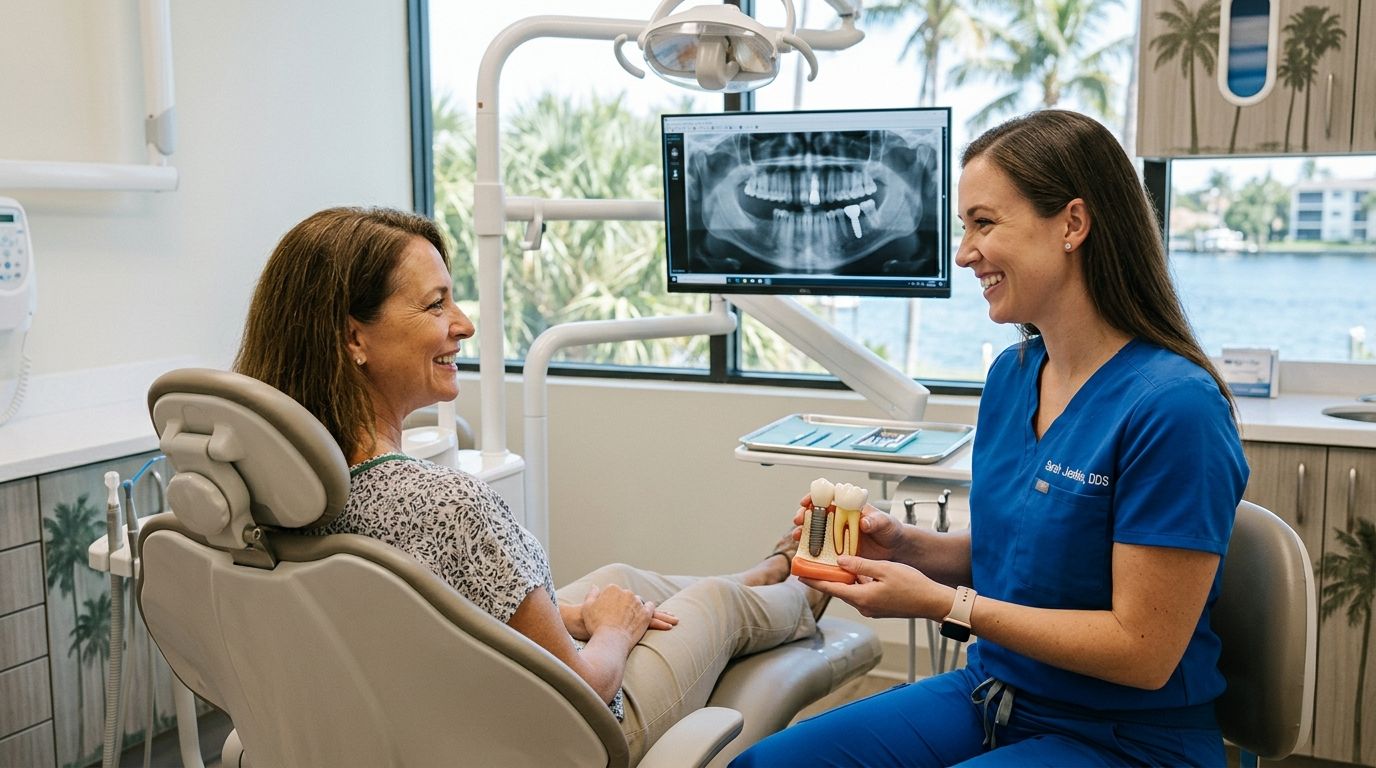
Dental implants for Lake Worth, Florida patients replace a missing tooth root with a titanium post and a fixed crown, built to hold up under a subtropical climate, year-round sun exposure, and a population split between full-time residents and seasonal snowbirds. Palm Beach County's retiree-heavy demographic means more patients arrive with osteoporosis, blood thinners, or years of denture wear — all factors that change how an implant case gets planned.
- Dental implants lake worth patients choose most often are single-tooth implants and All-on-4 for a full arch.
- Bone density and current medications decide candidacy more than age alone in 2026.
- Snowbird patients need two visits scheduled months apart, not a one-trip fix.
- Financing options exist for uninsured families since implants are rarely fully covered.
Why dental implants matter for Lake Worth patients
Lake Worth sits in a part of Palm Beach County with a large population of retirees and seasonal residents, which means implant planning has to account for medical histories that a 30-year-old in a different market wouldn't bring to the chair. Osteoporosis medication, blood thinners, and long-term denture wear are common enough locally that dental implants for patients with osteoporosis and dental care for patients on blood thinners are their own consult topics rather than footnotes.
The seasonal population shift also matters. Snowbirds who split time between Florida and a northern home need a treatment timeline that survives a six-month gap, not a plan that assumes weekly follow-ups. Getting the sequence right in 2026 means fewer redo appointments and fewer surprises when a patient returns in November to find their temporary crown has shifted.
Confirm you're a candidate before assuming anything
Most adults with a missing tooth and healthy gums qualify, but a handful of factors change the plan.
- Get a current panoramic X-ray to check bone volume at the site
- Disclose osteoporosis medications (bisphosphonates) before any surgical consult
- Flag blood thinner use so the surgical team can plan around bleeding risk
- Confirm gum disease is controlled — active infection delays implant placement
- Ask whether smoking status affects healing time, since it does
Assess bone density before picking an implant type
Bone loss at the extraction site is the single biggest reason implant plans change mid-course. A thin ridge that looked fine on a visual exam sometimes needs grafting once the scan comes back.
- Request a 3-D scan rather than a 2-D X-ray for an accurate bone map
- Ask how much bone width is needed for a standard-diameter implant
- Find out if bone grafting for dental implants with low bone density adds to the healing timeline in your case
- Compare standard implants against narrower mini implants if bone volume is limited
- Ask whether a same-day implant is even realistic given your bone density, or if grafting comes first
Choose the right implant type for your case
One missing tooth, several missing teeth in a row, and a full arch of missing teeth are three different procedures with different implant counts and healing timelines. Dental Arts of Atlantis walks patients through which category they fall into before quoting a plan, because guessing wrong here means redoing imaging and paperwork later.
- Single tooth: one implant, one crown, shortest healing window
- Several teeth in a row: a short bridge anchored on two implants instead of one per tooth
- Full arch: best implant type for a full arch of missing teeth usually points to four to six implants supporting a fixed bridge
- Loose denture: mini dental implants stabilize an existing denture without a full rebuild
- Denture wearer ready for fixed teeth: All-on-4 replaces the removable denture with an implant-supported bridge
Plan around insurance and financing
Dental insurance rarely covers implants at more than a partial rate, and most Lake Worth families end up paying out of pocket for at least part of the case. Sorting this out before surgery avoids a mid-treatment stall.
- Ask the practice to break the case into phases with separate cost estimates per phase
- Check whether your plan covers the crown portion even if it excludes the implant post
- Look into how to finance dental implants without insurance before assuming the case is out of reach
- Ask about membership plans if you're uninsured and want predictable annual costs
- Confirm whether a payment plan spans the full treatment timeline or just the surgical visit
Schedule around snowbird season
Patients who split the year between Lake Worth and a northern state need a different calendar than a full-time local. Implant placement and the final crown are usually three to six months apart to allow the bone to fuse to the post — a timeline that has to survive travel.
- Book placement early in the Florida season so healing overlaps with your time in-state
- Ask whether a temporary restoration can bridge the gap if you'll be away when the crown is ready
- Confirm your home dentist can handle a minor issue if something comes up out of season
- Build in a buffer week around your return date in case of a scheduling shift
Prepare for the surgical appointment
Most implant placements happen under local anesthesia with sedation options for anxious patients, and knowing what to expect cuts down on day-of stress.
- Arrange a ride home if you're using any sedation beyond local anesthesia
- Stock soft foods for the first several days after placement
- Ask specifically what how to prepare for your first dental implant consultation covers so nothing is a surprise on surgery day
- Confirm which medications to pause beforehand, especially blood thinners, only under physician guidance
Care for implants after surgery
Healing time and long-term implant survival both come down to how the first few weeks are handled.
- Rinse with a saltwater solution starting the day after surgery, not the same day
- Avoid brushing directly over the surgical site until cleared
- Watch for swelling that worsens instead of improves past day three, and call the practice if it does
- Keep follow-up appointments even if the site feels fine
Comparison: implant options for Lake Worth patients
| Option | Best for | Key limitation |
|---|---|---|
| Single-tooth implant | One missing tooth | Needs sufficient bone at the single site |
| Implant-supported bridge | Several missing teeth in a row | Requires two anchor implants minimum |
| All-on-4 implants | Full arch, moving off a removable denture | Grafting may still be needed with very low bone density |
| Mini dental implants | Stabilizing a loose denture | Narrower post carries less bite load than standard implants |
| Implant plus bone graft | Low bone density from osteoporosis or long-term tooth loss | Adds months of healing before the implant goes in |
Dental Arts of Atlantis works best for Lake Worth patients who need a full evaluation before committing to an implant type — the practice sorts candidacy, bone density, and financing in one consult rather than three separate ones.
Start your implant consultation
Get a bone density check and a treatment plan before you commit to a timeline.
Common mistakes Lake Worth patients make
- Booking placement too close to leaving for the season. A three-to-six month healing window doesn't compress just because a flight is booked.
- Skipping the bone density scan and assuming a standard implant will fit. Thin ridges show up on 3-D imaging, not always on a visual exam.
- Not disclosing osteoporosis medication or blood thinners before the surgical consult. Both change how the procedure is planned, not just how it's billed.
- Comparing implant types by price alone. Mini implants cost less to place but carry less load than standard implants — the wrong choice for a full arch.
- Assuming insurance covers the whole case. Most Palm Beach County plans cover only a portion, and financing needs to be sorted before surgery, not during it.
FAQ
What’s the best dental implant option for one missing tooth in Lake Worth?
A single-tooth implant with a fixed crown is the standard option for one missing tooth in 2026, provided there’s enough bone at the site. Patients with thin bone may need a small graft first.
Is a bone graft always required before a dental implant?
No — bone grafting is only needed when a 3-D scan shows insufficient bone width or height at the implant site. Many single-tooth cases proceed without one.
How long does dental implant healing take?
Standard healing between placement and the final crown runs three to six months to allow the implant to fuse to the jawbone. Snowbird patients should plan their travel calendar around this window.
Are dental implants covered by insurance in Florida?
Most dental insurance plans cover implants only partially, if at all, and coverage varies by plan. Financing plans exist specifically for the uninsured portion of implant treatment.
Can patients with osteoporosis get dental implants?
Many patients on osteoporosis medication can still get implants, but the type of medication and how long it’s been used affects the plan. This gets flagged during the candidacy evaluation, not after.
What’s the difference between All-on-4 and implant-supported dentures?
All-on-4 replaces a full arch with a fixed bridge anchored on four implants, while an implant-supported denture is typically removable and snaps onto a smaller number of implants. All-on-4 suits patients ready to leave removable dentures behind entirely.
Do smokers qualify for dental implants?
Smoking slows healing and raises the risk of implant failure, but it doesn’t automatically disqualify a patient. Case-by-case evaluation determines whether extra precautions or a longer healing window apply.
How much does dental implant aftercare involve?
Aftercare in the first weeks means saltwater rinses, avoiding the surgical site while brushing, and soft foods. Long-term care is closer to caring for a natural tooth — regular brushing, flossing, and checkups.
One last thing
The detail most Lake Worth patients miss isn't the surgery — it's the gap between placement and the final crown. A three-to-six month healing window means a snowbird who places an implant in January and leaves in April may need a temporary restoration that survives travel, not just a healed surgical site. Ask about that timeline in the first consultation, not the second.
Related guides
- Dental implants for one missing tooth
- Dental implants for seniors missing multiple teeth
- Dental implants for smokers
- How to know if you're a candidate for same-day implant teeth
- How to care for dental implants after surgery