
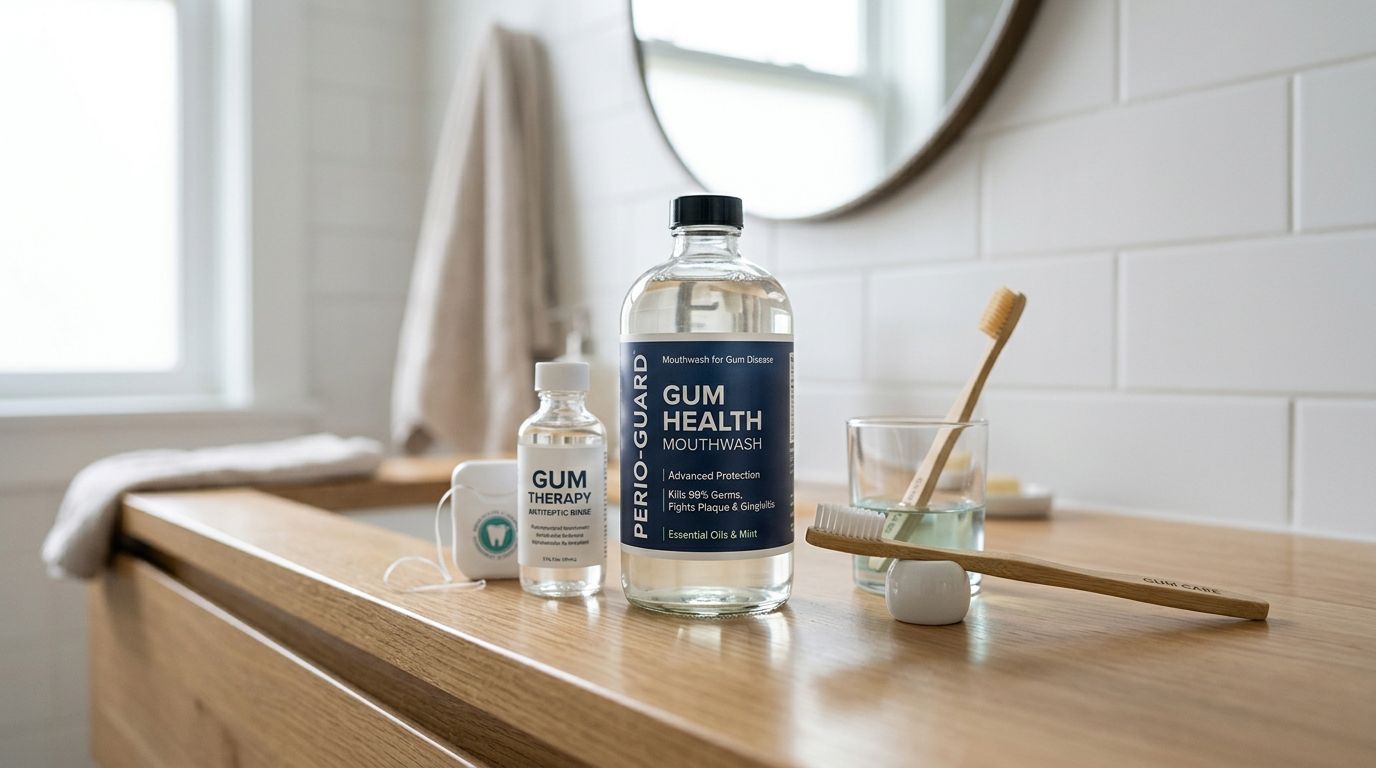
Chlorhexidine gluconate 0.12% prescription rinse is the best mouthwash for gum disease when a dentist has diagnosed active periodontal disease, while Listerine Antiseptic Original is the strongest over-the-counter option for daily plaque control in 2026.
- Chlorhexidine gluconate 0.12% (Peridex/PerioGard) is the best mouthwash for gum disease when periodontitis is active and prescribed short-term.
- Listerine Antiseptic Original is the top OTC pick for daily gingivitis and plaque control without a prescription.
- Crest Pro-Health Advanced suits patients dealing with gum recession and root sensitivity after scaling.
- CloSYS Sensitive works best for diabetic patients and anyone with dry mouth who cannot tolerate alcohol-based rinses.
- No mouthwash replaces a professional deep cleaning; rinsing controls bacteria between visits, it does not remove tartar.
Why this matters
Gum disease does not announce itself with pain until it is already destroying bone. CDC periodontal surveillance data puts the share of US adults 30 and older with some form of gum disease at 42%, and most of them do not know it yet. Catching early signs of gum disease at home — bleeding gums, persistent bad breath, receding gumline — changes what a mouthwash can actually do for you.
Mouthwash is not a substitute for a professional cleaning or a periodontal evaluation. It is a bacterial-control tool that either supports a treatment plan or maintains gum health after one. Picking the wrong formula wastes money and, in the case of long-term chlorhexidine use, stains teeth for nothing.
What makes the best mouthwash for gum disease
- Proven active ingredient — chlorhexidine gluconate, cetylpyridinium chloride (CPC), stannous fluoride, or essential oils, each with documented anti-gingivitis data
- ADA Seal of Acceptance or FDA-recognized status — confirms the formula was tested for the claim on the label
- Alcohol content — alcohol-free formulas matter for dry mouth, diabetic patients, and anyone on medications that reduce saliva
- Fit with a treatment plan — prescription rinses are built for short courses, not permanent daily use
- Staining risk — chlorhexidine and some essential-oil rinses discolor teeth with extended use
- Taste tolerance — a rinse nobody wants to use twice a day does not help anyone's gums
Gum disease mouthwash at a glance
| Mouthwash | Best for | Standout feature | Key limitation |
|---|---|---|---|
| Chlorhexidine gluconate 0.12% (Peridex/PerioGard) | Active periodontal treatment | Strongest documented plaque reduction | Prescription only; short-term use due to staining |
| Listerine Antiseptic Original | Daily OTC gingivitis control | ADA-accepted essential oil formula | High alcohol content, strong taste |
| Crest Pro-Health Advanced | Gum recession and root sensitivity | Stannous fluoride handles sensitivity and gums together | Metallic aftertaste for some users |
| CloSYS Sensitive | Diabetic patients and dry mouth | Alcohol-free, gentle enough for daily long-term use | Milder plaque reduction than chlorhexidine |
| TheraBreath Healthy Gums | Chronic bad breath tied to gum disease | CPC formula targets sulfur-compound odor | Does not treat deep pocket infection alone |
1. Chlorhexidine gluconate 0.12%: best mouthwash for active periodontal treatment
Chlorhexidine gluconate, sold under names like Peridex and PerioGard, is the prescription rinse dentists reach for after scaling and root planing or in stubborn gingivitis cases. It binds to oral tissue and keeps working for hours after you spit, which is why it outperforms nearly everything else on plaque reduction.
It is not a forever product. Dentists prescribe it in short courses tied to a specific treatment window, not as a daily 2026 habit.
Chlorhexidine pros:
- Strongest documented reduction in plaque and gingival inflammation
- Pairs directly with gum disease treatment for early-stage periodontitis
- Prescription oversight means a dentist tracks your response
Chlorhexidine cons:
- Stains teeth and can alter taste perception with extended use
- Requires a prescription, so there is no grabbing it off a shelf
- Not intended for indefinite daily use
Best for: patients mid-treatment for gingivitis or early periodontitis under a dentist's direction. Verdict: Buy when it is part of an active plan; Skip for casual maintenance.
2. Listerine Antiseptic Original: best over-the-counter mouthwash for daily plaque control
Listerine Antiseptic Original carries the ADA Seal of Acceptance for reducing plaque and gingivitis, and it is the most studied over-the-counter essential-oil rinse available in 2026. The formula uses thymol, eucalyptol, menthol, and methyl salicylate to break down bacterial cell walls.
It is everywhere and needs no appointment to start, which makes it the default recommendation for maintaining gum health between cleanings.
Listerine pros:
- No prescription required
- ADA-accepted for gingivitis and plaque reduction
- Easy to keep in a twice-daily routine
Listerine cons:
- High alcohol content stings and is not tolerated by everyone
- Strong taste leads to inconsistent use for some patients
- Does not match chlorhexidine in active, diagnosed disease
Best for: adults maintaining healthy gums or managing mild gingivitis without a prescription. Verdict: Buy for daily OTC maintenance.
3. Crest Pro-Health Advanced: best mouthwash for gum recession and root sensitivity
Stannous fluoride rinses do two jobs at once: they fight the bacteria behind gingivitis and calm sensitivity where roots are exposed. That matters once recession sets in, which is why it belongs in the same conversation as how to treat gum recession before it gets worse.
Stannous fluoride formulas have improved since the older versions that left a heavy metallic aftertaste, but some people still notice it.
Crest Pro-Health pros:
- Addresses sensitivity and gum inflammation in one rinse
- Fluoride adds cavity protection on exposed root surfaces
- Alcohol-free versions available
Crest Pro-Health cons:
- Metallic taste bothers a share of users
- Less aggressive against active pocket infection than chlorhexidine
- Mild surface staining risk with heavy daily use
Best for: patients with recession, exposed roots, or sensitivity after a deep cleaning. Verdict: Buy for recession-related sensitivity.
4. CloSYS Sensitive: best mouthwash for diabetic patients and dry mouth
Blood sugar control and gum health move together in both directions, which makes gum disease management for diabetic patients a daily routine rather than a one-time fix. CloSYS uses a pH-balanced, alcohol-free formula that does not dry out tissue that is already compromised.
Alcohol-based rinses can make dry mouth worse, and dry mouth is common with diabetes and with dozens of prescription medications. CloSYS sidesteps that entirely.
CloSYS pros:
- Alcohol-free and gentle enough for long-term daily use
- Does not sting or worsen dry mouth
- Neutral taste improves compliance
CloSYS cons:
- Milder plaque reduction than chlorhexidine or essential-oil rinses
- Not a substitute for treatment in advanced periodontitis
- Needs consistent daily use to show benefit
Best for: diabetic patients, dry mouth sufferers, and anyone who cannot tolerate alcohol-based rinses. Verdict: Buy for long-term gentle maintenance.
5. TheraBreath Healthy Gums: best mouthwash for bad breath tied to gum disease
Breath that will not improve is often a gum disease symptom, not a hygiene failure. TheraBreath Healthy Gums uses cetylpyridinium chloride to neutralize the sulfur compounds bacteria produce inside periodontal pockets, rather than covering the smell with mint.
It is the narrowest pick here. It works best alongside a primary rinse or as a maintenance step once treatment is done.
TheraBreath pros:
- Targets sulfur-compound odor at the source
- Alcohol-free
- Does not rely on a temporary mint mask
TheraBreath cons:
- Does not treat deep pocket infection by itself
- Narrower use case than the other four rinses
- Only works paired with brushing, flossing, and cleanings
Best for: patients whose main complaint is chronic bad breath linked to gum inflammation. Verdict: Hold as a standalone fix; Buy as an add-on.
How we ranked these
Every rinse was scored against the same six criteria: documented anti-gingivitis effect, ADA or FDA-recognized status, alcohol content, staining risk, taste tolerance, and fit with an active treatment plan versus daily maintenance. Chlorhexidine wins on raw data and loses points for being a short-course prescription tool. Listerine and CloSYS split the daily-use lane by alcohol tolerance. Crest Pro-Health and TheraBreath fill narrower jobs — sensitivity and odor — that the broader rinses handle poorly.
Get your gums evaluated first
Know which stage of gum disease you are dealing with before you pick a rinse.
Which mouthwash for gum disease should you choose?
If a dentist just diagnosed active disease, chlorhexidine gluconate 0.12% is the right call for the prescribed window, then move off it. For daily maintenance without a prescription, Listerine Antiseptic Original covers the most ground in 2026. Diabetic patients and anyone with dry mouth should default to CloSYS Sensitive instead of fighting an alcohol burn twice a day.
None of these replace scaling and root planing once tartar has hardened below the gumline. A rinse manages bacteria between visits. It does not remove what has already calcified onto the root.
“The strongest rinse on this list is the one you should use the least often.”
FAQ
What is the best mouthwash for gum disease in 2026?
Chlorhexidine gluconate 0.12% is the strongest option for active periodontal disease and is prescribed short-term by a dentist. For daily over-the-counter use, Listerine Antiseptic Original carries the ADA Seal for plaque and gingivitis control.
Can mouthwash alone cure gum disease?
No. Mouthwash reduces bacteria between brushing and cleanings, but it cannot remove hardened tartar below the gumline. Active gum disease needs a dental evaluation and usually a deep cleaning.
Is chlorhexidine mouthwash better than Listerine for gum disease?
Chlorhexidine shows stronger plaque and gingivitis reduction, but it is meant for short courses because it stains teeth. Listerine is the better long-term daily choice for most people.
Why does chlorhexidine mouthwash stain teeth?
Chlorhexidine binds to tooth surfaces and oral tissue so it keeps working for hours, and that same binding picks up staining compounds from coffee, tea, and red wine. Dentists limit the course length to manage it.
What mouthwash is safe for diabetic patients with gum disease?
Alcohol-free, pH-balanced rinses such as CloSYS Sensitive are better tolerated by diabetic patients. Alcohol-based formulas can worsen the dry mouth that often comes with diabetes and its medications.
Does alcohol-free mouthwash work as well for gum disease?
Alcohol-free formulas using CPC or chlorine dioxide reduce plaque, though generally less aggressively than chlorhexidine or high-alcohol essential-oil rinses. They are the better daily choice for sensitive tissue or dry mouth.
How long can you use chlorhexidine mouthwash?
Chlorhexidine is prescribed for a short course tied to a specific treatment, not for ongoing daily use. Extended use raises the risk of tooth staining and altered taste.
Can mouthwash fix bad breath caused by gum disease?
CPC rinses like TheraBreath Healthy Gums neutralize the sulfur compounds bacteria produce in gum pockets, which helps. Chronic bad breath tied to gum disease still needs the underlying infection treated.
One last thing
Most patients get the strength question backwards. They reach for the gentlest daily rinse when they need a prescription-strength course, or they stay on chlorhexidine for months and stain their teeth for no added benefit. Match the rinse to where you are in treatment in 2026, not to which label sounds toughest. If your gums bleed when you floss, the rinse aisle is the wrong place to start — a periodontal exam is.
Related guides
- Best deep cleaning schedule for gum disease patients
- How to protect your heart health by treating gum disease