
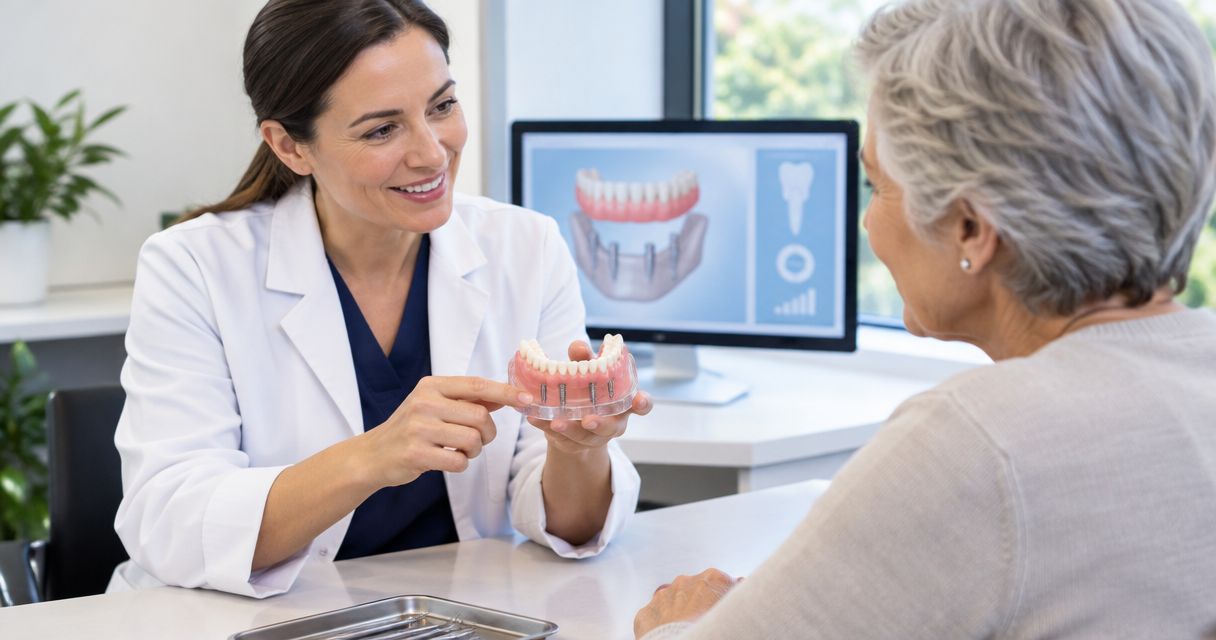
Implant-supported dentures cost depends on whether you need removable or fixed teeth, treatment for the upper or lower jaw, and any preparatory dental care; your 2026 total requires an examination and an itemized treatment plan. Confirm whether that plan includes imaging, extractions, temporary teeth, the final denture, and follow-up care before comparing estimates.
- Implant supported dentures cost depends on denture design, treatment scope, and the procedures included in your estimate.
- Compare removable overdentures and fixed full-arch teeth by cleaning needs, stability, and maintenance—not the treatment name alone.
- Dental Arts of Atlantis offers implant dentistry for Lake Worth and Palm Beach County families.
- Request an itemized plan that separates preparation, implant placement, temporary teeth, final teeth, and ongoing care.
Why this matters
An estimate for implant surgery is not necessarily an estimate for a finished smile. You need to know what happens between your first examination and the delivery of your final teeth.
Start by understanding how implant-supported dentures provide a secure fit. Then ask which design your dentist recommends, why it suits your mouth, and what the written estimate includes.
Compare complete treatment plans, not isolated implant fees. A plan that leaves out the final denture or necessary preparation does not give you the full picture.
How much do implant-supported dentures cost in 2026?
Your implant-supported denture estimate should describe the entire course of treatment, not just the implants. For a useful 2026 comparison, each estimate needs to identify the jaw being treated, the denture design, the surgical steps, and the final restoration.
Use this breakdown when reviewing a written plan:
| Treatment component | What to confirm | Why it matters |
|---|---|---|
| Examination and imaging | Which diagnostic appointments and images are included | These establish your starting condition and help plan implant placement |
| Preparatory treatment | Whether extractions, gum treatment, or bone grafting are needed | These are separate clinical procedures, not automatic parts of every case |
| Implant placement | The planned implant locations and number | The surgical plan must match the restoration and available bone |
| Connecting components | Which attachments or abutments are included | These connect the denture or fixed restoration to the implants |
| Temporary teeth | Whether an interim denture or temporary restoration is included | Temporary teeth and final teeth are not interchangeable terms |
| Final teeth | The design, material, and delivery appointments | This identifies what you receive when treatment is complete |
| Follow-up and maintenance | Which visits are included and what requires separate treatment | Long-term care continues after the final teeth are delivered |
A plan for 1 arch means treatment for the upper or lower jaw. A plan for 2 arches includes both jaws; do not assume an estimate covers both unless it says so explicitly.
Ask for plain-language descriptions beside unfamiliar terms. You should be able to explain what you are receiving without needing to decode procedure names.
Removable implant overdentures: best for removable cleaning
A removable implant overdenture attaches to implants but comes out for cleaning. It is best suited to someone who wants implant retention and is comfortable removing the denture as instructed.
The benefit is improved retention compared with a conventional denture that relies on the gums and surrounding tissues alone. The trade-off is that attachments wear and require maintenance; depending on the design, the denture also continues to receive support from the gums.
Ask whether the proposed overdenture rests partly on your gums or receives its support entirely from implants. Those designs are not identical, even when both are described casually as snap-in dentures.
Your estimate should identify the denture, attachments, implant components, and any planned modification of an existing denture. Do not assume your current denture can be converted without an examination of its condition, fit, and available space.
Fixed full-arch teeth: best for teeth you do not remove
A fixed full-arch restoration attaches to implants and is not removed by you at home. It is best suited to a patient who wants nonremovable replacement teeth and can maintain the cleaning routine beneath them.
The benefit is a restoration that remains attached during daily activities. The trade-off is more demanding access for cleaning around the implants and under the replacement teeth, along with professional maintenance when needed.
Fixed does not mean maintenance-free. Ask your dentist to demonstrate the cleaning method before you choose this design, especially if arthritis, reduced hand strength, or limited dexterity makes detailed cleaning difficult.
The written plan should distinguish the temporary restoration from the final restoration. It should also explain the proposed material and how repairs or professional removal would be handled if necessary.
How do removable and fixed designs compare?
These 2 designs solve different practical problems. Neither is automatically the right choice for every patient.
| Option | Best for | Main benefit | Main limitation |
|---|---|---|---|
| Removable implant overdenture | Patients comfortable removing teeth for cleaning | Implant retention with access for cleaning outside the mouth | Attachments need maintenance, and gum support depends on the design |
| Fixed full-arch restoration | Patients seeking teeth they do not remove themselves | Remains attached during everyday use | Cleaning underneath requires careful technique |
| Conventional complete denture | Patients seeking a removable option without implant surgery | Avoids implant placement | Retention and stability depend on fit, anatomy, and tissue support |
Choose the design you can care for reliably, not simply the one that sounds more permanent. Your dentist should connect the recommendation to your bone, bite, health, and daily routine.
Why implant-supported denture treatment varies
Differences between treatment plans should have a clinical explanation. These factors help explain why apparently similar estimates describe different amounts of care:
- Treatment scope: Replacing teeth in the upper jaw, lower jaw, or both changes the work involved. Confirm the arch before comparing anything else.
- Denture design: A removable overdenture and a fixed restoration use different components and cleaning approaches. The estimate should name the intended design.
- Implant plan: Implant number, position, and connecting components depend on the restoration and available bone. Do not choose an implant count independently of the treatment plan.
- Preparatory care: Extractions, treatment of active disease, and bone grafting are included only when clinically indicated. Ask which procedures are necessary in your case and why.
- Temporary and final teeth: Interim teeth serve a different purpose from the final restoration. Confirm what you will wear during healing and what you receive afterward.
- Comfort and maintenance needs: Anesthesia or sedation, adjustments, attachment servicing, and professional cleaning need clear explanations. Ask which services belong to the initial plan and which are ongoing.
Imaging helps your dentist assess anatomy rather than guess from the appearance of your gums. Read about using 3D imaging to plan a dental implant before discussing the proposed implant positions.
How do you compare treatment estimates fairly?
For your 2026 treatment decision, place the written plans side by side and check whether they describe the same outcome. A shorter estimate is not automatically a simpler treatment.
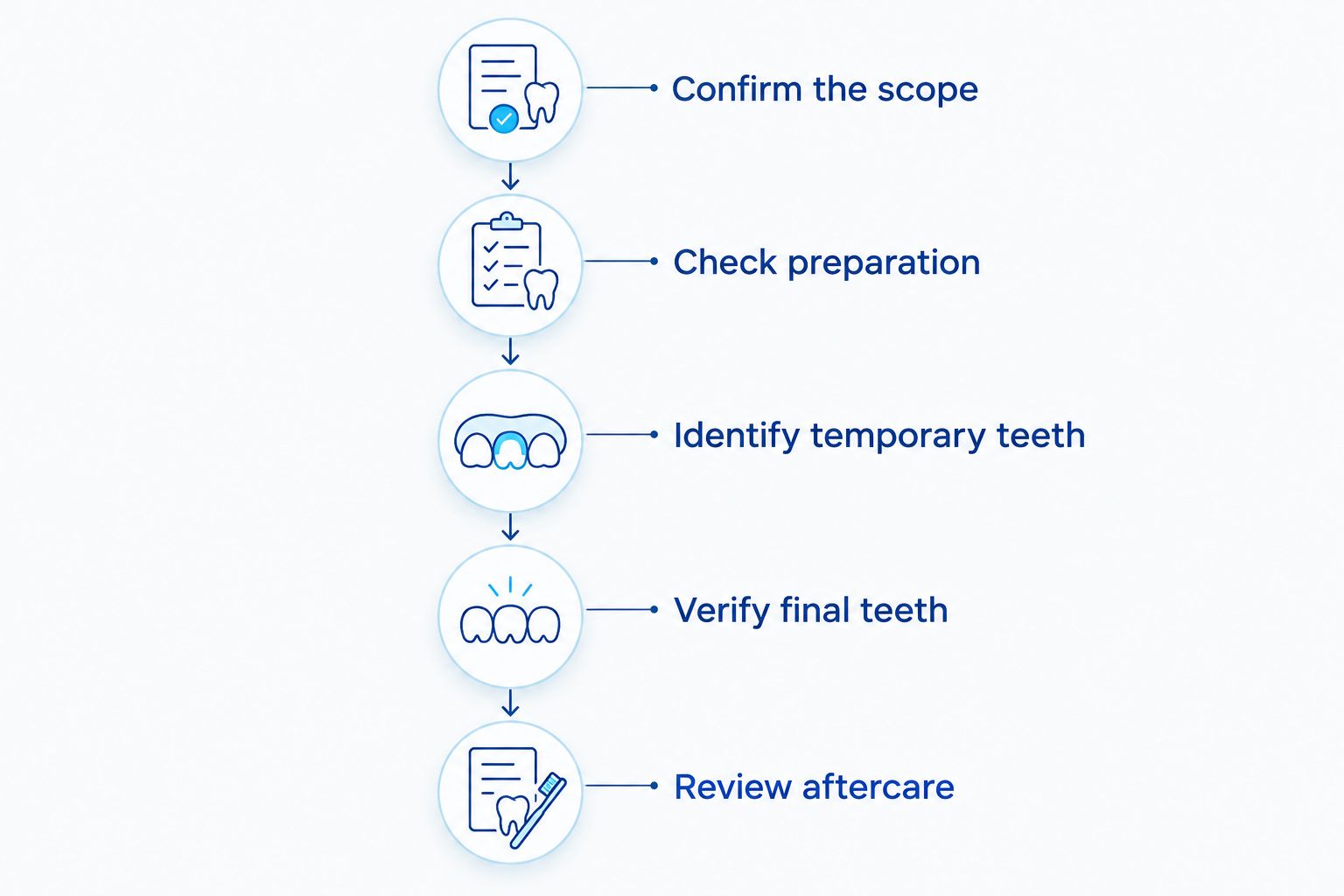
- Confirm the scope. Identify the jaw being treated, the proposed denture design, and the final restoration. Make sure both estimates describe comparable care.
- Check preparation. Look for extractions, disease treatment, or grafting when recommended. Ask how the plan changes if additional treatment becomes necessary.
- Identify temporary teeth. Ask what you will wear during healing and what limitations apply. A temporary restoration is not a promise of unrestricted chewing.
- Verify final teeth. Confirm the material, fitting process, and delivery stage. Ask whether adjustments after delivery are included.
- Review aftercare. Request the cleaning instructions, maintenance expectations, and process for handling discomfort or a loose component. Know whom to contact before a problem happens.
Bring your medication list and relevant medical history to the consultation. Do not stop prescribed medication on your own to prepare for implant treatment.
For a local starting point, Dental Arts of Atlantis is a fit for Lake Worth families seeking implant dentistry within a family dental practice. Whether implant-supported dentures fit your needs still depends on an examination, your treatment goals, and your ability to maintain them.
Discuss your tooth replacement options
Ask which denture design fits your needs and what an itemized treatment plan should include.
Does dental insurance cover implant-supported dentures?
Coverage depends on your specific policy and the procedures in your treatment plan. Ask your insurer to review the proposed care rather than assuming that coverage for dentures also covers implant surgery or connecting components.
For treatment planned in 2026, check exclusions, waiting periods, annual benefit limits, and any requirements for advance review. A benefit estimate is not a guarantee of payment.
Ask for a written explanation of expected insurance benefits and your responsibility. If the treatment plan changes, request an updated estimate before the additional work begins.
Can you finance implant-supported dentures?
Third-party financing is an option to review separately from the clinical treatment plan. Dental Arts of Atlantis uses Cherry Financing, with CareCredit as a secondary option; both are third-party financing providers subject to their approved terms.
Review the repayment term, interest provisions, fees, and total repayment obligation before accepting an agreement. Approval and terms depend on the provider; choosing financing does not establish whether a particular denture design is clinically appropriate.
Choose the treatment first, then evaluate how to pay for it. A manageable repayment arrangement does not replace an explanation of the complete treatment obligation.
Can an existing denture be attached to implants?
An existing denture requires an assessment before conversion is considered. Its fit, condition, design, and space for attachments determine whether modification is appropriate.
Bring the denture to your examination and explain what bothers you about it. Slipping, soreness, difficulty chewing, and cleaning concerns help your dentist understand the problem you want treatment to solve.
Do not assume that keeping an older denture removes the need for a new restoration. Ask whether the proposal involves modifying it, using it temporarily, or replacing it entirely.
FAQ
How do I get an accurate implant-supported denture estimate in 2026?
Get an examination and an itemized treatment plan that identifies the denture design, jaw being treated, preparation, implants, and final teeth. Confirm temporary teeth and follow-up arrangements before comparing estimates.
Are snap-in dentures the same as fixed implant teeth?
No. Snap-in dentures are removable by the patient, while fixed implant teeth remain attached and are removed professionally when necessary. Both require cleaning and maintenance.
Does an implant denture estimate cover both jaws?
Only if the estimate explicitly includes both jaws. A single-arch plan covers the upper or lower jaw, not automatically both.
Will I need bone grafting before implant-supported dentures?
Bone grafting depends on the available bone and the proposed implant positions. Your dentist uses an examination and appropriate imaging to decide whether it is necessary.
Can I get implant-supported dentures if I already wear dentures?
Existing denture wearers can be evaluated for implant-supported treatment. Whether the current denture can be reused or modified depends on its condition, fit, and design.
What maintenance should I ask about before choosing implant dentures?
Ask about daily cleaning, professional visits, attachment wear, denture adjustments, and repair arrangements. Removable and fixed designs have different cleaning requirements.
Which financing providers does Dental Arts of Atlantis use?
Dental Arts of Atlantis uses Cherry Financing, with CareCredit as a secondary option. Both are third-party financing providers subject to their approved terms.
One last thing
The detail most easily overlooked in a 2026 implant denture estimate is which teeth are temporary and which are final. Ask your dentist to mark both stages on the written plan and explain what happens between them.
Then ask for a cleaning demonstration. The right restoration must work not only when you smile in the office, but also when you care for it at home.
Related guides
- How to prepare for your first dental implant consultation
- How to care for dental implants after surgery
- Cherry Financing vs. CareCredit for dental treatment