
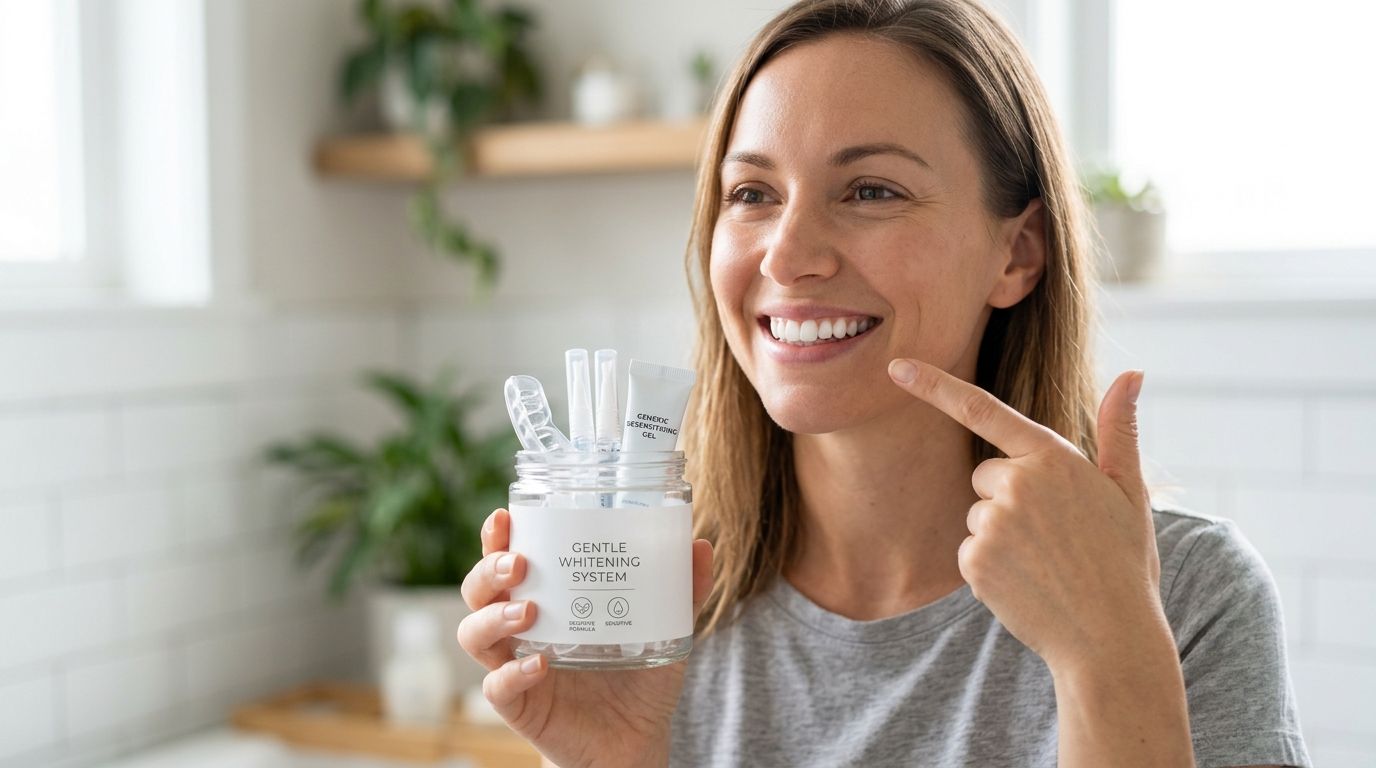
Sensitive teeth do not rule out a brighter smile in 2026, but the wrong whitening method can turn mild sensitivity into days of sharp, lingering pain. The best teeth whitening for sensitive teeth balances real results with lower peroxide exposure, desensitizing agents, and professional oversight.
- Custom take-home trays with low-concentration gel are the best teeth whitening for sensitive teeth in 2026.
- In-office whitening with a desensitizing protocol works fastest but carries a higher short-term sensitivity risk.
- Potassium nitrate toothpaste used for two weeks before whitening cuts sensitivity spikes noticeably.
- Over-the-counter whitening strips are the option to skip if your teeth are already sensitive.
- Dentist-supplied touch-up kits protect results without re-triggering sensitivity months later.
Why this matters
Whitening sensitivity happens because peroxide gel penetrates enamel and reaches the dentin layer underneath, temporarily irritating the nerve inside the tooth. If you already deal with tooth sensitivity to hot and cold, that same nerve is more reactive to any whitening chemical, not just extreme temperatures.
The fix is not avoiding whitening altogether. It is picking a method that controls concentration, exposure time, and includes a desensitizing step before and after treatment. Dental Arts of Atlantis sees this exact question from patients across Palm Beach County every month, and the answer almost always comes down to matching the method to how reactive your teeth already are.
What makes the best teeth whitening for sensitive teeth
- Lower peroxide concentration — take-home gels run lighter than in-office formulas, which means less nerve irritation.
- Desensitizing agents built in — potassium nitrate and fluoride block pain signals from reaching the nerve.
- Custom fit — trays or applications molded to your teeth avoid gel touching gum tissue, a major sensitivity trigger.
- Controlled exposure time — shorter, supervised sessions beat long unsupervised wear.
- Enamel safety over repeated use — a method should not thin enamel or worsen existing sensitivity with each round.
- Suitability for existing conditions — exposed roots, cracked teeth, or gum recession change which option is safe.
Teeth whitening options for sensitive teeth at a glance
| Option | Best for | Standout feature | Key limitation |
|---|---|---|---|
| In-office whitening with desensitizing protocol | Fast results before an event | Desensitizing gel applied before and after treatment | Higher concentration means short-term sensitivity is more likely |
| Custom take-home trays, low-concentration gel | Gradual whitening with full control | You control wear time and can pause if sensitivity spikes | Slower results, takes one to two weeks |
| Potassium nitrate toothpaste pre-treatment | Prepping mild sensitivity before any whitening | Blocks nerve pain signals over time | Not a whitening method on its own |
| Dentist-supplied touch-up kits | Maintaining results without redoing full treatment | Lower-strength gel, shorter sessions | Not designed for a first whitening round |
| Over-the-counter whitening strips | People without existing sensitivity | Widely available, no appointment needed | Uneven fit lets gel touch gums and gaps |
1. In-office whitening with a desensitizing protocol: best for a big event on short notice
Professional in-office whitening uses a stronger hydrogen peroxide gel, typically in the 25-40% range, applied under isolation so it never touches gum tissue. A desensitizing gel containing potassium nitrate or fluoride goes on before the whitening agent and again afterward to calm the nerve.
In-office whitening pros:
- Visible results in a single visit, useful before a wedding, interview, or photo shoot
- Professional isolation keeps peroxide off soft tissue
- Desensitizing step is built into the appointment, not left up to you
In-office whitening cons:
- Higher concentration means more patients report short-term zinging pain
- Requires a scheduled appointment rather than doing it on your own timeline
- Results fade faster without a touch-up plan
Best for: sensitive teeth patients who need a fast, one-time result and can tolerate a day or two of mild post-treatment sensitivity. Check the best in-office whitening option before a big event for how the desensitizing step is timed around the treatment.
Verdict: Buy if you have an event on the calendar and mild-to-moderate sensitivity that responds to standard desensitizing gel.
2. Custom take-home trays with low-concentration gel: best for long-term control
Custom trays use carbamide peroxide, generally 10-20% strength, worn for shorter daily sessions over one to two weeks. Because the concentration is lower and you control the schedule, this is the option most sensitive-teeth patients tolerate best in 2026.
Take-home tray pros:
- Lower concentration means less nerve irritation per session
- You can shorten wear time or skip a day if sensitivity flares
- Trays are molded to your teeth, so gel stays off the gums
Take-home tray cons:
- Full results take one to two weeks, not one visit
- Requires consistent daily use to reach the shade you want
- Custom trays need a dental impression first
Best for: anyone prioritizing enamel safety and gradual control over speed. The guide on how to whiten teeth safely without damaging enamel walks through pacing a take-home schedule around sensitivity.
Verdict: Buy — this is the default recommendation for sensitive teeth in 2026 unless you are on a strict deadline.
3. Potassium nitrate toothpaste pre-treatment: best prep step, not a standalone fix
Desensitizing toothpaste with potassium nitrate works by blocking the nerve's pain signal at the tooth surface. Used for roughly two weeks before starting any whitening method, it lowers the baseline sensitivity level so whichever whitening option you pick hurts less.
Desensitizing toothpaste pros:
- Reduces baseline sensitivity before whitening even starts
- Doubles as daily care for sensitivity unrelated to whitening
- No appointment needed, just a toothpaste swap
Desensitizing toothpaste cons:
- Does not whiten teeth by itself
- Needs about two weeks of consistent use to build effect
- Not a substitute for a custom-fit whitening method
Best for: patients with mild, ongoing sensitivity who want to whiten later without starting from a raw nerve. See the best toothpaste for sensitive teeth for what to look for on the label.
Verdict: Buy as a prep step ahead of either in-office or take-home whitening.
4. Dentist-supplied touch-up kits: best for protecting results without restarting
Once whitening results start fading, months after the first round, a full retreatment is not always necessary. Dentist-supplied touch-up kits use a shorter application and a lower-strength gel to maintain shade without exposing sensitive teeth to a full new cycle of peroxide.
Touch-up kit pros:
- Shorter sessions than a first-time whitening round
- Lower gel strength reduces the chance of re-triggering sensitivity
- Stretches the life of an original whitening result
Touch-up kit cons:
- Only effective if the first whitening treatment was done properly
- Will not lift heavy new staining, only maintain existing shade
- Still requires some peroxide exposure, so sensitivity is not zero risk
Best for: patients past their initial whitening who want to avoid starting sensitivity management over from scratch.
Verdict: Hold — skip this until your first whitening round has actually faded, then use it to maintain rather than restart.
5. Over-the-counter whitening strips: skip if you already have sensitive teeth
Drugstore whitening strips are not custom-fit, which means the gel often extends past the tooth surface onto gum tissue and into gaps between teeth. That uneven contact is one of the most common causes of sharp, unpredictable sensitivity, and strips give you no desensitizing step and no professional oversight if it gets bad.
Whitening strip pros:
- No appointment required
- Lower barrier to entry than professional options
- Fine for people with no history of sensitivity
Whitening strip cons:
- One-size-fits-all fit means gel contacts gums unevenly
- No desensitizing agent included in most formulas
- Harder to stop or adjust mid-treatment if pain starts
Best for: people without existing sensitivity who want a low-effort option — not this list's audience.
Verdict: Skip if you already deal with sensitive teeth in 2026.
How this list was ranked
Each option was weighed against the criteria above: peroxide concentration, whether a desensitizing agent is built in, custom fit versus one-size application, and how much control the patient has over exposure time. In-office whitening and custom trays both score well because a dentist controls the variables; strips score lowest because none of those controls exist.
One rule of thumb sums up most of this list.
“The lower the peroxide concentration and the better the fit, the less likely whitening is to trigger sensitivity.”
Which teeth whitening option should you choose?
For most sensitive-teeth patients in 2026, custom take-home trays with a low-concentration gel are the safest default — you control pacing and can stop the moment sensitivity flares. If you are working against a deadline, in-office whitening with a desensitizing protocol gets you there faster, at the cost of more short-term discomfort. Either way, two weeks of potassium nitrate toothpaste beforehand makes both options easier to tolerate, and dentist-supplied touch-up kits keep you from starting the whole process over once results fade.
Get a sensitivity-safe whitening plan
Talk through which whitening option fits your teeth before you start.
FAQ
What is the best teeth whitening for sensitive teeth in 2026?
Custom take-home trays using a low-concentration carbamide peroxide gel, typically 10-20% strength, are the best teeth whitening for sensitive teeth because you control wear time and can pause at the first sign of discomfort.
Does in-office whitening hurt more than take-home trays?
In-office whitening uses a stronger hydrogen peroxide gel, generally 25-40%, so short-term sensitivity is more common than with lower-concentration take-home trays. A desensitizing gel applied before and after the treatment reduces that risk.
How long before whitening should I start using desensitizing toothpaste?
Start potassium nitrate toothpaste about two weeks before your whitening appointment. That window gives the nerve-blocking effect time to build before peroxide exposure begins.
Are whitening strips safe for sensitive teeth?
Over-the-counter whitening strips are not custom-fit, so gel commonly contacts gum tissue and gaps between teeth, which is a common trigger for sensitivity. They suit people with no history of sensitive teeth better.
What ingredients help stop whitening sensitivity?
Potassium nitrate and fluoride are the two ingredients most commonly used to block nerve pain signals during and after whitening. Both appear in professional desensitizing gels and in over-the-counter sensitivity toothpaste.
How long does whitening sensitivity usually last?
Sensitivity from whitening is typically short-term, easing within a day or two after an in-office session or resolving between sessions with take-home trays. Sensitivity that persists beyond a few days is a reason to check in with your dentist.
Is professional whitening safer than at-home kits for enamel?
Professional whitening, whether in-office or custom take-home trays, is safer for enamel because a dentist controls concentration and exposure time. Unsupervised drugstore kits carry more risk of uneven exposure and overuse.
One last thing
The order of operations matters more than the whitening method itself: patients who spend two weeks on desensitizing toothpaste before starting any whitening report noticeably less discomfort than patients who go straight to the gel, regardless of which option they pick in 2026.
Related guides