
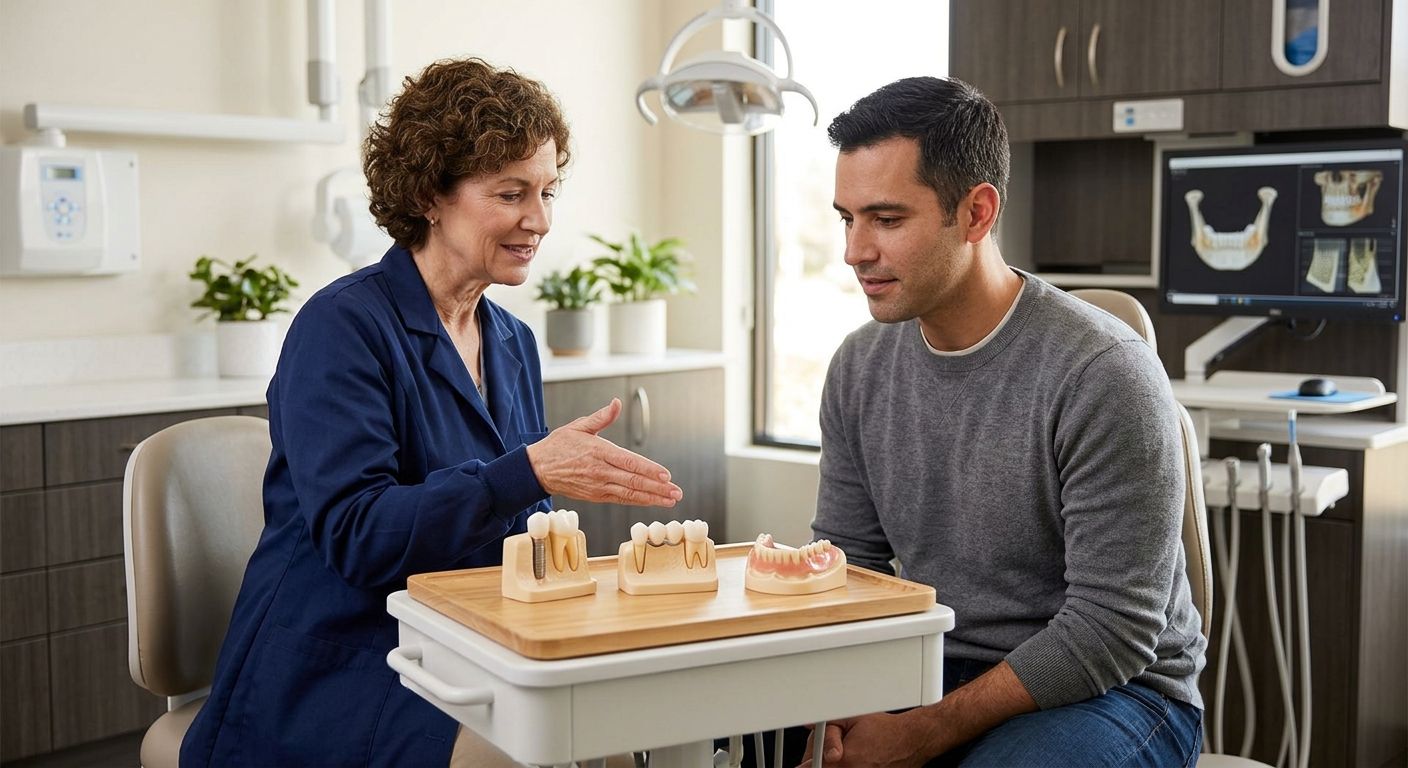
Missing one tooth? Your fastest path to a decision: a dental implant is the best overall way to replace a single missing tooth in 2026 for most healthy adults. A fixed bridge is the best option if you want a permanent fix without surgery. A removable partial denture is the best budget-conscious choice. A resin-bonded (Maryland) bridge is the best pick for a front tooth with strong, minimally-restored neighbors.
- Dental implants win on durability and jawbone health, with 95-98% ten-year success rates cited across dental research.
- Fixed bridges restore a missing tooth fast without surgery but require reshaping two healthy neighboring teeth.
- Removable partial dentures are the lowest-commitment option and the easiest to adjust if you lose more teeth later.
- Resin-bonded Maryland bridges preserve neighboring enamel but work best on front teeth with light bite force.
- The best way to replace a single missing tooth depends on bone health, budget, and how soon you want a permanent result.
Why This Matters
A missing tooth doesn't stay a cosmetic issue for long. Neighboring teeth drift into the gap, your bite shifts, and the jawbone under the empty socket starts to resorb without a root to stimulate it.
The options below aren't equally good for every mouth. Bone density, the health of the teeth next door, and how fast you need a fix all change the answer. This guide ranks four real options side by side so you can walk into a consultation already knowing what questions to ask.
Dental Arts of Atlantis in Lake Worth works through this exact decision with patients every week, and the dental implants for one missing tooth page covers what a single-tooth implant involves in more detail.
What Makes the Best Replacement for a Missing Tooth
- Bone preservation — does the option stimulate the jawbone or let it shrink over time
- Impact on neighboring teeth — does it require reshaping healthy teeth, or leave them untouched
- Durability — how many years of normal function before repair or replacement
- Speed to treatment — weeks versus months from decision to finished result
- Daily maintenance — fixed and cleaned like a natural tooth, or removed nightly
- Reversibility — can the choice be adjusted later if more teeth are lost
At a Glance
| Option | Best For | Standout Feature | Key Limitation |
|---|---|---|---|
| Dental Implant | Long-term durability and bone health | Stands alone, no reliance on neighboring teeth | Requires a minor surgical procedure and healing time |
| Fixed (Traditional) Bridge | Avoiding surgery | Restores function without an implant site | Neighboring teeth must be reshaped |
| Resin-Bonded (Maryland) Bridge | A healthy front tooth with strong neighbors | Minimal to no reduction of adjacent enamel | Bonded wing can debond under heavy bite force |
| Removable Partial Denture | Budget-conscious, adjustable solution | Least invasive, no permanent tooth alteration | Removable, and doesn't stop bone loss at the site |
1. Dental Implant: Best Missing Tooth Replacement for Long-Term Durability
A dental implant places a small titanium post into the jawbone where the root used to be, then tops it with a custom crown once it fuses to the bone. It's the only option on this list that replaces the root, not just the visible tooth.
Dental Implant pros:
- Stimulates the jawbone the way a natural root does, which slows the resorption that starts within months of losing a tooth
- Doesn't touch or weaken the teeth on either side
- Cleans and functions like a natural tooth — brush and floss normally
- Ten-year success rates around 95-98% are commonly cited in dental implant research
Dental Implant cons:
- Requires a minor surgical procedure and a healing period before the crown is placed, often 3-6 months
- Needs adequate jawbone; a thin or resorbed ridge may call for grafting first
- Not automatically bundled into standard dental insurance the way a filling is
Best for: anyone with healthy or graft-eligible bone who wants a standalone, long-term fix and doesn't want the tooth next door involved. Planning starts with imaging — see how 3-D imaging plans a dental implant for what that mapping actually shows a dentist.
Verdict: Buy. For a single missing tooth with adequate bone, this is the option that holds up longest with the fewest downstream problems.
2. Fixed Bridge: Best Missing Tooth Replacement for Avoiding Surgery
A traditional fixed bridge crowns the two teeth next to the gap, then suspends a false tooth between them. It's a well-established, non-surgical way to close a gap in a single appointment sequence.
Fixed Bridge pros:
- No surgical site to heal, which shortens the overall timeline compared to an implant
- Fixed in place — no removing it at night
- A familiar, decades-old procedure most general dentists perform routinely
Fixed Bridge cons:
- Both neighboring teeth get reshaped and capped, even if they were previously healthy
- Doesn't replace the root, so bone loss under the gap continues
- Average lifespan runs 10-15 years before the bridge itself may need replacement — see what replaces a failing dental bridge when that day comes
Best for: patients who want a fixed, non-removable result but either aren't ready for a surgical procedure or have a medical reason to avoid one right now.
Verdict: Buy if you'd rather skip surgery and your neighboring teeth are already candidates for crowns.
3. Resin-Bonded (Maryland) Bridge: Best for a Healthy Front Tooth
A Maryland bridge holds a false tooth in place with a thin metal or ceramic wing bonded to the backs of the neighboring teeth, with little to no drilling on the teeth themselves. It's most often used on front teeth, where biting forces are lighter than on molars.
Resin-Bonded Bridge pros:
- Preserves almost all of the healthy enamel on the neighboring teeth
- No surgery, and typically faster than an implant timeline
- Reversible in a way full-coverage bridges and implants aren't
Resin-Bonded Bridge cons:
- The bonded wing can pop loose under heavy chewing force
- Generally not recommended for back teeth that take the brunt of biting
- Less durable long-term than an implant or a full-coverage bridge
Best for: a single front tooth where the neighboring teeth are healthy, minimally filled, and biting force at that spot is light.
Verdict: Hold. A solid short-to-medium-term front-tooth fix, but not the one to pick if you want a single, final answer.
4. Removable Partial Denture: Best Budget-Conscious Option
A removable partial denture replaces the missing tooth with an artificial one attached to a small framework that clips onto the teeth next to the gap. It comes out for cleaning and at night.
Removable Partial Denture pros:
- The least invasive option on this list — no cutting, grafting, or bonding to natural tooth structure
- Addresses the gap quickly while you decide on something more permanent
- Easy to modify later if additional teeth are lost
Removable Partial Denture cons:
- Removable, which some patients find inconvenient day to day
- Clasps rest on neighboring teeth and can stress them over years of wear
- Doesn't stimulate the jawbone, so resorption at the site continues
Best for: patients who want a functional, lower-commitment fix now, or who may lose more teeth soon and want an appliance that can grow with that. Whether a partial denture is right for you depends heavily on how many teeth are actually at risk.
Verdict: Wait on this as a permanent answer — it's a good bridge-to-something-else, not usually the final destination.
How We Ranked These Options
Each option was measured against the same six criteria: bone preservation, impact on neighboring teeth, durability, speed to treatment, daily maintenance, and reversibility. Dental implants score highest on bone health and durability but lowest on speed. Removable partial dentures flip that: fastest and most reversible, weakest on long-term bone health. Bridges and Maryland bridges sit in between, split mainly by how much they ask of the teeth next door.
Find out which option fits your mouth
A consultation checks bone density and neighboring teeth before you commit.
Which Option Should You Choose?
If your jawbone is healthy and you want a single result that lasts, the dental implant is the default answer in 2026 — it's the only option that replaces the root and stops the bone loss that starts in the months right after tooth loss. If surgery is off the table right now, a fixed bridge gets you a permanent, non-removable result fast. On a tight budget, or if you're still deciding, a removable partial denture buys time without closing off other options. Reserve the Maryland bridge for a front tooth with strong, healthy neighbors and a light bite.
FAQ
What is the best way to replace a single missing tooth?
A dental implant is the best way to replace a single missing tooth for most patients with adequate jawbone, because it replaces the root and stops bone loss at the site. Fixed bridges and removable partial dentures are the next-best options depending on budget and how soon you need a fixed result.
Is a dental implant better than a bridge for one missing tooth?
An implant is generally better long-term because it doesn’t require reshaping the neighboring teeth and it stimulates the jawbone. A bridge is a reasonable alternative when surgery isn’t an option or when the neighboring teeth already need crowns.
How long does a dental implant take to heal in 2026?
Healing before the final crown is placed typically runs 3 to 6 months, depending on bone quality and whether grafting was needed. The timeline hasn’t changed much year over year; it’s driven by bone healing biology, not technology.
Can a partial denture replace just one tooth?
Yes, a removable partial denture can replace a single missing tooth using a small framework that clips onto the neighboring teeth. It’s a lower-cost, reversible option, though it doesn’t stop bone loss at the site the way an implant does.
What is a Maryland (resin-bonded) bridge?
A Maryland bridge is a false tooth held in place by a thin wing bonded to the back of the neighboring teeth, with minimal to no drilling. It’s used mainly on front teeth where biting force is lighter.
How long does a dental bridge last?
A traditional fixed bridge typically lasts 10 to 15 years before it needs repair or replacement. Lifespan depends on the health of the supporting teeth and how well the area is cleaned daily.
What happens if I don’t replace a missing tooth?
Neighboring teeth drift into the gap, your bite shifts to compensate, and the jawbone under the socket begins to resorb without a root to stimulate it. The longer the gap sits open, the more it can complicate a future implant or bridge.
Does insurance cover a single-tooth implant?
Coverage varies by plan, and implants aren’t always bundled the same way fillings or crowns are. Checking with your specific plan before treatment, or asking about financing options through Cherry Financing, is worth doing early.
One Last Thing
Most patients weighing options for a missing tooth don't realize how fast the clock is running. Dental literature on extraction sites commonly cites that the alveolar ridge can lose up to half its width within the first year after a tooth is lost — most of that shrinkage happens in the first few months, not gradually over years. If you're leaning toward a dental implant, that's the strongest argument for not waiting through multiple "maybe next year" cycles: less bone today means a simpler, less invasive procedure than the same decision made in 2027 or later.
Related Guides