

Veneer costs in 2026 depend on the material, the teeth being treated, and the dental work needed before placement; an itemized estimate after an examination is the reliable answer for your smile. Ask whether the estimate includes planning, temporary restorations when needed, and follow-up care—not just the veneers themselves. This guide explains how to compare treatment plans without overlooking tooth health or future maintenance.
- How much do veneers cost in 2026? Compare itemized treatment plans, not isolated per-tooth estimates.
- Porcelain veneers and composite veneers differ in stain resistance, repair needs, and preparation.
- Dental Arts of Atlantis offers cosmetic dentistry for families in Lake Worth and Palm Beach County.
- Choose the treatment that addresses your concern while preserving healthy tooth structure.
Why this matters
A veneer estimate makes sense only when you know what treatment it describes. Changing the color of healthy teeth is different from restoring worn edges, covering existing fillings, or addressing a bite that puts pressure on front teeth.
Before comparing practices, understand how to get a dental cost estimate before treatment. Compare the same material, the same teeth, and the same included services. Otherwise, you are comparing different treatment plans rather than different estimates for equivalent care.
You also deserve to understand the commitment. When veneer preparation removes enamel, that change is permanent. A comfortable decision starts with knowing both the appearance you want and what achieving it means for your natural teeth.
How much do veneers cost in 2026?
Your veneer estimate should separate the restorations from any supporting treatment. The dentist needs to examine your enamel, existing dental work, gums, and bite before recommending the material and extent of treatment.
Use this breakdown to check a written plan. It identifies treatment components—not services every patient needs or services automatically included by every practice.
| Treatment component | What to ask | Why it matters |
|---|---|---|
| Examination and records | Which examinations, photographs, scans, or X-rays are clinically needed? | Planning should reflect your tooth health and cosmetic goals. |
| Veneer material | Does the plan specify porcelain or composite? | Materials differ in appearance, stain resistance, and repair options. |
| Teeth being treated | Which teeth are included, and why? | The scope should match your smile rather than a preset package. |
| Preparatory care | Do cavities, gum problems, or existing restorations need treatment first? | Cosmetic coverage does not correct underlying disease. |
| Temporary restorations | Will you need temporaries, and are they included? | Some treatment sequences require protection between appointments. |
| Placement and follow-up | What checks and adjustments are part of the plan? | Appearance, bite, and comfort all need evaluation. |
| Ongoing protection | Is a protective appliance appropriate for your bite or grinding habits? | Managing damaging forces helps protect restorations. |
Ask for a written explanation of what is included, what is separate, and what would change the plan. Keep a copy so you can compare recommendations accurately and return to the details without relying on memory.
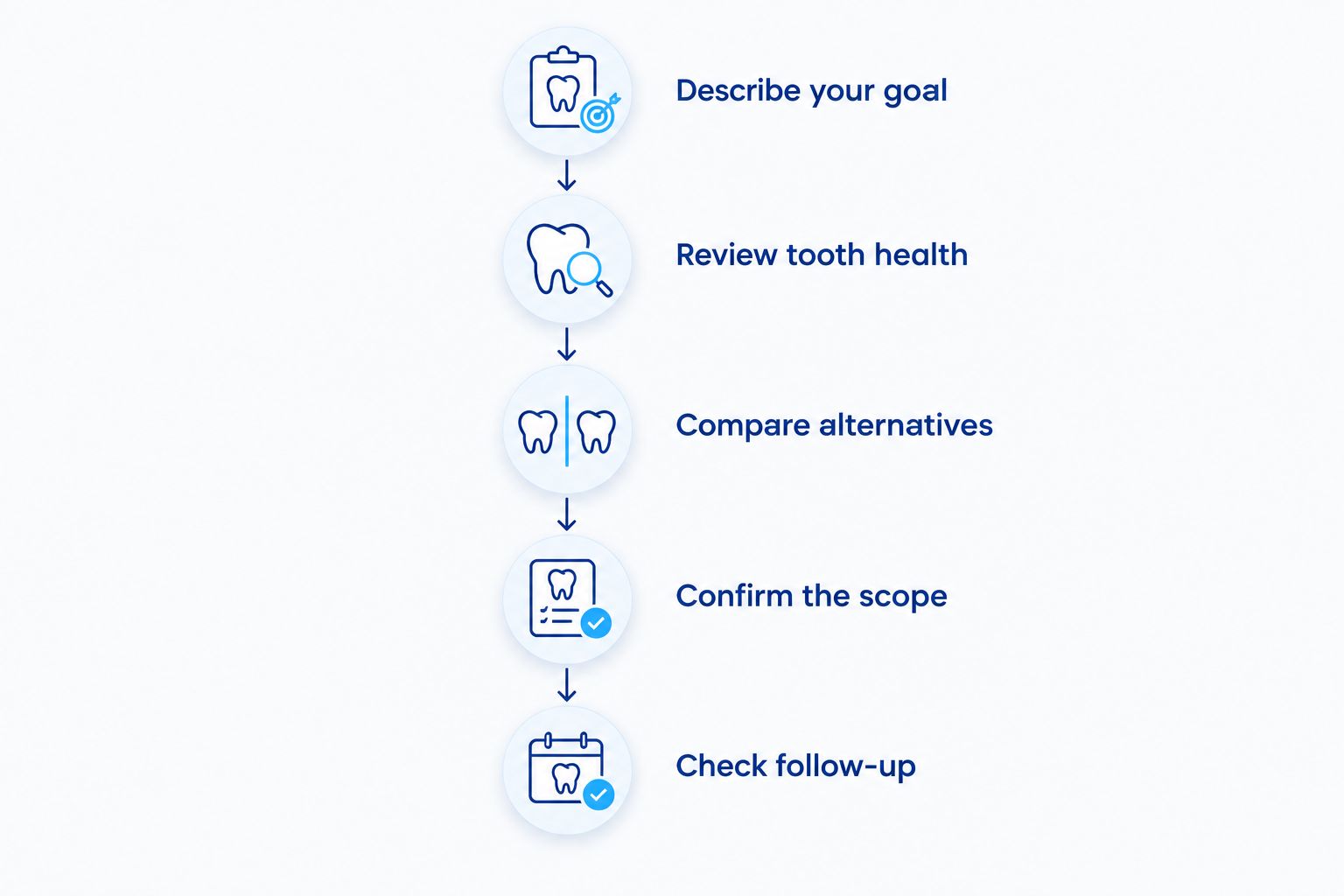
How to request a useful veneer estimate
- Describe your goal. Explain whether color, shape, chips, gaps, or worn edges bother you. Bring examples of what you like, but ask what is realistic for your teeth.
- Review tooth health. Tell the dentist about sensitivity, previous restorations, grinding, and any discomfort when biting.
- Compare alternatives. Ask whether whitening, bonding, or orthodontic treatment addresses the concern without veneers.
- Confirm the scope. Have the dentist identify the teeth, material, preparation, and treatment sequence in writing.
- Check follow-up. Clarify maintenance, adjustment visits, and the process if a restoration needs repair or replacement.
Give yourself room to ask questions before approving treatment. A plan should explain why each tooth needs a restoration and what happens if you decide to treat fewer teeth or choose a different approach.
Porcelain veneers: appearance and preparation
Best for: patients seeking changes to tooth color and shape when the dentist confirms suitable enamel, gum health, and bite conditions.
Porcelain veneers are custom ceramic restorations bonded to the fronts of teeth. Their advantages include stain resistance and the ability to create detailed changes in shape and translucency. The material can help a dentist reproduce characteristics of natural teeth rather than making every surface look identical.
The trade-offs matter. Preparation can involve removing enamel, and a chipped or broken porcelain veneer can require replacement rather than a simple repair. Veneers do not prevent decay around their margins or eliminate the need for regular dental care.
For a porcelain veneer plan in 2026, ask what appearance you can review before final placement and how the dentist will evaluate your bite. Read about veneer materials for a natural-looking smile to prepare questions about shade, translucency, and matching neighboring teeth.
Composite veneers: flexibility and maintenance
Best for: selected shape changes and cosmetic corrections when a dentist finds resin treatment appropriate.
Composite veneers use tooth-colored resin to alter the visible tooth surface. Composite can allow conservative treatment in suitable cases, and damaged resin is often repairable by adding or reshaping material. That flexibility is an advantage when discussing future maintenance.
Composite also has limitations. It is more susceptible to staining and wear than porcelain and can need polishing or repair as its appearance changes. The result depends on the tooth underneath, the extent of the correction, and the dentist's handling of the material.
Ask whether the proposed treatment is a full composite veneer or a small area of bonding. Those are different scopes of care. The estimate should name the procedure clearly instead of using veneer and bonding interchangeably.
Which cosmetic treatment fits your concern?
The most appropriate treatment is not always a veneer. Start with the problem you want to solve, then ask which options can address it without unnecessary changes to healthy teeth.
| Option | Best for | Main advantage | Main limitation |
|---|---|---|---|
| Porcelain veneers | Suitable patients seeking combined color and shape changes | Stain-resistant ceramic with detailed aesthetic control | Preparation can be irreversible; damage can require replacement. |
| Composite veneers or bonding | Selected chips, edges, and shape corrections | Resin is often repairable and can support conservative treatment. | Resin is more prone to staining and wear. |
| Teeth whitening | Discoloration that responds to bleaching | Changes tooth color without adding a restoration | Does not change tooth shape or whiten existing restorations. |
| Orthodontic treatment | Tooth-position or bite concerns | Moves teeth rather than covering their position | Requires an appropriate treatment and retention plan. |
These options sometimes work together, but combining treatments should have a clear purpose. For example, discuss whitening before choosing a restoration shade because veneers and bonding do not whiten like natural enamel.
Do not choose a veneer solely to avoid discussing a bite problem. Covering the front surface of a tooth does not move its root or correct every alignment concern. Ask the dentist to distinguish changes in appearance from changes in tooth position.
Why veneer treatment plans vary
Veneer estimates in 2026 vary because the clinical work varies. These factors explain what to look for when plans do not match:
- Material and fabrication: Porcelain and composite require different methods of shaping, finishing, and placement. Confirm the proposed material rather than assuming all veneers are equivalent.
- Treatment scope: The teeth included should reflect your goals, visible smile, and tooth condition. Ask why each tooth is part of the plan.
- Existing dental work: Fillings, previous restorations, and remaining enamel affect treatment choices. A tooth with substantial damage needs evaluation beyond cosmetic appearance.
- Gum and tooth health: Decay or gum inflammation needs attention before elective cosmetic treatment. Ask which care is necessary and which changes are optional.
- Bite and grinding: Clenching, grinding, and the way teeth meet influence suitability and protection. Tell the dentist about jaw discomfort and worn or chipped edges.
- Treatment sequence: Whitening, orthodontic care, temporary restorations, or other preparatory steps change the overall scope. The written plan should show the order of treatment.
There is no reason to accept an unexplained bundle. You should be able to connect every recommended step to tooth health, appearance, or protection.
What should you know about future care?
Veneers are restorations, not a way to stop caring for the teeth beneath them. Brush with fluoride toothpaste, clean between your teeth, and attend the dental visits recommended for your oral health. Avoid biting hard objects or using your teeth as tools.
Ask how you should respond to a rough edge, a loose restoration, or new sensitivity. Do not try to file, glue, or adjust a veneer yourself. A dentist needs to check whether the problem involves the restoration, the bond, the bite, or the underlying tooth.
No restoration has a guaranteed lifespan for every patient. Discuss repair and replacement before treatment, not only after something breaks. Your habits and oral health remain part of the plan long after placement.
Does dental insurance cover veneers?
Dental insurance commonly excludes treatment performed only to improve appearance. Your actual benefits depend on the policy and the reason for treatment, so confirm coverage with the insurer before proceeding.
If your dentist identifies a restorative need, ask for the diagnosis and proposed procedure in writing. A tooth needing treatment does not automatically mean the insurer will cover a veneer. Request any available predetermination and remember that it is not a guarantee of payment.
For a 2026 treatment decision, separate insurance questions from clinical ones. Choose appropriate care first, then confirm what your plan recognizes and what documentation it requires.
Can you treat fewer teeth instead of a full smile?
Yes, veneers can be planned for selected teeth when that approach fits the clinical findings and cosmetic goal. The challenge is matching treated teeth to their neighbors in color, shape, and proportion.
Ask the dentist to explain what a more limited plan achieves and what it leaves unchanged. Do not assume every visible tooth needs treatment. Preserving an unaffected tooth is a valid treatment goal.
Where can you discuss cosmetic dentistry in Lake Worth?
Dental Arts of Atlantis is a local cosmetic dentistry option for Palm Beach County families seeking care in Lake Worth. The practice also offers general, pediatric, and implant dentistry, making its stated services relevant to households with different dental needs.
For a veneer discussion, bring your cosmetic goals and questions about tooth preservation. Dental Arts of Atlantis offers cosmetic dentistry, but the right procedure for your teeth depends on an examination—not a photograph or an online estimate alone.
FAQ
How much do veneers cost in 2026?
Veneer costs in 2026 depend on the material, teeth being treated, and any preparatory dental work. Request an itemized estimate after an examination and confirm which services are included.
What’s the best way to compare veneer estimates?
Compare estimates for the same material, the same teeth, and the same included treatment. Check whether preparation, temporaries when needed, placement, and follow-up are described separately.
Are porcelain veneers better than composite veneers?
Porcelain veneers resist staining better, while composite veneers are often easier to repair. The better choice depends on your teeth, cosmetic goals, bite, and willingness to maintain the restorations.
Do veneers damage your natural teeth?
Veneer preparation can remove enamel, and removed enamel does not grow back. Ask how much preparation your proposed treatment requires and whether a more conservative alternative fits your concern.
Can I get veneers if I grind my teeth?
Grinding needs evaluation before veneer treatment because repeated force can damage restorations. Your dentist should assess your bite and discuss appropriate protection before you approve a plan.
Will whitening work instead of veneers?
Whitening is an alternative when your main concern is discoloration that responds to bleaching. It does not repair chips, change tooth shape, or whiten existing veneers and fillings.
Can Dental Arts of Atlantis help me discuss cosmetic treatment?
Dental Arts of Atlantis offers cosmetic dentistry in Lake Worth for families in the Palm Beach County area. An examination helps determine which treatment is appropriate for your teeth and goals.
One last thing
The shade decision can affect teeth you never planned to restore. Natural teeth can respond to whitening, but veneers do not change shade the same way. If whitening interests you, discuss its place in the treatment sequence before selecting the final veneer color.
For your 2026 consultation, bring this question: What is the least invasive treatment that addresses the concern I actually have? It keeps the discussion centered on a healthy, comfortable smile rather than on a predetermined number of restorations.
Related guides
- How to care for veneers to keep them looking new
- Cosmetic options for a small chip without a veneer
- Night guards for teeth grinding and jaw pain