
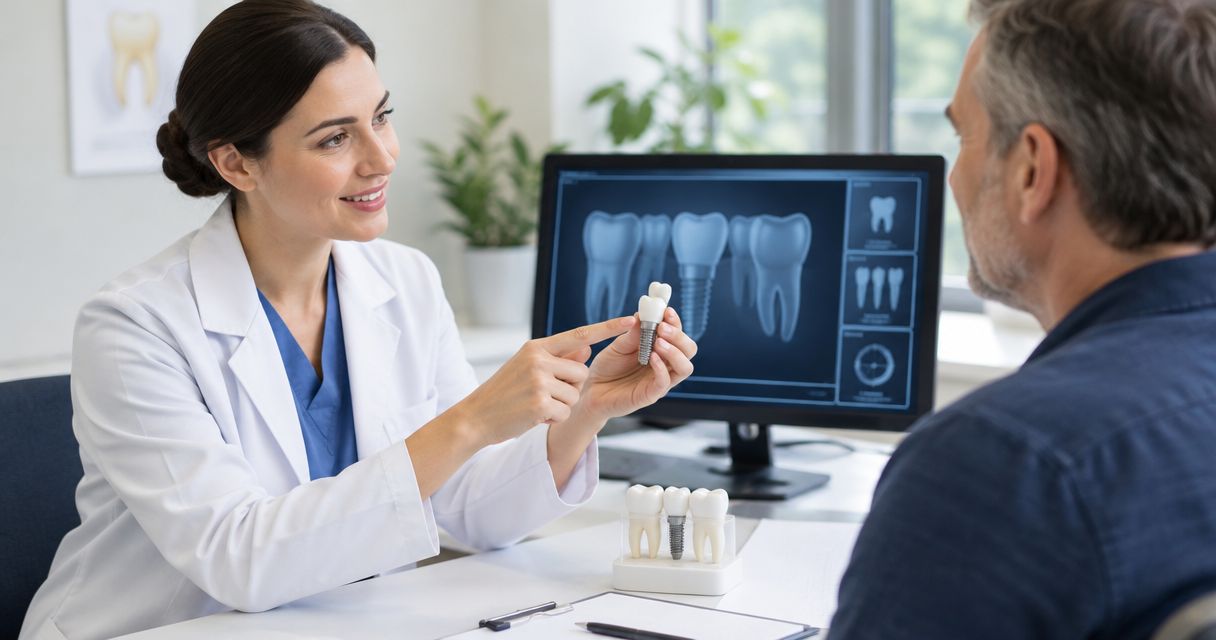
A dental implant takes several months from initial planning to the final crown because the bone needs time to heal around the implant; extraction or bone grafting can extend that process. In 2026, same-day implant treatment still does not mean healing is complete that day, so your treatment plan should distinguish the surgery date, temporary tooth, and final tooth.
- How long does a dental implant take from start to finish? Expect a process measured in months, not days.
- Bone healing, tooth extraction, and bone grafting determine the dental implant timeline.
- Same-day implant teeth do not mean same-day completion of bone healing.
- Dental Arts of Atlantis offers implant dentistry for Lake Worth and Palm Beach County families.
How long does a dental implant take from start to finish?
The full dental implant timeline includes planning, any necessary preliminary treatment, implant placement, bone healing, and the final crown. The surgical appointment is only one part of that sequence. Feeling comfortable after surgery does not establish that the implant is ready for normal chewing pressure.
If you are replacing a single tooth, the guide to dental implants for one missing tooth explains that treatment context. Your personal schedule depends on what the examination finds, not simply on how many teeth you are replacing.
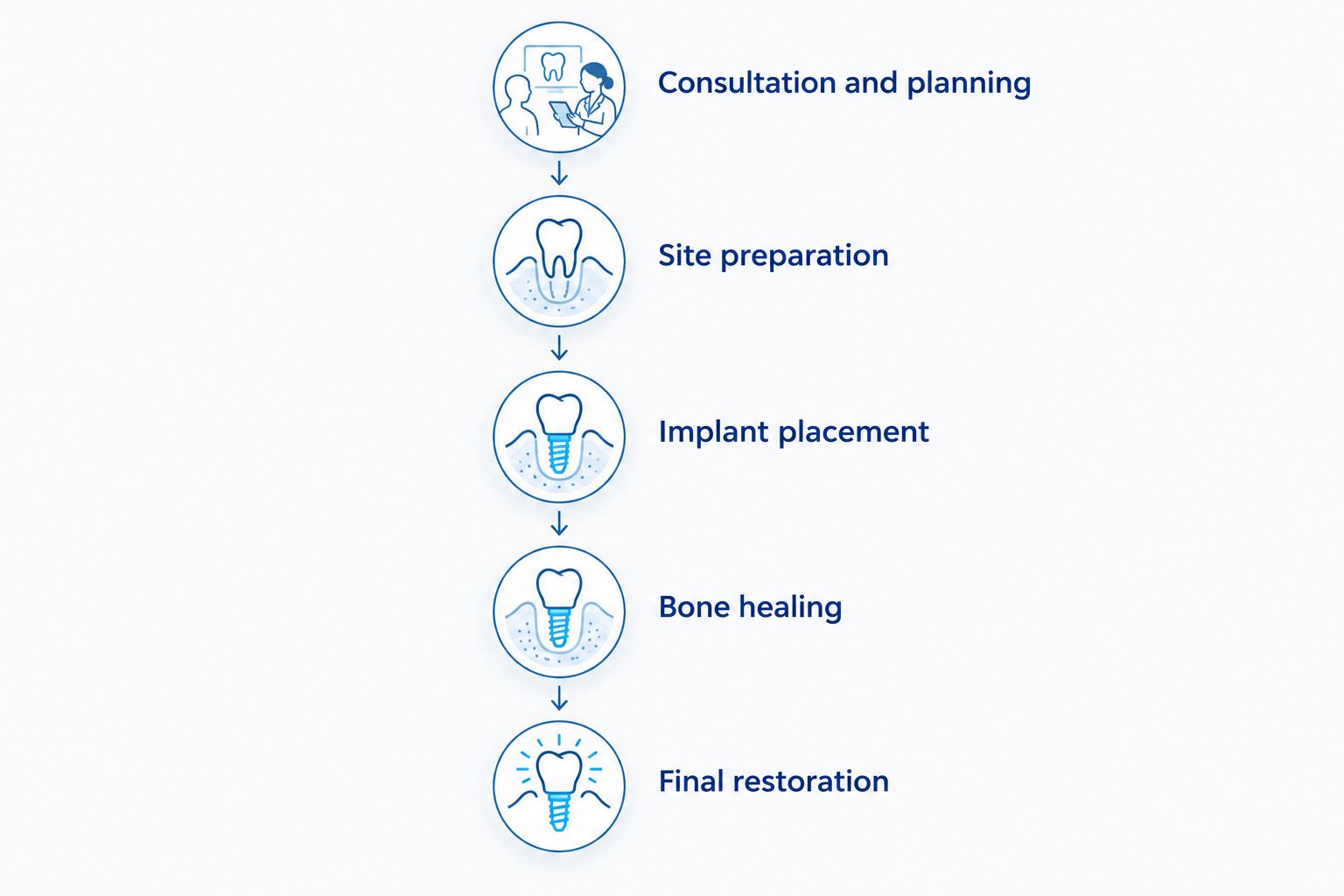
Here is the usual sequence, with the checkpoints that determine when you move forward:
- Consultation and planning: Your dentist examines your mouth, reviews your health history, and evaluates the implant site with appropriate imaging.
- Site preparation: Treatment addresses any necessary extraction, infection control, or bone grafting before or alongside implant placement.
- Implant placement: The implant enters the jawbone. A temporary tooth is a separate decision based on the treatment plan.
- Bone healing: The surrounding bone integrates with the implant. Follow-up examinations help determine readiness for restoration.
- Final restoration: Your dentist takes the necessary measurements or scans, fits the final crown, and checks the bite.
The steps do not always require separate appointments. Some can happen together, while others require a healing interval that cannot be replaced by booking appointments closer together.
Why this matters
An implant timeline affects meals, work arrangements, travel, and how you will look while the site heals. The most useful schedule tells you both when treatment happens and what you can safely do between visits. It should also explain what will replace the missing tooth during healing, if a temporary replacement is appropriate.
Dental Arts of Atlantis is a local implant dentistry option for families in Lake Worth and Palm Beach County. The practice also offers general, cosmetic, and pediatric dentistry. Those services establish its family-care scope, but an individual implant completion date still requires an examination and treatment plan.
When planning treatment in 2026, ask for milestones rather than a single promised finish date. A milestone-based plan explains which appointments are predictable and which depend on the condition of the healing site.
Implant placement without a separate grafting stage
Best for: Patients whose examination shows an implant site with suitable bone and no need for a separate preparatory procedure.
This pathway avoids an additional graft-healing stage before placement. It does not eliminate the time needed for the implant to integrate with the jawbone. Your dentist must still assess the site, place the implant, monitor healing, and complete the restoration.
The advantage is a simpler sequence. The limitation is that suitable bone alone does not guarantee immediate placement of the final crown; implant stability, bite forces, and the surrounding tissues also matter.
Ask whether the proposed completion date includes the final crown fitting or stops at the surgery. These are different endpoints. A clear plan names both.
Implant treatment after tooth extraction or bone grafting
Best for: Patients whose remaining tooth or implant site needs treatment before the implant can be restored safely.
Extraction changes the treatment sequence because the dentist must decide whether to place the implant during the extraction visit or after the site heals. Bone grafting introduces another decision: whether the graft can accompany placement or needs its own healing stage first.
The advantage of staged treatment is that it addresses the conditions needed to support the implant. The drawback is a longer process with additional treatment and follow-up. Do not treat a necessary healing interval as wasted time.
For your 2026 treatment plan, ask which procedure starts the healing interval. Otherwise, a timeline described as beginning “after surgery” can be confusing when your plan includes more than one surgical procedure.
Immediate placement and same-day temporary teeth
Best for: Selected patients whose dentist confirms that the extraction site, implant stability, and bite conditions support the proposed approach.
Immediate placement means putting the implant in during the tooth-extraction procedure. Immediate restoration or loading concerns attaching a tooth or restoration soon after placement. These terms describe different decisions, and neither guarantees that the final tooth is ready that day.
The benefit is that selected patients can combine parts of treatment or receive a temporary tooth earlier. The limitation is that the approach is not appropriate for every site, and temporary teeth can come with chewing restrictions while healing continues.
When considering a same-day approach in 2026, ask whether the tooth is temporary or final and whether it is intended to carry normal biting pressure. Do not assume the word “fixed” means unrestricted chewing.
| Treatment pathway | Best for | Main advantage | Main limitation |
|---|---|---|---|
| Placement without separate grafting | A suitable implant site | Avoids a separate graft-healing stage | Bone integration still takes time |
| Staged extraction or grafting | A site needing preparation | Addresses conditions before restoration | Adds treatment and healing stages |
| Immediate placement or temporary restoration | Carefully selected sites and patients | Can combine steps or provide a tooth earlier | Does not remove healing requirements |
Choose the pathway that fits your mouth, not the one with the shortest advertised schedule. The table compares treatment sequences, not interchangeable packages that every patient can select.
Why the dental implant timeline varies
Your dentist uses the examination and follow-up findings to decide when each stage is appropriate. These factors explain why two people replacing a similar-looking missing tooth can receive different schedules:
- Available bone: The site needs enough suitable bone to support the planned implant. A graft can change the sequence.
- Extraction needs: A tooth that still needs removal adds a decision about immediate or delayed placement.
- Gum health and infection: Active disease needs assessment and treatment rather than being ignored to meet a date.
- Health and medications: Conditions affecting healing and certain medications require review before treatment. Do not stop prescribed medication on your own.
- Implant stability and bite: The implant's stability and the forces placed on a temporary tooth influence restoration decisions.
- Healing and follow-up findings: The next appointment depends on what the dentist observes, not only on elapsed calendar time.
Appointment coordination also affects your experience. Tell the team about travel, seasonal moves, or a demanding work schedule before treatment starts, so the plan can account for follow-up needs without assuming healing will finish by a deadline.
What happens while the implant heals?
Bone integration is a biological process, not simply a wait for soreness to disappear. The gum surface and the bone around the implant do not necessarily reach their treatment milestones together. That is why you need professional checks even when the area feels settled.
Your dentist will give you instructions for cleaning, food choices, and protecting the site. Follow the instructions for your actual restoration: a removable temporary tooth, a fixed temporary tooth, and an uncovered healing site can require different care.
Ask what symptoms warrant a call and how to reach the treating team. Increasing pain, worsening swelling, drainage, fever, or a restoration that feels loose need prompt dental advice. Trouble breathing or swallowing requires emergency medical care.
Do not test the implant by pushing on it or repeatedly biting hard foods to see whether it feels secure. Your dentist should assess readiness for increased chewing pressure. Protecting the healing site is part of completing treatment.
Will I have a missing tooth while I wait?
A temporary replacement is sometimes possible during implant healing, but it needs a separate plan. Your dentist considers appearance, space, pressure on the surgical site, and whether the temporary tooth will contact opposing teeth.
Ask about the temporary arrangement before the procedure, especially for a visible front tooth. You should understand whether it is removable or fixed, how to clean it, and what eating restrictions apply. Do not assume a temporary tooth is included simply because an implant is planned.
A temporary replacement helps you through the healing period; it does not prove that the implant is fully integrated. Appearance and readiness for full chewing are separate milestones. That distinction matters when planning photographs, meetings, or a family event.
How do I know when the implant is ready for the final crown?
Your dentist determines readiness through the treatment history, examination, and appropriate checks of healing and stability. The absence of pain alone is not enough. Nor should you use another patient's completion date as a deadline for your own restoration.
Once the site is ready, the restorative stage includes measurements or scans, crown fabrication, and fitting. Your dentist checks how the crown meets the opposing teeth and how you can clean around it. Adjustments are part of achieving an appropriate fit and bite.
In 2026, digital planning and scans can assist treatment, but they do not replace biological healing. Ask which parts of the restorative process happen in the dental office and which depend on laboratory work, rather than assuming every appointment completes a tooth.
What should I ask before starting treatment?
Bring a current medication list and tell your dentist about smoking, previous dental treatment, relevant health conditions, and upcoming travel. Explain whether your main concern is surgery, the appearance of a missing tooth, eating, or fitting visits around family responsibilities.
Use these questions to turn a broad estimate into a usable plan:
- What is the starting point for my timeline: consultation, extraction, grafting, or implant placement?
- Do I need a separate healing stage before placement?
- What will replace my tooth during healing?
- Which findings must you confirm before fitting the final crown?
- What restrictions apply to my temporary tooth?
- Which symptoms should prompt me to call rather than wait for the next visit?
- What happens to the schedule if healing takes longer than expected?
Request a written sequence that identifies the temporary and final restorations. It should distinguish planned appointments from checkpoints that depend on healing. A useful timeline explains the reason for each wait, not just the next date.
Explore local implant care
Learn about dental implant care for Lake Worth patients before discussing your treatment timeline.
FAQ
How long does a dental implant take from start to finish?
A dental implant takes several months from planning through healing and the final crown. Extraction, bone grafting, and individual healing can extend the sequence, so your dentist should provide an examination-based timeline.
Can I get a dental implant and a tooth on the same day?
Selected patients can receive an implant and a temporary tooth during the same treatment visit. Same-day treatment does not mean the bone has finished healing or that unrestricted chewing is safe.
Does bone grafting make dental implant treatment take longer?
Bone grafting can lengthen dental implant treatment when it requires a separate healing stage. Some grafting accompanies implant placement; your dentist decides which sequence fits the site.
Can I get the final crown as soon as my gums feel better?
Feeling better does not establish that the implant is ready for the final crown. Your dentist needs to assess healing and implant stability before completing the restoration.
Will I be able to eat normally with a temporary implant tooth?
A temporary implant tooth does not automatically allow normal chewing. Follow the restrictions for your specific restoration and ask when your dentist will reassess them.
Does Dental Arts of Atlantis offer dental implant care in Lake Worth?
Dental Arts of Atlantis offers implant dentistry in Lake Worth, Florida, for families in the Palm Beach County area. Your treatment sequence and completion estimate depend on an individual examination.
One last thing
Before choosing a start date, ask your dentist to identify the date you expect to have a tooth for appearance and the milestone when that tooth is ready for normal function. Those are not always the same. This question gives you a more practical answer than asking only how long the surgery takes.
For families considering Dental Arts of Atlantis for dental implants, the next step is an individualized plan that separates placement, healing, and restoration. Keep the final-crown milestone in view, but let the condition of the implant site determine when it is safe to reach it.
Related guides
- How to prepare for your first dental implant consultation
- How to use 3D imaging to plan a dental implant
- How to know if you are a candidate for same-day implant teeth
- How to care for dental implants after surgery