
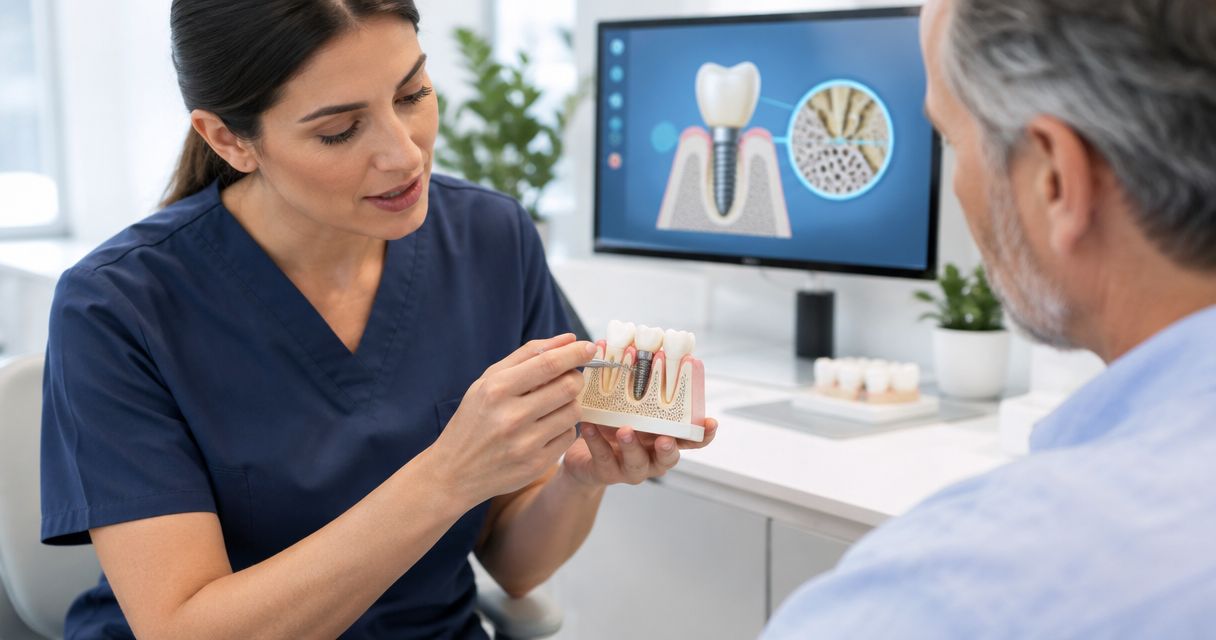
Yes, you can get dental implants with bone loss if the remaining bone can support an implant or treatment can rebuild enough support. Bone loss does not automatically rule you out, but active gum disease, nearby nerves or sinuses, and your ability to heal can change the treatment plan.
- Can you get dental implants with bone loss? Yes, when existing or rebuilt jawbone provides enough support.
- Bone grafting helps selected patients rebuild an implant site; it does not guarantee implant eligibility.
- Dental Arts of Atlantis offers implant dentistry for families in Lake Worth and Palm Beach County.
- Treat active gum disease before implant placement, and review medical conditions and medications with your dentist.
Can you get dental implants with bone loss?
Yes—bone loss changes the planning, not automatically the answer. Your dentist needs to assess the bone at the proposed implant location, rather than judge your entire jaw by a single description such as thin or weak.
An examination and appropriate imaging help establish whether the site needs additional treatment. This guide to using 3D imaging to plan a dental implant explains how the scan fits into that assessment.
| Treatment path | Best for | Main advantage | Main limitation |
|---|---|---|---|
| Implant without grafting | Patients with sufficient bone in a suitable position | Avoids an additional grafting procedure | Requires adequate support and safe positioning |
| Grafting with implant placement | Selected sites where the implant can obtain initial stability | Combines procedures when clinically appropriate | Not suitable for every bone defect |
| Grafting before implant placement | Sites needing additional support before an implant can be stable | Allows the rebuilt site to heal first | Adds a separate treatment stage |
| Tooth-supported bridge | Patients with suitable supporting teeth who prefer a non-implant option | Does not require an implant in the missing-tooth site | Usually requires preparation of supporting teeth |
| Removable denture | Patients seeking a nonsurgical replacement option | Replaces teeth without implant surgery | Fit and movement require ongoing attention |
These are treatment categories, not interchangeable choices. A plan that works for a missing front tooth can be unsuitable for a back-tooth site with different bone anatomy and biting forces.
Why this matters
Hearing that you have bone loss can sound like a permanent rejection of implants. It is not the same as a complete implant assessment. The cause, location, and shape of the missing bone matter.
For your 2026 treatment decision, separate two questions: can an implant be placed safely, and can the finished tooth function in a position you can keep clean? A technically possible implant is not automatically the right treatment.
Dental Arts of Atlantis is best suited to Lake Worth and Palm Beach County patients seeking local implant dentistry alongside family dental care. Implant eligibility still requires an individual examination; location and service offerings cannot establish whether surgery is appropriate for you.
Implant placement without bone grafting
Best for: patients whose remaining bone supports a safe, correctly positioned implant. Bone loss in one area does not prove that every possible implant site lacks support. Your dentist evaluates the specific location and the planned replacement tooth together.
Avoiding a graft means avoiding an additional procedure. The trade-off is that the remaining bone must still allow proper implant positioning without compromising nearby structures or the final restoration.
Do not choose a no-graft approach simply because it sounds easier. Ask your dentist to explain how the implant position will support the tooth and allow daily cleaning.
Bone grafting with implant placement
Best for: selected patients whose implant can achieve initial stability while a surrounding defect is grafted. Initial stability means the implant is mechanically secure when placed. That stability matters while healing connects the implant to the surrounding bone.
Combining grafting and implant placement can reduce the number of separate surgical stages. It does not eliminate healing, and it is not appropriate when the existing bone cannot hold the implant securely.
Ask what happens if the site looks different during surgery than expected. Your consent discussion should explain whether the dentist would proceed, graft first, or change the plan.
Bone grafting before implant placement
Best for: patients whose proposed implant site needs reconstruction before it can support an implant. A graft provides material and space for bone healing. The dentist reassesses the site before deciding whether it is ready for implant placement.
The advantage is a staged approach to rebuilding support. The limitation is an additional procedure and healing period, with risks that include infection, wound opening, and incomplete graft healing.
Read about bone grafting for dental implants before discussing which approach fits your site. Ask what the graft is intended to correct: insufficient width, insufficient height, or a localized defect.
A graft is not a promise that an implant will follow. Your 2026 treatment plan should identify the findings needed to move from graft healing to implant placement.
Why implant eligibility varies with bone loss
Your dentist considers more than the amount of missing bone. These factors help explain why two people with bone loss receive different recommendations:
- Bone dimensions: The site needs enough width and height for the proposed implant, with appropriate clearance from nearby structures.
- Bone location: Bone near a lower-jaw nerve or beneath an upper-jaw sinus creates different planning limits.
- Gum health: Active periodontal disease needs treatment; inflammation and infection threaten supporting tissues.
- Medical history: Diabetes control, previous radiation involving the jaws, and other health conditions affect risk assessment.
- Medication history: Certain medicines used for osteoporosis or cancer require particular attention before jaw surgery.
- Bite and maintenance: Grinding, excessive loading, and difficulty cleaning influence the restoration design and follow-up plan.
Do not stop prescribed medication to improve implant eligibility. Your dentist and prescribing clinician should coordinate any medically necessary changes.
What happens during an implant assessment?
An implant assessment should connect the condition of your jaw to the tooth or teeth you want replaced. Bring previous scans and treatment records if you have them, but expect your dentist to decide whether updated imaging is necessary.
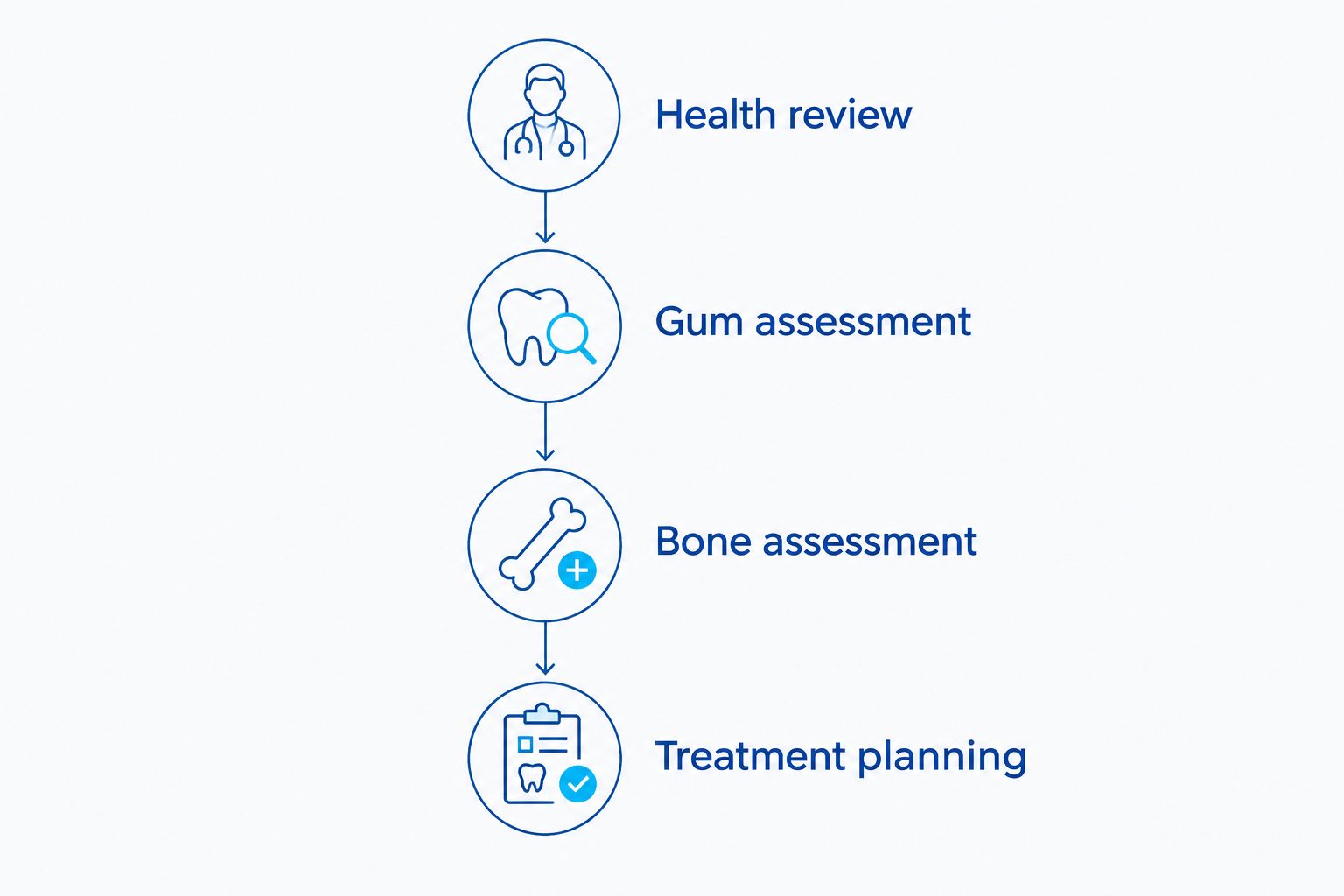
- Health review: Share your medical conditions, medications, tobacco use, and previous problems with dental healing. Include injections or infusions, not just daily tablets.
- Gum assessment: Your dentist checks for inflammation, infection, and support around remaining teeth. Loose teeth and bleeding gums need attention even if they are away from the missing tooth.
- Bone assessment: Appropriate imaging shows the proposed implant site and nearby anatomy. Cone-beam computed tomography, often called CBCT, provides 3-D information when indicated.
- Treatment planning: Your dentist explains whether to place an implant, rebuild the site first, or consider a different replacement. The plan should address your temporary tooth, final restoration, and maintenance.
Ask to see the problem on your images. A useful explanation shows where support is missing, why it matters, and what the proposed treatment is expected to change. You should leave understanding the next decision, not just the procedure name.
Dental Arts of Atlantis provides implant dentistry in Lake Worth. Bring your questions about bone loss to the assessment, including any previous explanation that implants were not possible.
Can severe bone loss still be treated?
Severe bone loss does not always exclude implants, but it can require more complex treatment or specialist assessment. Some sites need substantial reconstruction; others do not offer a reasonable implant option after risks and expected benefits are considered.
Upper back-tooth sites sometimes need a sinus augmentation procedure to create additional bone support beneath the sinus. Lower-jaw sites require careful attention to nerve position. Neither procedure should be assumed necessary from the words severe bone loss alone.
A second opinion is reasonable when the proposed treatment is extensive or when different clinicians recommend different approaches. Ask each clinician to explain the anatomy, alternatives, and reasons behind the recommendation.
Can you get dental implants without a bone graft?
Yes, you can get dental implants without a bone graft when the remaining bone supports an appropriate implant and restoration. Bone loss elsewhere in your mouth does not automatically mean the proposed site needs grafting.
Shorter or differently positioned implants suit selected situations, but they are not universal substitutes for rebuilding bone. Ask whether avoiding a graft changes the restoration design, cleaning access, or surgical risk.
Does bone loss mean you need to remove more teeth?
No, bone loss does not automatically mean additional teeth need extraction. Each remaining tooth needs its own assessment of support, infection, damage, and prospects for treatment.
Before agreeing to a broader implant plan in 2026, ask which teeth remain maintainable and why any extraction is recommended. Replacing teeth and preserving treatable teeth should be considered together.
Does osteoporosis rule out dental implants?
No, osteoporosis alone does not automatically rule out dental implants. The jaw site, your overall health, and your medication history all contribute to the decision.
Tell your dentist the exact medication name, why you take it, and whether you receive it by mouth, injection, or infusion. Do not change the schedule without guidance from the prescribing clinician.
Questions to ask before agreeing to treatment
Your 2026 implant plan should explain the sequence and the decision points, not just name the surgery. Take these questions to your visit:
- Where is the bone missing, and what caused the loss?
- Is any gum disease active, and how will treatment address it?
- What makes grafting necessary—or unnecessary—at this site?
- What findings would change the plan during surgery?
- What will I use for chewing and appearance while the site heals?
- What non-implant alternative is reasonable for me?
Ask about discomfort management and your responsibilities after surgery, too. Comfort matters, but so does knowing which symptoms require a call and how to avoid pressure on a healing site.
Protecting the bone around a future implant
Implants do not develop cavities, but the tissues around them can become inflamed and lose bone. Replacing a missing tooth does not remove the need for daily cleaning or professional maintenance.
Follow the cleaning method recommended for your restoration, including access beneath connected teeth where applicable. Tell your dentist about bleeding, swelling, drainage, or a change in how the implant-supported tooth feels.
For your 2026 maintenance plan, ask how often the site needs review based on your gum history and other risks. A generic schedule is not a substitute for an individualized recommendation.
FAQ
Can you get dental implants with bone loss from gum disease?
Yes, implants remain an option for some patients with bone loss from gum disease, but active disease needs treatment first. Your dentist must assess the remaining bone, infection control, and your ability to maintain the restoration.
How much bone do I need for a dental implant?
There is no single bone measurement that establishes eligibility for every implant site. Your dentist evaluates width, height, nearby anatomy, and the implant needed to support the planned tooth.
Will I definitely need a bone graft before dental implants?
No, bone loss does not automatically require a graft. A graft is considered when the proposed site lacks the support needed for an appropriately positioned implant.
Can I get same-day implant teeth if I have bone loss?
Bone loss can limit eligibility for same-day implant teeth because the implants need sufficient initial stability. A temporary restoration placed on surgery day does not mean bone healing is complete.
How long does a bone graft take to heal before an implant?
Bone graft healing depends on the defect, procedure, and your healing response. Your dentist reassesses the site before deciding whether it is ready for implant placement rather than relying on a calendar alone.
Can vitamins rebuild enough jawbone for an implant?
Vitamins cannot reliably reconstruct a localized jawbone defect that requires surgical treatment. Address nutritional deficiencies with your clinician, but do not substitute supplements for an implant-site assessment.
What if I cannot have dental implants because of bone loss?
A tooth-supported bridge or removable denture can be an alternative when implants are unsuitable. The choice depends on your remaining teeth, oral tissues, cleaning needs, and treatment goals.
One last thing
Ask what the replacement tooth needs before asking which implant you need. Bone in the wrong location for a cleanable, functional tooth does not solve the whole problem. The restoration and the surgical plan need to fit together.
Related guides
- How to prepare for your first dental implant consultation
- Dental implants for patients with osteoporosis
- How to care for dental implants after surgery