

Dry mouth, or xerostomia, turns eating, talking, and sleeping into a low-grade discomfort, and reaching for the wrong rinse can make the burning and stickiness worse. This guide ranks six over-the-counter and prescription rinses for 2026 so you match the product to the cause of your dry mouth, not just the symptom.
- Biotene Dry Mouth Oral Rinse is the best overall pick for daily xerostomia relief in 2026.
- ACT Dry Mouth Mouthwash adds fluoride, so it doubles as cavity protection for a dry mouth at higher decay risk.
- TheraBreath Dry Mouth Oral Rinse targets the sulfur compounds behind dry-mouth bad breath specifically.
- Spry Xylitol Oral Rinse suits Sjogren’s syndrome and medication-induced dry mouth because it skips alcohol entirely.
- A prescription 1.1% fluoride rinse is the strongest cavity shield, available only through a dentist.
Why this matters
More than 500 prescription and over-the-counter medications list dry mouth as a side effect, according to the National Institute of Dental and Craniofacial Research, and antihistamines, blood pressure drugs, and antidepressants top that list. Saliva does more than keep your mouth wet: it buffers acid, carries minerals back into enamel, and washes away the bacteria that cause decay and bad breath. Lose that flow and cavity risk climbs fast, which is why patients managing dry mouth caused by medication need a rinse that does more than mask the dryness for an hour.
Not every rinse on a drugstore shelf is built for this. Regular mouthwash with alcohol pulls moisture out of already-dry tissue and stings on contact. The right rinse replaces what saliva does chemically, not just what it feels like.
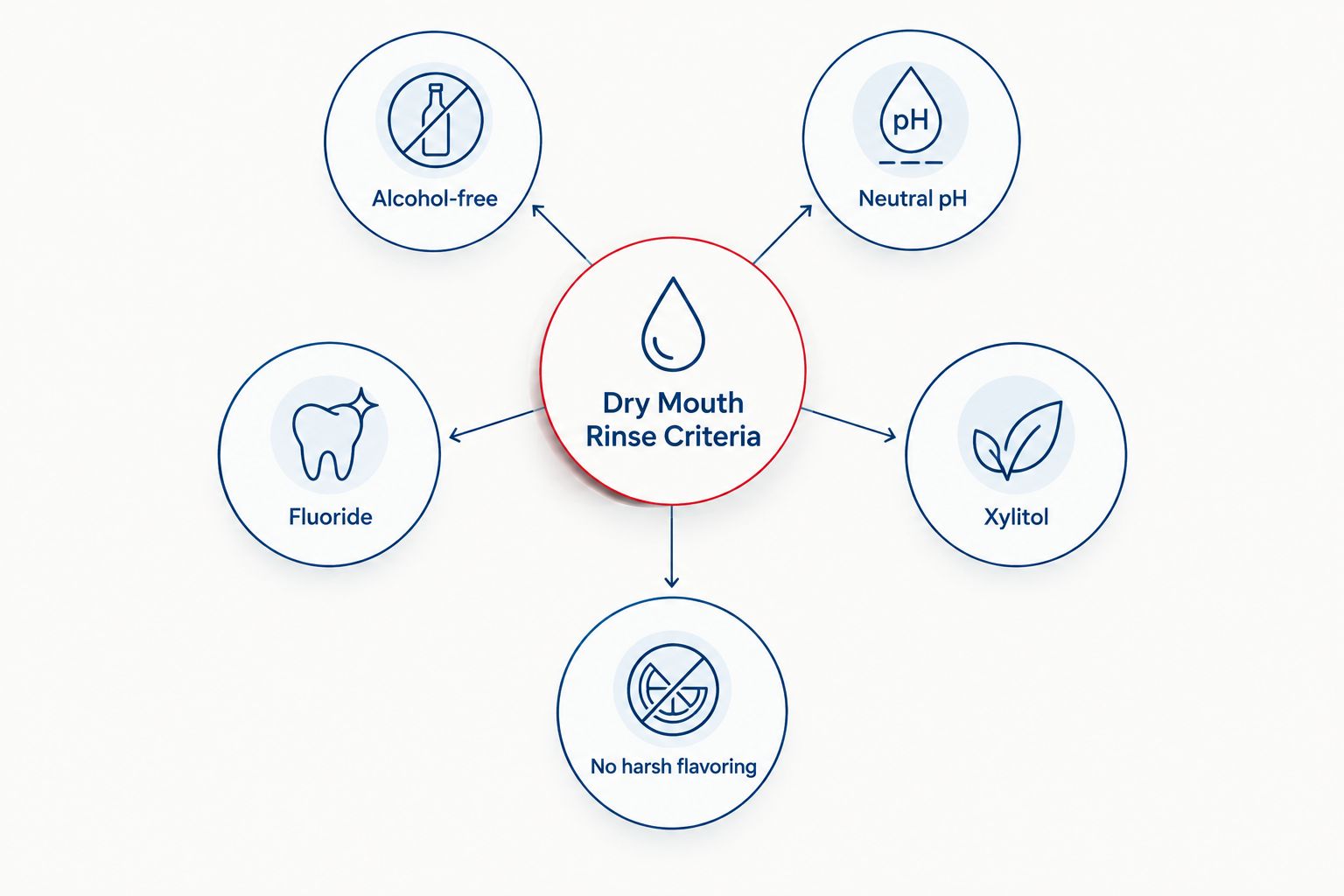
What makes the best dry mouth rinse
- Alcohol-free formula — alcohol dehydrates oral tissue further and stings when tissue is already irritated.
- Neutral pH — a balanced pH protects enamel that's already vulnerable from reduced saliva buffering.
- Fluoride or remineralizing agents — extra protection matters because dry mouth raises cavity risk on its own.
- Xylitol or moisturizing agents — these extend comfort between rinses instead of relief lasting a few minutes.
- No SLS or harsh flavoring — sodium lauryl sulfate and strong mint oils irritate tissue that's already dry and thin.
At a glance
| Rinse | Best For | Standout Feature | Key Limitation |
|---|---|---|---|
| Biotene Dry Mouth Oral Rinse | Daily relief overall | Enzyme system mimics natural saliva | Relief fades within a couple of hours for severe cases |
| ACT Dry Mouth Mouthwash | High cavity risk | Contains fluoride alongside moisturizers | Mild mint flavor still bothers some raw tissue |
| TheraBreath Dry Mouth Oral Rinse | Dry mouth with bad breath | Oxygenating formula neutralizes sulfur compounds | Weaker on long-lasting moisture than enzyme rinses |
| CloSYS Alcohol-Free Oral Rinse | Sensitive or irritated tissue | pH-balanced, no dyes or harsh flavoring | No fluoride, so it needs a separate cavity-fighting toothpaste |
| Spry Xylitol Oral Rinse | Sjogren's or medication-induced dry mouth | Xylitol-based with no alcohol or detergents | Thinner, less coating feel than gel-based rinses |
| Prescription 1.1% fluoride rinse | Frequent cavities | Highest fluoride concentration available | Requires a dentist visit and a prescription |
1. Biotene Dry Mouth Oral Rinse: best overall dry mouth rinse for daily relief
Biotene uses an enzyme system built around lactoferrin and lysozyme, proteins meant to stand in for the antibacterial enzymes natural saliva already carries. It's alcohol-free and mild enough for twice-daily use without stinging tissue that's already sensitive.
Biotene pros:
- Alcohol-free and gentle on irritated tissue
- Widely available at most pharmacies
- Works for general xerostomia, not just one cause
- Neutral flavor that doesn't overpower a dry mouth
Biotene cons:
- Contains no fluoride, so cavity risk still needs a separate product
- Relief runs shorter than a full night's sleep for severe dry mouth
Best for: anyone starting with daily, general dry mouth who wants one dependable rinse. Verdict: Buy.
2. ACT Dry Mouth Mouthwash: best mouth rinse for dry mouth with high cavity risk
ACT's dry mouth formula pairs moisturizing agents with fluoride, which matters because reduced saliva flow speeds up decay on its own. It's built for patients who need both comfort and enamel protection from one bottle instead of layering two products.
ACT pros:
- Fluoride adds cavity protection most dry-mouth rinses skip
- Alcohol-free
- Affordable and sold at nearly every drugstore
ACT cons:
- Mint flavoring still bothers some raw or ulcerated tissue
- Moisturizing effect is shorter than xylitol-forward rinses
Best for: patients with dry mouth and a recent history of new cavities. Verdict: Buy.
3. TheraBreath Dry Mouth Oral Rinse: best rinse for dry mouth with bad breath
TheraBreath's oxygenating formula is built to neutralize the volatile sulfur compounds that cause bad breath, which flourish faster in a low-saliva mouth. It solves a specific complaint dry mouth patients raise often: the dryness comes with breath odor that regular mints don't fix.
TheraBreath pros:
- Directly targets odor-causing sulfur compounds
- Alcohol-free formula
- Noticeably fresher breath reported by users beyond basic moisture relief
TheraBreath cons:
- Less coating, gel-like moisture than Biotene
- No fluoride included
Best for: patients whose main complaint is dry-mouth-related bad breath. Verdict: Buy.
4. CloSYS Alcohol-Free Oral Rinse: best rinse for sensitive or irritated tissue
CloSYS is built around a pH-balanced, chlorine dioxide formula with no dyes, alcohol, or heavy flavoring agents. That makes it the gentlest option on this list for tissue that's already cracked, sore, or ulcerated from chronic dryness.
CloSYS pros:
- No sting, no burn, minimal ingredients
- pH-balanced formula protects already-weakened enamel
- Good option for patients also managing mouth sores
CloSYS cons:
- No fluoride, so it doesn't address cavity risk on its own
- Milder moisturizing effect than enzyme or xylitol formulas
Best for: anyone with sore, irritated, or ulcerated oral tissue alongside dryness. Verdict: Buy.
5. Spry Xylitol Oral Rinse: best rinse for Sjogren's syndrome and medication-induced dry mouth
Spry leans entirely on xylitol rather than enzymes or detergents, which suits patients whose dry mouth comes from an autoimmune cause or a long medication list rather than a temporary irritation. Patients managing Sjogren's syndrome dental care often need a rinse this simple, since their tissue reacts to more ingredients than most dry mouth sufferers.
Spry pros:
- No alcohol, no SLS, no artificial dyes
- Xylitol also slows bacterial growth tied to decay
- Well tolerated by patients with multiple oral sensitivities
Spry cons:
- Thinner texture, less of a coating feel than gel rinses
- No fluoride included
Best for: Sjogren's syndrome patients and anyone on multiple dry-mouth-causing medications. Verdict: Buy.
6. Prescription 1.1% fluoride rinse: best rinse for patients with a history of frequent cavities
A prescription-strength rinse at 1.1% sodium fluoride carries roughly five times the fluoride concentration of a standard 0.02% daily over-the-counter rinse. It's the strongest cavity defense on this list, but it only comes through a dentist, which means it's a step up rather than a first try.
Prescription fluoride rinse pros:
- Highest fluoride concentration available for home use
- Directly addresses the cavity risk that comes with reduced saliva
- Dentist-guided, so dosing is matched to actual risk
Prescription fluoride rinse cons:
- Requires an office visit before you can start
- Doesn't address dryness itself, only decay risk
Best for: patients who've had multiple new cavities since their dry mouth started. Verdict: Buy if your dentist confirms high risk; Hold otherwise.
Ask about your dry mouth cause
A quick exam can flag the right rinse and check for early decay risk.
How we ranked these
Each rinse was measured against the five criteria above: alcohol content, pH balance, fluoride or remineralizing agents, moisturizing ingredients, and irritation potential from SLS or strong flavoring. None of these rinses replace a full oral hygiene routine — patients managing gum inflammation alongside dry mouth should also check the best mouthwash for gum disease, since a dry-mouth rinse and a gum-disease rinse solve different problems.
Which dry mouth rinse should you choose?
Biotene Dry Mouth Oral Rinse is the default pick for 2026 if your dry mouth is general and you want one product that works most days. Switch to ACT Dry Mouth Mouthwash if a dentist has flagged new cavities, and switch to Spry Xylitol Oral Rinse if your dry mouth traces back to Sjogren's syndrome or a long medication list rather than a passing irritation. Anyone with repeat cavities since their dry mouth started should ask a dentist about the prescription 1.1% fluoride option before the next round of decay sets in.
FAQ
What is the best mouth rinse for dry mouth in 2026?
Biotene Dry Mouth Oral Rinse is the best overall choice in 2026 for general daily dryness because it’s alcohol-free and uses an enzyme system that mimics natural saliva. Patients with cavity risk or an autoimmune cause do better with ACT or Spry instead.
Is alcohol-free mouthwash better for dry mouth?
Yes, alcohol pulls moisture out of oral tissue and worsens the burning sensation that comes with xerostomia. Every rinse on a legitimate dry mouth list, including Biotene, ACT, and CloSYS, skips alcohol entirely.
Can a dry mouth rinse prevent cavities?
Only rinses with fluoride, like ACT Dry Mouth Mouthwash or a prescription 1.1% fluoride rinse, directly address cavity risk. Non-fluoride rinses like Biotene or CloSYS manage dryness but need a fluoride toothpaste alongside them.
How often should you use a dry mouth rinse?
Most over-the-counter dry mouth rinses are labeled for use two to four times daily, including before bed when saliva flow naturally drops further. Check the specific product label since concentrations vary by brand.
Is Biotene or ACT better for dry mouth?
Biotene is better for general daily comfort, while ACT is better when cavity protection matters more because it contains fluoride. Many patients rotate between the two depending on the day.
Does dry mouth increase the risk of gum disease?
Yes, reduced saliva flow lets bacteria build up faster along the gumline, raising both cavity and gum disease risk. A separate gum-focused rinse alongside a dry mouth rinse addresses both issues.
Can medication cause permanent dry mouth?
Dry mouth from medication is usually reversible once the medication changes or stops, but more than 500 common drugs list it as a side effect. A dentist can help identify whether the cause is medication, an autoimmune condition, or something else.
Should Sjogren’s syndrome patients use a special rinse?
Yes, Sjogren’s patients generally need the simplest formula available, like Spry Xylitol Oral Rinse, since their tissue reacts more to added ingredients than typical dry mouth cases. A dentist familiar with autoimmune dry mouth can help fine-tune the routine.
One last thing
Rinsing right before bed matters more than rinsing during the day, because saliva flow drops further during sleep and leaves teeth exposed to acid and bacteria for hours at a stretch. Swishing water helps temporarily, but water carries none of the enzymes or buffering minerals that real saliva — or a rinse built to mimic it — provides.
Related guides