
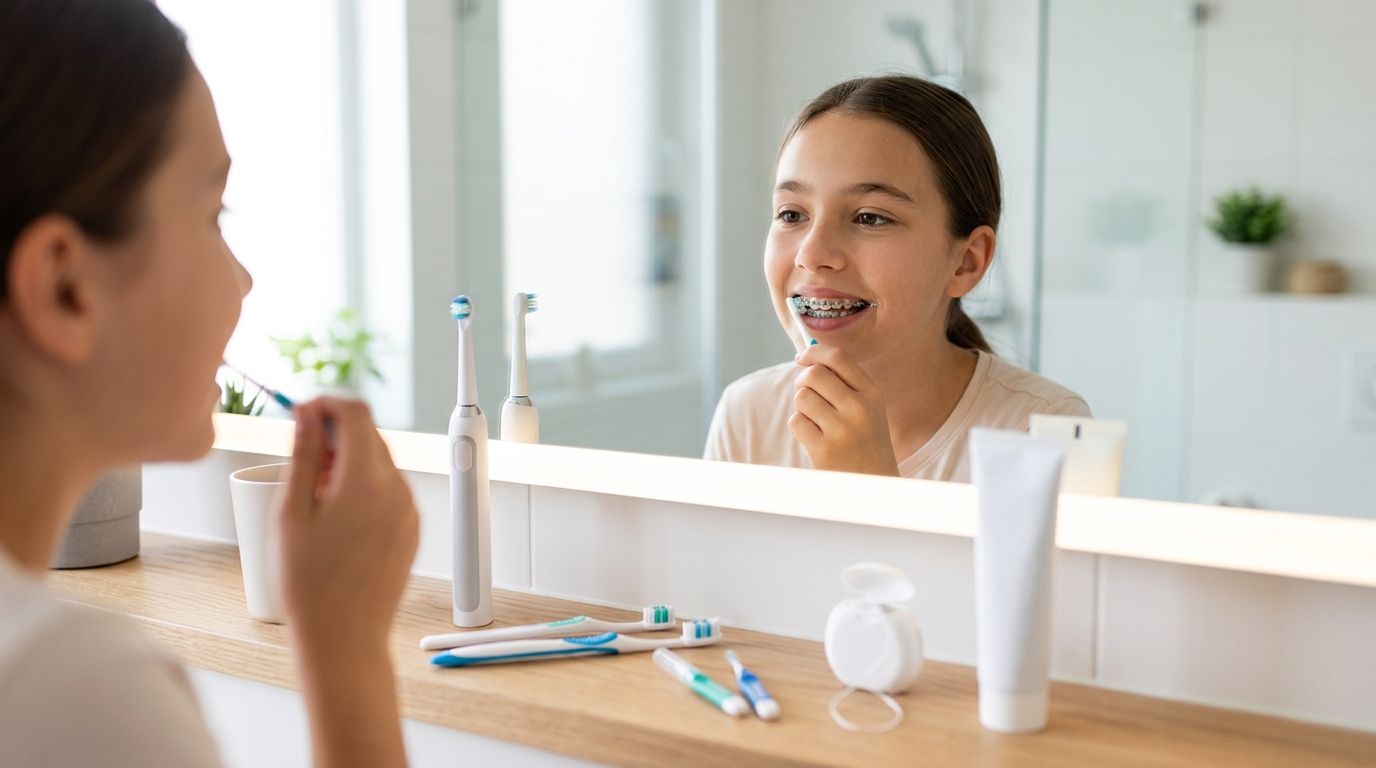
Braces turn a two-minute brushing routine into a project with more moving parts than most parents expect. Get the daily habits right and a teenager finishes treatment with a clean, cavity-free smile; skip steps and you're looking at white spot scars, gum inflammation, or a longer stint in the chair.
- An electric toothbrush with an orthodontic head is the best overall pick for the best oral care routine for braces in 2026.
- Water flossers beat string floss for kids who refuse to thread it around wires.
- Interdental brushes clear the spots a toothbrush bristle physically cannot reach.
- Fluoride rinse cuts cavity risk for the roughly 12 to 24 months braces stay on.
- Orthodontic wax solves bracket irritation in under a minute and belongs in every backpack.
Best overall: an electric toothbrush fitted with an orthodontic brush head. Best for kids who refuse to floss: a water flosser. Best for clearing wires and brackets a toothbrush can't reach: interdental brushes.
Why this matters
Brackets and wires create ledges where food and plaque hide. A toothbrush alone misses roughly a third of the tooth surface once braces go on, which is why cavity rates and white spot lesions climb during orthodontic treatment if the routine doesn't adapt. Sports add another layer — any child playing contact sports in braces needs a mouthguard built for wires and brackets, not a generic boil-and-bite model that can catch on hardware.
Dental Arts of Atlantis sees the same pattern across Palm Beach County families: kids with a solid daily routine finish braces with clean enamel, and kids without one show up with decalcification the orthodontist can't fix with a bracket adjustment. The right tools cost a few minutes a day. The wrong routine costs a filling.
What makes the best oral care routine for braces
- Reaches under wires and around brackets, not just tooth surfaces
- Fits a kid's actual patience level — a tool nobody uses is worthless
- Delivers fluoride contact time since braces trap plaque against enamel longer
- Handles emergencies like a poking wire or a rubbed sore spot
- Works three times a day, ideally after meals, without a 20-minute production
- Backed by dentist or orthodontist guidance, not just a YouTube trend
At a glance
| Tool | Best for | Standout feature | Key limitation |
|---|---|---|---|
| Electric toothbrush (ortho head) | Daily plaque removal | Oscillating bristles clear bracket edges | Still misses tight wire gaps |
| Water flosser | Reluctant flossers | Clears debris in seconds, no threading | Doesn't replace brushing |
| Interdental brushes | Cleaning around wires | Fits between bracket and gumline | Takes practice for young kids |
| Fluoride rinse | Cavity-prone kids | Extra fluoride exposure, no brushing needed | Not a substitute for brushing |
| Orthodontic wax | Bracket irritation | Stops rubbing in under a minute | Temporary fix only |
| Floss threaders | Kids ready for real flossing | Cleans below the gumline like string floss | Slow for younger children |
1. Electric toothbrush with an orthodontic head: best for daily plaque control
An electric toothbrush with a brush head designed for braces uses oscillating or sonic bristles to work around bracket edges instead of just skating over them. It's the base of the routine — everything else supplements it, nothing replaces it.
Electric toothbrush pros:
- Removes more plaque along the gumline than manual brushing in most side-by-side comparisons
- Built-in timers enforce the full two minutes
- Pressure sensors stop kids from scrubbing too hard against brackets
Electric toothbrush cons:
- Bristles still can't get fully under the wire
- Kids need a few days to adjust to the vibration
- Requires charging, which means one more thing to forget
Best for: the daily foundation every kid in braces needs, no exceptions. Verdict: Buy.
2. Water flosser: best for kids who won't floss with string
A water flosser aims a pressurized stream of water at the gumline and between teeth, flushing out debris without threading anything under a wire. For families stuck in nightly flossing battles, it's the tool that actually gets used.
Water flosser pros:
- No threading floss under wires, which cuts flossing time dramatically
- Kids tolerate it far better than string floss
- Reaches gum pockets that brushing skips entirely
Water flosser cons:
- Doesn't scrape plaque off tooth surfaces the way floss does
- Countertop models take up space and need water refills
- Messy for a first-time user until they get the angle right
Best for: the household where getting a kid to floss without a fight has become a nightly standoff. Verdict: Buy.
3. Interdental brushes: best for the spots under the wire
These small, cone-shaped brushes slide between the wire and the gumline to knock loose the food particles a toothbrush bristle physically cannot reach. Orthodontists hand them out for a reason — they solve the exact geometry problem braces create.
Interdental brush pros:
- Cleans directly under the archwire, the single hardest spot to reach
- Cheap, disposable, and easy to carry
- Visibly removes debris a rinse alone won't touch
Interdental brush cons:
- Younger kids need a parent to help position them correctly at first
- Sizing varies by wire gap, so one brush doesn't fit every mouth
- Easy to skip when a kid is tired or rushing
Best for: clearing the wire line daily, layered on top of brushing. Verdict: Buy.
4. Fluoride rinse: best for cavity-prone kids in braces
A fluoride mouth rinse adds a daily dose of protection while enamel sits exposed to plaque for 12 to 24 months of treatment. It's a five-second step, not a routine overhaul, which is exactly why it sticks.
Fluoride rinse pros:
- Extra fluoride contact time strengthens enamel weakened by plaque buildup
- Takes under a minute, no equipment required
- Reduces the white spot lesions common with braces
Fluoride rinse cons:
- Doesn't remove plaque mechanically — brushing still has to happen
- Some formulas sting or taste unpleasant to younger kids
- Skipped easily if it's not tied to an existing habit like bedtime brushing
Best for: kids flagged during checkups for cavity risk that needs extra fluoride support. Verdict: Buy.
5. Orthodontic wax: best for bracket irritation
Wax is the fix nobody thinks about until a bracket rubs a raw spot on the inside of a cheek at 9pm. Pressing a small ball over the offending bracket stops the friction immediately.
Orthodontic wax pros:
- Solves cheek and lip irritation in under a minute
- Cheap enough to keep in a backpack, gym bag, and car
- No skill required — press and go
Orthodontic wax cons:
- Doesn't fix the underlying wire or bracket problem
- Falls off with eating and needs reapplication
- Not a substitute for calling the orthodontist about a poking wire
Best for: the kid who gets sore spots in the first week after an adjustment. Verdict: Buy — keep it stocked everywhere.
6. Floss threaders: best for kids ready to master traditional flossing
Floss threaders guide regular string floss under the archwire so it can reach the gumline the way it would on teeth without braces. It's the most thorough clean on this list, and also the slowest to learn.
Floss threader pros:
- Cleans below the gumline as effectively as normal flossing
- Builds a flossing habit that carries over after braces come off
- Inexpensive and available at any drugstore
Floss threader cons:
- Slow going for kids under 10 or anyone with limited patience
- Easy to give up on without a parent coaching the technique
- Not realistic as a daily habit for every family
Best for: older kids and teens with the coordination and patience to thread it themselves. Verdict: Hold — introduce once the basics are locked in.
How this list was ranked
Each tool was scored against the six criteria above: reach under wires, kid compliance, fluoride exposure, emergency handling, three-times-daily practicality, and whether dentists actually recommend it. The electric toothbrush and interdental brushes scored highest on reach and dentist backing; the water flosser scored highest on compliance for kids who resist string floss.
“A toothbrush alone misses roughly a third of the tooth surface once braces go on.”
Diet plays into this too — sticky and hard foods work brackets loose faster than any brushing lapse, so pairing this routine with a look at snacks that are actually safe for braces closes the loop on cavity prevention.
Which oral care routine should you choose?
For most families, layer the electric toothbrush and interdental brushes as the daily minimum, add a fluoride rinse if the last checkup flagged cavity risk, and keep wax and a water flosser as backups for irritation and flossing resistance. That combination covers every failure point braces create without turning brushing into a 20-minute chore.
Book a braces checkup today
Confirm the routine is working before small issues become fillings.
FAQ
What is the best oral care routine for braces?
The best oral care routine for braces in 2026 combines an electric toothbrush with an orthodontic head, interdental brushes for the wire line, and a fluoride rinse, brushed three times a day when possible.
How often should kids with braces brush and floss?
Kids with braces should brush three times a day, ideally after meals, and floss or use a water flosser at least once daily to clear food trapped under the wire.
Is a water flosser as good as string floss for braces?
A water flosser clears debris faster and gets used more consistently, but it doesn’t scrape plaque off tooth surfaces the way string floss or a floss threader does, so the two work best together.
What toothpaste should kids with braces use?
A fluoride toothpaste is the standard choice for kids in braces since it helps counter the extra plaque exposure braces create over 12 to 24 months of treatment.
How do you clean around brackets and wires?
Interdental brushes slide between the wire and gumline to remove debris a toothbrush bristle can’t reach, and should be used daily alongside regular brushing.
What if a bracket cuts the cheek or lip?
Press a small ball of orthodontic wax over the bracket to stop the friction immediately, then call the orthodontist if a wire is poking rather than just rubbing.
Can kids with braces still get cavities?
Yes — braces trap plaque against enamel longer than normal, which is why cavity risk rises during treatment without a routine that includes fluoride exposure.
How often should kids with braces see the dentist?
Kids in braces should keep regular dental checkups on top of orthodontist visits, since a dentist checks for cavities and gum inflammation the orthodontist isn’t focused on.
One last thing
The tool most families skip entirely is the interdental brush, and it's the one that clears the exact spot — under the archwire — where plaque sits longest. A $5 pack of them does more for cavity prevention over a year of braces than any premium electric toothbrush upgrade.
Related guides