

Best fit to discuss for fresh breath: Streptococcus salivarius K12. Best fit for plaque-focused questions: Streptococcus salivarius M18. Best fit for gum-treatment questions: the studied Limosilactobacillus reuteri strain combination. No oral probiotic is a proven overall winner; this 2026 guide from Dental Arts of Atlantis explains how to compare these options without mistaking a supplement for dental treatment.
- The best probiotics for oral health depend on the exact strain, your symptoms, and the outcome studied.
- Streptococcus salivarius K12 is a breath-focused candidate, not a guaranteed treatment for bad breath.
- Streptococcus salivarius M18 and specific Limosilactobacillus reuteri strains address different research questions.
- Dental Arts of Atlantis provides dental care for families; supplements do not replace diagnosis, brushing, or gum treatment.
Why this matters
Bad breath is a symptom, not a diagnosis. Tongue coating, gum disease, trapped food, dry mouth, and dental infections require different responses; adding bacteria does not address every cause.
Start with how to get rid of chronic bad breath if odor keeps returning. Your best first step is identifying the source, not choosing the supplement with the longest ingredient list.
For your 2026 decision, separate a promising research finding from a reliable personal result. A study showing changes in bacterial measurements does not automatically establish lasting fresh breath, fewer cavities, or healthier gums.
What makes the best probiotics for oral health?
Compare oral probiotics using these criteria before considering any ranking:
- Exact strain identity: Look for the full organism name and strain designation. Evidence about K12 does not establish the same effect for M18.
- Relevant outcome: Breath odor, plaque, bleeding, and cavities are different outcomes. Match the research question to your concern.
- Matching formulation: A swallowed digestive capsule is not interchangeable with an oral lozenge used in a dental study.
- Transparent directions: Check ingredients, allergens, storage instructions, expiration information, and the intended age group.
- Realistic claims: Reject promises to cure gum disease, repair cavities, or replace brushing and professional care.
- Personal suitability: Discuss medical conditions, immune suppression, pregnancy, and use in children with an appropriate clinician before starting.
A larger colony-forming unit count is not proof of better results. The National Institutes of Health Office of Dietary Supplements explains that probiotic effects depend on the microorganisms used, and that higher counts alone do not necessarily mean greater benefit.
Oral probiotic options at a glance
This ranking organizes candidates by the question you want to ask your dentist. It does not establish that one strain outperforms another in direct clinical comparisons.
| Option | Best for | Standout distinction | Key limitation |
|---|---|---|---|
| Streptococcus salivarius K12 | Breath-focused discussions | A named strain investigated for oral malodor | Results do not establish a dependable cure for persistent bad breath |
| Streptococcus salivarius M18 | Plaque-focused discussions | A different strain investigated for plaque and oral-health outcomes | Changes in plaque measurements do not prove cavity prevention |
| Limosilactobacillus reuteri DSM 17938 plus ATCC PTA 5289 | Questions about adjuncts to gum treatment | A specific combination investigated alongside periodontal care | Not a replacement for professional gum treatment or daily cleaning |
Best for an unresolved symptom: a dental examination before any supplement. None of these options removes hardened tartar, restores a cavity, or treats an infected tooth.
1. Streptococcus salivarius K12: best for breath-focused questions
Streptococcus salivarius K12 is a specific bacterial strain investigated for oral malodor. That makes K12 a relevant starting point when you want to discuss oral probiotics for fresh breath, but it does not establish K12 as the most effective treatment.
Research findings depend on the people enrolled, the formulation, accompanying oral hygiene, and the outcome measured. You cannot assume that every product mentioning Streptococcus salivarius reproduces results from research using K12.
Streptococcus salivarius K12 pros:
- Has an identifiable strain designation you can check on a label.
- Has been investigated for a concern directly related to breath odor.
- Gives you a focused question to discuss rather than a vague digestive-health claim.
Streptococcus salivarius K12 cons:
- Does not identify or treat all causes of bad breath.
- Evidence does not guarantee lasting improvement after you stop using it.
- Products with different ingredients or instructions are not automatically equivalent.
Best for: Adults discussing an optional breath-focused supplement after dental causes have been assessed.
If your breath improves only while a mint flavor lasts, that does not establish a probiotic effect. Distinguish immediate flavor from a sustained change in the underlying concern.
Verdict: Hold until persistent odor has been assessed; consider K12 only as an optional adjunct.
2. Streptococcus salivarius M18: best for plaque-focused questions
Streptococcus salivarius M18 is not another name for K12. M18 has been investigated for plaque and other oral-health measures, so it belongs in a different discussion from a product chosen specifically for breath odor.
The distinction matters when you read advertising. A reduction in a bacterial marker or plaque score does not establish that a supplement prevents cavities or reverses existing decay.
Streptococcus salivarius M18 pros:
- Provides a specific strain identity to compare against research.
- Has been investigated for outcomes relevant to plaque control.
- Helps distinguish oral-health research from general digestive probiotic claims.
Streptococcus salivarius M18 cons:
- Is not an established substitute for fluoride toothpaste or interdental cleaning.
- Does not remove tartar already attached to teeth.
- Cannot be assumed to deliver the breath-related results reported for another strain.
Best for: Adults asking whether a plaque-focused probiotic has a useful role alongside an established preventive routine.
For your 2026 oral-health plan, keep prevention centered on cleaning, fluoride, diet, and the checkup schedule your dentist recommends. Treat M18 as a question about additional support, not permission to relax those habits.
Verdict: Hold unless your dentist identifies a clear reason to add it; skip cavity-reversal promises.
3. Limosilactobacillus reuteri: best for gum-treatment discussions
Specific Limosilactobacillus reuteri preparations have been investigated as additions to periodontal treatment. The combination DSM 17938 plus ATCC PTA 5289 is more informative than a label that says only L. reuteri.
You will also encounter the older organism name, Lactobacillus reuteri. Check the strain identifiers rather than assuming that a familiar species name establishes a match to the research.
Limosilactobacillus reuteri pros:
- Specific strains have been investigated alongside professional periodontal care.
- Exact strain identifiers make the proposed formulation easier to assess.
- Frames the supplement as an adjunct rather than a stand-alone treatment.
Limosilactobacillus reuteri cons:
- Does not replace periodontal assessment or professional cleaning.
- Findings from one strain combination do not apply to every L. reuteri product.
- Research does not establish a universal regimen for everyone with bleeding gums.
Best for: Patients already receiving gum care who want their treating dentist to assess a specific adjunct.
Bleeding gums deserve attention even when they do not hurt. Dental Arts of Atlantis offers general dental care for families in the Lake Worth area; bring your symptoms and supplement label to the dental discussion rather than trying to diagnose yourself from a product description.
Verdict: Hold for your treating dentist’s advice; skip using it instead of gum treatment.
How this ranking works
The order follows the concerns in the query: fresh breath first, broader plaque questions second, and gum-treatment adjuncts third. It is a use-case ranking, not a claim of proven clinical superiority.
The criteria are strain identity, relevance to your concern, formulation, safety, and realistic expectations. No individual retail supplement receives an endorsement here because strain research alone does not verify a finished product’s ingredients, quality, or effects.
In 2026, the useful question remains specific: “Does evidence for this exact preparation support the outcome I want?” A broad promise to “balance the oral microbiome” does not answer that question.
How to check a label before you start
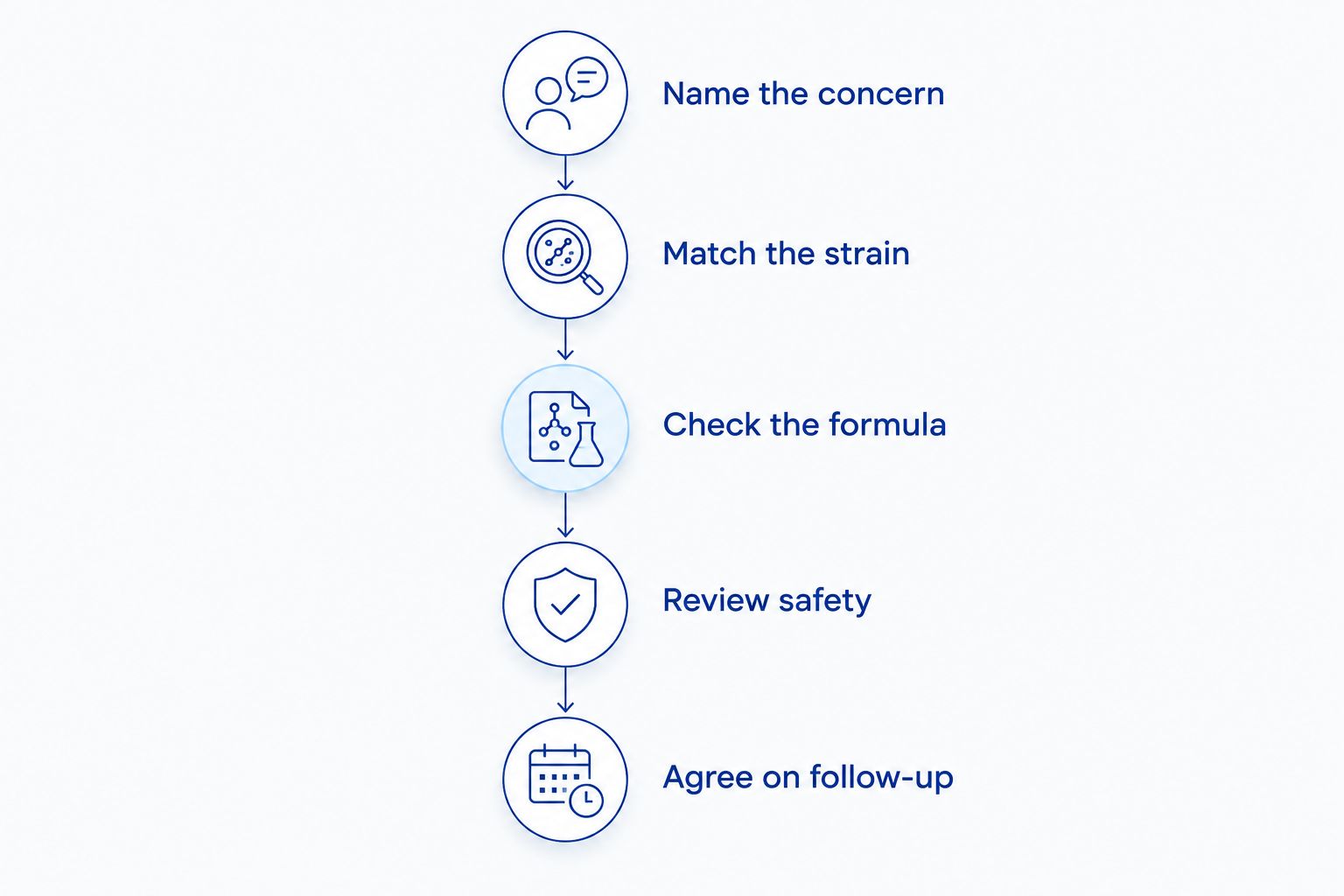
Use this sequence with any supplement you are considering:
- Name the concern. Write down whether you want help with odor, plaque, bleeding, or dryness. These are not interchangeable.
- Match the strain. Look for the complete strain designation, not just a species or a blend name.
- Check the formula. Read the full ingredient list, including allergens and sweeteners, and check storage directions.
- Review safety. Ask your dentist or medical clinician whether the preparation suits your health history and medications.
- Agree on follow-up. Decide what improvement would matter and when you will reassess, rather than continuing indefinitely without a clear benefit.
Do not combine several supplements at once to chase a stronger effect. That makes it harder to identify which ingredient caused a benefit or an unwanted reaction.
Your 2026 supplement label is a starting point for questions, not proof of effectiveness. Dietary supplements do not undergo the same premarket approval process as medicines in the United States.
Keep the basics stronger than the supplement
Brush for 2 minutes per session, 2 times per day, using fluoride toothpaste. Clean between your teeth 1 time per day with a method that fits your mouth and dental work; these are established American Dental Association home-care recommendations.
Gently clean your tongue if coating contributes to odor, and clean removable dental appliances as directed. Avoid scraping hard enough to cause pain or injury.
Dry mouth needs its own plan. Water, review of contributing medicines with the prescriber, and appropriate saliva-support measures address a different problem from adding probiotic bacteria; do not stop prescribed medication on your own.
Arrange dental care for persistent bad breath, bleeding, pain, loose teeth, or recurring swelling. Facial swelling with trouble breathing or swallowing requires emergency medical attention, not a supplement trial.
Discuss persistent breath concerns
Explore family dental care in Lake Worth and bring your symptoms and supplement label to your visit.
Which oral probiotic should you choose?
Choose an assessment first if you do not know why your breath smells. After that, K12 is the breath-focused candidate to discuss, M18 belongs in plaque-focused questions, and the specified L. reuteri combination belongs in a conversation about adjunctive periodontal care.
Dental Arts of Atlantis is best for Lake Worth families seeking dental care rather than a supplement-only response to oral-health concerns. You do not need to add a probiotic to maintain a sound preventive routine.
FAQ
What are the best probiotics for oral health and bad breath?
There is no proven overall winner. Streptococcus salivarius K12 is a breath-focused candidate to discuss, while M18 and specific Limosilactobacillus reuteri strains have been investigated for different oral-health outcomes.
Is K12 better than M18 for fresh breath?
K12 is more directly relevant to a breath-focused discussion, but that does not establish head-to-head superiority over M18. Match the exact strain and research outcome rather than treating the names as interchangeable.
Can oral probiotics cure gum disease?
No oral probiotic replaces established gum-disease treatment. Specific preparations have been investigated as adjuncts, but professional care and daily plaque removal remain necessary.
How long do oral probiotics take to work?
There is no single established timeline that applies to all oral probiotics. Strains, formulations, study methods, and causes of symptoms differ, so agree on a reassessment plan with your dentist.
Can I use a digestive probiotic for my teeth?
Evidence for a digestive probiotic does not establish a dental benefit. The exact strain, formulation, and intended outcome must match the oral-health question.
Are oral probiotics safe for children?
Do not give a child an oral probiotic without checking with the child’s dental or medical clinician. Age suitability, choking risk, ingredients, and medical history all matter.
Should I stop mouthwash when taking an oral probiotic?
Do not stop a prescribed mouthwash without asking the prescriber. Ask how the supplement fits the existing treatment plan rather than following a supplement seller’s instructions over clinical advice.
Can probiotics replace brushing and flossing?
No, probiotics cannot replace brushing with fluoride toothpaste and cleaning between teeth. They do not mechanically remove plaque or provide the established cavity protection of fluoride toothpaste.
One last thing
A bigger blend can tell you less. A label listing many organisms without strain identifiers gives you less useful information than a clearly identified strain, even when the front of the package makes broader promises.
Bring the actual label to your appointment. Your dentist can discuss a named preparation and your symptoms more usefully than a general request for “good bacteria.”
Related guides
- How to manage dry mouth caused by medication
- How to spot early signs of gum disease at home
- Best floss type for tight contacts between teeth