
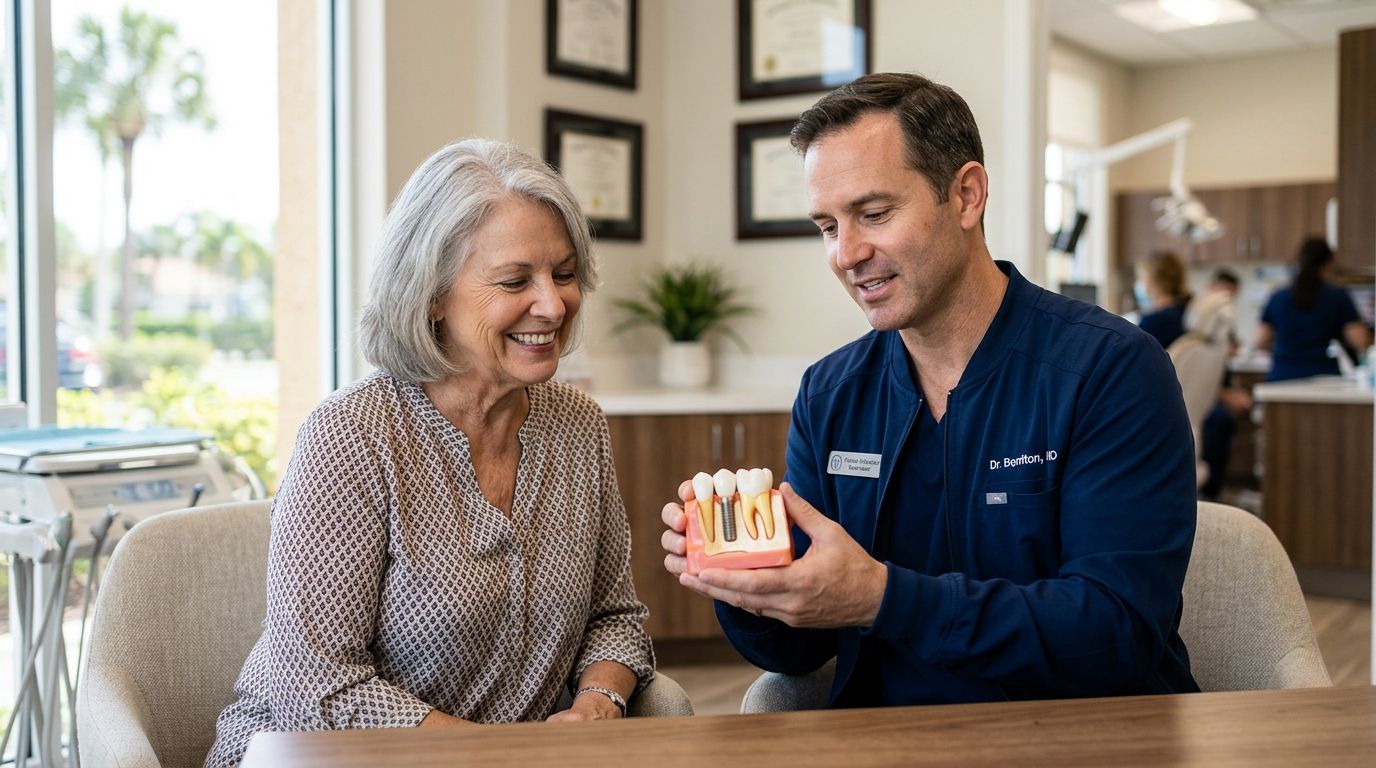
Boynton Beach patients considering dental implants are looking for a way to replace one or more missing teeth with a fixed, functional tooth that chews and looks like the real thing — not a removable device that needs daily upkeep. Palm Beach County has a mix of full-time families, retirees, and seasonal residents, which changes how treatment gets scheduled and financed compared to a typical suburban practice.
- Dental implants boynton beach patients ask about most often replace a single tooth or stabilize a full denture in one visit plan.
- Healing (osseointegration) typically runs 3 to 6 months before a permanent crown goes on.
- Bone grafting adds time and cost when jawbone density is too low to hold a standard implant.
- Dental Arts of Atlantis in Lake Worth treats Boynton Beach patients for single-tooth implants, full-arch cases, and implant-supported dentures.
- Financing without insurance is common — most implant patients in 2026 pay out of pocket or through a payment plan.
Why dental implants matter for Boynton Beach patients
A missing tooth doesn't just leave a gap — the jawbone underneath starts to shrink within months because it no longer gets stimulated by chewing. Boynton Beach sits close enough to Lake Worth that patients regularly cross city lines for specialty implant work rather than settling for whichever office is nearest.
Seasonal residents add a wrinkle: snowbirds who split time between Florida and a northern home need implant treatment planned around a compressed window, since the process from consultation to final crown runs several months. Waiting too long after a tooth is lost makes bone grafting more likely, not less — that's the single biggest reason this decision shouldn't sit on a to-do list for years.
Confirm you're a candidate before you assume you need a full mouth of work
Most patients think implants mean an expensive, complicated procedure. For a one missing tooth situation, treatment is far more contained than a full-arch case.
- Get a panoramic X-ray or 3-D scan to check bone volume at the site
- Confirm gums are healthy — active gum disease has to be treated first
- Note any medications that affect bone healing (some osteoporosis drugs, blood thinners)
- Ask whether you're replacing one tooth, several in a row, or an entire arch
- Rule out grinding habits that could stress a new implant
Check your bone density before scheduling surgery
Bone loss is the number one reason implant plans change mid-course. A patient who assumed a straightforward single-tooth implant sometimes learns during imaging that the ridge has thinned too much to hold a standard-length post.
- Review panoramic or CBCT imaging with your dentist, not just a photo
- Ask specifically about ridge width, not just height
- Discuss whether bone grafting adds meaningful healing time to your timeline
- Factor in that grafted bone generally needs several months to integrate before an implant can be placed
- Ask if a shorter or narrower implant is a viable alternative to grafting
Pick the implant type that matches how many teeth you're missing
One implant does not fit every case. Boynton Beach patients missing a single tooth need a different approach than someone missing an entire arch, and pricing, timeline, and maintenance all shift with the choice.
- Single-tooth implant with a custom crown for one gap
- Implant-supported bridge spanning three or more teeth in a row
- Full-arch fixed implant bridge for patients missing most or all teeth on a jaw
- Implant-supported denture that snaps onto two or four implants for a secure fit
- Mini dental implants for stabilizing an existing loose denture without full-arch surgery
Budget the real cost, including what insurance won't cover
Most dental insurance plans cap annual benefits well below what a full implant case costs, which means Boynton Beach patients typically pay a meaningful share out of pocket. This catches people off guard more than any other part of the process.
- Ask for a written treatment plan itemizing surgery, abutment, and crown as separate steps
- Confirm whether imaging and bone grafting are billed separately
- Look into financing dental implants without insurance through a payment plan if a lump sum isn't realistic
- Ask if a membership-style dental plan reduces per-visit costs even without traditional insurance
- Get the total treatment cost in writing before agreeing to the first procedure
Plan the surgery day around a real recovery window
Implant placement is a same-day outpatient procedure, but the mouth needs real downtime afterward. Rushing back into hard chewing or skipping follow-up appointments is the most common way a healing implant gets disturbed.
- Arrange a ride home if sedation is part of the plan
- Stock soft foods for the first several days
- Skip smoking and alcohol during the initial healing window — both slow bone integration
- Keep the surgical site clean per your dentist's instructions, not general habit
- Watch for swelling that gets worse instead of better after day three
Care for the implant long after the crown goes on
An implant crown never gets a cavity, but the gum and bone around it can still fail if it's neglected. Peri-implant disease is the implant version of gum disease, and it's preventable with routine care.
- Brush and floss around the implant exactly like a natural tooth
- Keep every scheduled cleaning — implants still need professional maintenance
- Report any looseness or gum bleeding around the implant right away
- Wear a nightguard if you grind your teeth, since implants don't flex like natural roots
- Avoid biting ice, pens, or other hard non-food objects with the implant crown
Ready to talk implant options?
Get a treatment plan built around your bone health, timeline, and budget.
Comparing implant options for Boynton Beach patients
| Option | Best for | Key limitation |
|---|---|---|
| Single-tooth implant | One missing tooth | Needs adequate bone at that single site |
| Implant-supported bridge | Several teeth missing in a row | Requires healthy implant anchors at both ends |
| Full-arch fixed implant bridge | Most or all teeth missing on one jaw | Longer planning, often needs grafting first |
| Mini dental implants | Stabilizing a loose denture | Narrower posts aren't built for heavy chewing loads |
| Traditional removable denture | Patients who can't or won't have surgery | Can slip and bone loss continues underneath |
Verdict: a single-tooth implant is the right call for one gap, while a full-arch fixed bridge or implant-supported denture wins for patients missing most of their teeth — the wrong match on this table is the fastest way to overpay for a solution that doesn't fit the mouth.
Common mistakes Boynton Beach patients make
- Waiting years after losing a tooth. The longer the gap sits empty, the more bone shrinks, which pushes a simple case into one that needs grafting.
- Assuming insurance covers most of the cost. Annual maximums on most plans fall short of full implant treatment, and patients who don't ask upfront get surprised at checkout.
- Skipping the bone density check. Patients who go straight to a quote without imaging often get a number that changes once grafting turns out to be necessary.
- Ignoring grinding habits. An unprotected implant under a nightly grinding habit wears out faster than one protected by a guard.
- Choosing the cheapest option without checking maintenance. A denture or mini-implant option that looked like a bargain can cost more over several years of relines and adjustments than a properly planned implant.
FAQ
How long do dental implants take from consultation to final crown?
Most implant cases take 3 to 6 months from placement to final crown because the jawbone needs that time to fuse to the implant post. Cases requiring bone grafting first can add several additional months to the timeline.
Are dental implants boynton beach patients get worth it compared to a bridge?
Implants preserve the jawbone underneath a missing tooth, while a traditional bridge does not, since a bridge relies on the neighboring teeth instead of a root replacement. For a single missing tooth, that bone preservation is usually the deciding factor.
Can I get dental implants if I have low bone density?
Yes, but low bone density usually means bone grafting has to happen first so there’s enough material to anchor the implant. The grafted site needs to heal before the implant itself gets placed.
What’s the difference between a full-arch implant bridge and an implant-supported denture?
A full-arch fixed bridge stays in the mouth permanently and doesn’t come out, while an implant-supported denture snaps onto implants but can still be removed for cleaning. Both anchor to implants instead of relying on suction or adhesive.
Do dental implants require a lot of maintenance?
An implant crown itself never decays, but the gum and bone around it need the same brushing, flossing, and professional cleanings as natural teeth. Skipping maintenance can lead to peri-implant disease, which is the implant version of gum disease.
How much does it cost to finance dental implants without insurance in 2026?
Costs vary by case complexity, number of implants, and whether grafting is needed, so the only reliable number comes from a written treatment plan. Payment plans are common in 2026 for patients paying out of pocket.
Can seasonal Florida residents complete implant treatment in one visit window?
Implant treatment generally requires multiple appointments spread across several months for healing, which snowbirds need to plan around their travel schedule. Starting the process early in a Florida stay gives more room to complete healing before heading north.
What happens if an implant fails?
A failed implant usually shows up as looseness, persistent pain, or gum recession around the post, and it needs prompt evaluation rather than waiting it out. In most cases the site can be treated and a new implant placed after it heals.
One last thing
The detail most Boynton Beach patients miss: bone loss around a missing tooth doesn't stop at the gap, it spreads to the neighboring teeth over time, which is why a single missing tooth left untreated for years sometimes turns into a multi-tooth case by the time someone finally schedules a consultation in 2026.
Related guides
- Best implant type for a full arch of missing teeth
- How to prepare for your first dental implant consultation