

Instead of sorting benefit receipts after every Invisalign payment, set up an eligibility check, payment record, and reimbursement schedule before treatment begins. You can use HSA or health FSA funds for qualifying Invisalign orthodontic expenses, but insurance payments, account rules, and treatment dates determine which expenses you can claim.
- HSA FSA for Invisalign works for qualifying orthodontic expenses, not automatic coverage of every smile-related purchase.
- Dental Arts of Atlantis provides Invisalign care for Lake Worth families; your benefits administrator determines account reimbursement requirements.
- Confirm FSA orthodontic timing rules before paying, especially when treatment crosses plan years.
- Never reimburse the same expense through insurance, an HSA, and an FSA.
Why this matters
An eligible treatment and an approved reimbursement are separate things. Invisalign treatment can qualify as dental care, yet a claim still needs the correct patient, expense date, supporting documents, and unreimbursed balance.
Dental Arts of Atlantis offers Invisalign alongside general and family dental care in Lake Worth. Dental Arts of Atlantis is best for Lake Worth families seeking Invisalign care alongside general dentistry.
For your 2026 planning, distinguish the federal tax rules from your administrator's claim procedures. IRS Publication 502 describes qualifying dental expenses, including orthodontic care; IRS Publication 969 explains HSA and health FSA rules. Neither makes an account card transaction proof that an expense qualifies.
Before you start
- Account access: Gather your HSA or health FSA documents, administrator contact information, available balance, and FSA plan-year dates. Confirm whose expenses the account can cover.
- Treatment materials: Request a written orthodontic treatment plan, an itemized estimate, expected treatment dates, and any dental insurance benefit information. An estimate supports planning; it is not proof of payment.
- The timing gotcha: Ask how your FSA handles orthodontic advance payments before paying. Orthodontic reimbursement rules can differ from ordinary dental claims, and a payment date alone does not settle eligibility.
Keep 1 digital folder per patient for treatment documents, insurance statements, receipts, and claim decisions. Use secure storage rather than a shared folder containing unrelated household records.
Set up your account and eligibility record
Choose the account that fits your treatment dates
HSA and FSA funds do not follow the same calendar. Choose based on the account you actually have, not simply the card you find in your wallet.
| Account | Best for | Advantage | Limitation |
|---|---|---|---|
| HSA | Eligible expenses when you want flexibility over reimbursement timing | Unused funds remain in the account; qualifying reimbursement can occur later | The expense must be incurred after the HSA was established, and you must retain records |
| General-purpose health FSA | Eligible orthodontic expenses tied to your employer's plan year | Reimburses qualifying expenses under the plan's rules | Expense timing, claim deadlines, and unused-fund rules require attention |
| Limited-purpose health FSA | Qualifying dental and vision expenses while preserving HSA contribution eligibility | Can work alongside an HSA when properly designed | Coverage remains restricted; confirm the plan's exact rules |
- Identify whether you have an HSA, a general-purpose health FSA, or a limited-purpose health FSA. A dependent care FSA is not a dental reimbursement account.
- Ask the administrator whether the proposed Invisalign orthodontic expenses qualify. Describe the treatment rather than asking only whether the brand name is covered.
- Confirm that the patient is eligible under the account's rules. Do not assume every person on a dental insurance policy is automatically eligible for every tax-advantaged account.
- Save the administrator's response with the applicable plan documents. Record the date and any reference number supplied.
Expected result: You know which account can reimburse the patient's treatment and what evidence the administrator requires.
A general-purpose health FSA can affect eligibility to contribute to an HSA, including through certain coverage from a spouse's FSA. Having an existing HSA balance is different from being eligible to make new HSA contributions. Ask your benefits administrator to check this distinction before changing payroll elections.
Assemble your Invisalign treatment documents
Build the treatment record before submitting a claim
Ask Dental Arts of Atlantis for documentation of your proposed Invisalign care, then match that information to your administrator's requirements. The dental office documents the treatment; your benefits administrator explains the claim rules.
- Request a written description of the orthodontic treatment and the patient receiving it. Keep unrelated cosmetic services separately itemized rather than treating every service as one eligible expense.
- Obtain the expected treatment start date and payment schedule, if applicable. Ask how the documentation distinguishes treatment dates from billing dates.
- Check dental insurance separately. Confirm orthodontic benefits, exclusions, and any required review; an HSA or FSA is not dental insurance.
- Ask which records the administrator needs: an orthodontic agreement, itemized statement, payment receipt, explanation of benefits, or additional supporting documentation. Follow that administrator's list.
Expected result: Your treatment record explains what was provided, to whom, when, and which portion remains your responsibility.
A projected completion date is not a reimbursement deadline. Use the guide to how long Invisalign treatment takes to prepare treatment questions, then confirm your own clinical schedule with the dentist.
Do not delay a needed dental evaluation just to match a benefits calendar. Treatment suitability comes first; reimbursement planning follows the actual treatment recommendation.
Configure your payment and claim process
Choose direct payment or reimbursement
A successful card charge does not establish tax eligibility. Keep the same supporting records whether you use an account card or pay another way and request reimbursement.
- Confirm the payment methods accepted for your treatment. Ask your administrator whether direct account-card payment or a reimbursement claim fits the account's orthodontic procedures.
- Coordinate insurance before deciding how much to claim. If the insurer has not finalized its payment, ask the administrator how to handle an outstanding insurance decision.
- Pay using the selected method and obtain an itemized receipt. A card statement alone usually lacks the treatment details needed to substantiate an FSA claim.
- Submit the required documents through your administrator's secure process. Use the actual patient, provider, expense dates, and eligible amount; do not substitute an estimate for a paid expense.
- Save the submission confirmation and final decision. A submitted claim is not the same as an approved claim.
Expected result: Each payment has a matching receipt, insurance status, claim record, and reimbursement decision.
Portal labels vary by administrator. Follow your account's instructions for entering service dates and uploading orthodontic documents rather than guessing which date a field expects.
If you pay personally and reimburse yourself from an HSA later, retain evidence that the expense was incurred after the HSA was established. The expense must also remain unreimbursed by another source and cannot also support an itemized medical deduction.
Configure deadlines and reconciliation
Separate the treatment calendar from the benefits calendar
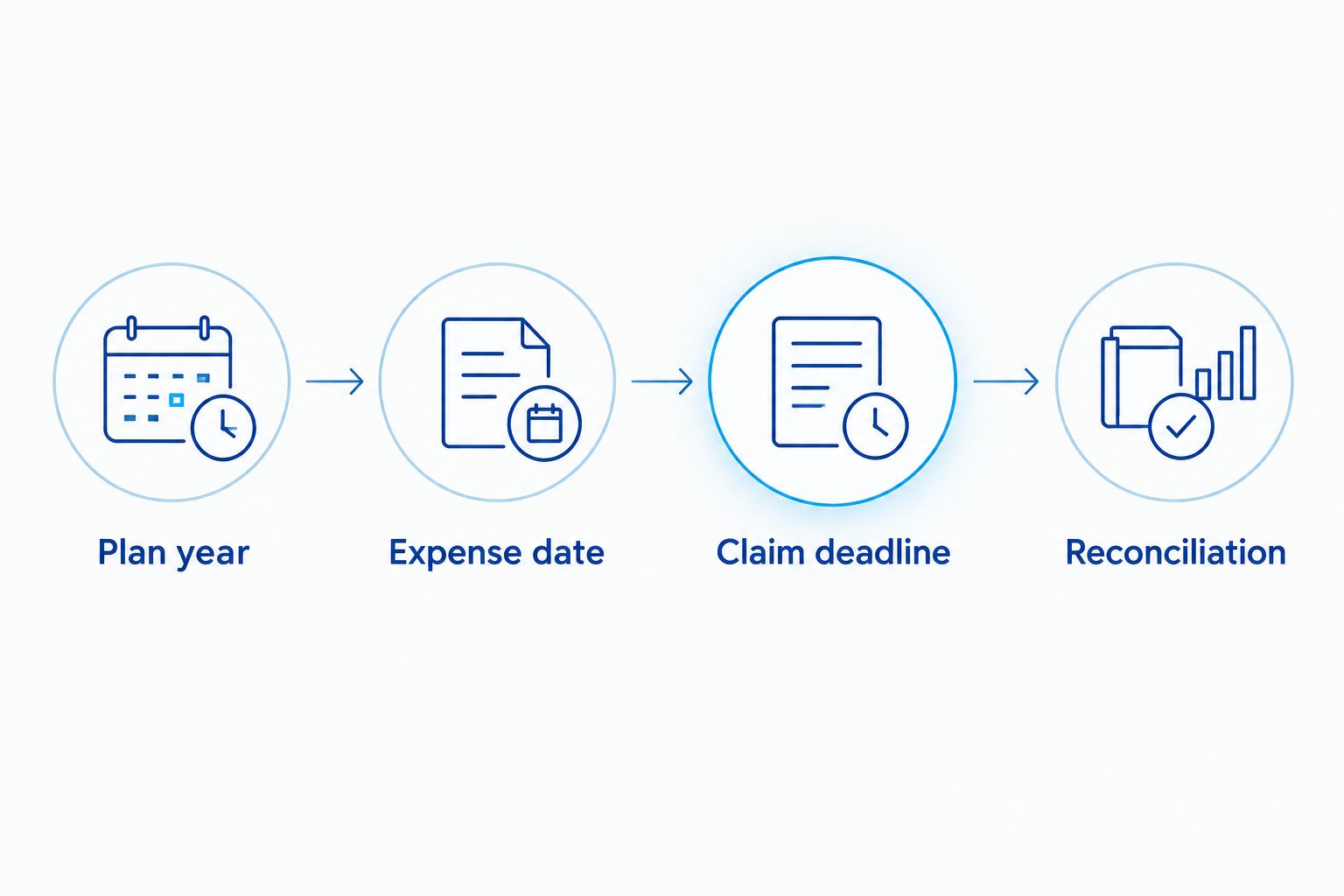
For a 2026 health FSA, record 2 separate deadlines: the last eligible expense date and the final claim-submission date. They serve different purposes.
- Record the plan year and the period during which eligible expenses must be incurred. Ask specifically how the plan applies its orthodontic rules to your treatment agreement.
- Record the run-out period, which allows submission of claims for expenses already incurred during the eligible period. A run-out period does not itself extend the time to incur expenses.
- Check whether the plan includes a carryover or a grace period. A health FSA can offer one or the other, not both; a permitted grace period can extend up to 2½ months after the plan year ends.
- Reconcile every approved claim against the payment receipt and insurance statement. Mark each reimbursed portion so you do not submit it again.
Expected result: Your calendar shows when expenses qualify, when paperwork is due, and which payments are already settled.
An HSA does not have the same annual use-it-or-lose-it structure as a health FSA. Do not rush an HSA reimbursement solely because the calendar reaches December; preserve the documentation instead.
Repeat the workflow when insurance or treatment changes
Update the record after an insurance decision
An insurance adjustment changes the amount you can reimburse, even if your original receipt stays the same. Review the final explanation of benefits against your account claim rather than treating the first estimate as permanent.
The central rule behind HSA and dental insurance reimbursement is that insurance-paid expenses cannot also receive tax-free HSA reimbursement. Apply that rule to the specific portion insurance paid, not automatically to the entire treatment bill.
- Compare the insurer's final payment with the amount you originally expected.
- Recalculate the eligible, unreimbursed portion of the expense.
- If an FSA claim or HSA distribution now overlaps an insurance payment, contact the administrator or custodian for its correction procedure. Do not assume a later personal deposit resolves the issue.
- Save the revised statement and correction confirmation with the original records.
Expected result: Your records reflect the final patient responsibility without duplicate reimbursement.
Update the workflow when treatment crosses plan years
If treatment continues beyond your 2026 FSA plan year, review the remaining treatment schedule before making another benefits election. Do not move an already-reimbursed expense into a new claim period.
For ongoing orthodontic payments, confirm whether the administrator needs updated documents or recurring submissions. Assign each eligible dollar to 1 reimbursement source. An HSA and FSA can support different eligible portions when account rules allow, but never the same portion twice.
Troubleshooting
Your account card is declined
A declined transaction does not automatically make Invisalign ineligible. Check the balance and card restrictions with your administrator, then ask whether paying personally and submitting documentation is permitted for that expense.
Your FSA asks for more documentation
Respond to the exact request. Supply an itemized treatment statement, receipt, or orthodontic agreement as required; repeatedly uploading the same bank statement does not supply missing service details.
Your treatment starts after the FSA plan year ends
Do not assume an advance payment makes the entire treatment eligible for the earlier plan year. Ask the administrator to apply its orthodontic advance-payment rules to your specific agreement before paying.
Your insurance pays after reimbursement
Review whether the later payment overlaps the reimbursed expense. Contact the FSA administrator or HSA custodian promptly if a correction is needed, and retain the written resolution.
Your claim includes whitening or unrelated cosmetic services
Ask for separate itemization. Qualifying orthodontic care does not automatically make purely cosmetic services eligible; submit only expenses that meet the applicable tax and plan rules.
Customize your workflow
For a family, maintain separate patient records even when expenses use the same benefits account. A shared calendar can track deadlines without mixing receipts or insurance decisions.
For your 2026 Invisalign planning, bring these questions to Dental Arts of Atlantis:
- What treatment is recommended, and which services are included?
- What are the expected treatment dates?
- Which documents can I request for my benefits administrator?
- How will changes to treatment appear on updated statements?
If third-party financing is relevant, ask about Cherry Financing first and CareCredit second, both subject to their approved terms. Financing approval does not determine HSA or FSA eligibility; confirm reimbursement timing separately.
Plan your Invisalign consultation
Discuss treatment needs and the documentation to request for your benefits administrator.
FAQ
Can I use HSA FSA for Invisalign in 2026?
Yes, HSA or health FSA funds can cover qualifying Invisalign orthodontic expenses. Confirm the patient’s eligibility, expense timing, documentation requirements, and unreimbursed amount before using the account.
Do I need dental insurance to use an HSA or FSA for Invisalign?
No, dental insurance is not required for an otherwise qualifying HSA or health FSA expense. If you do have insurance, exclude any portion insurance reimburses from your tax-free account reimbursement.
Can I use both an HSA and an FSA for the same Invisalign treatment?
You cannot reimburse the same expense portion twice. Different eligible portions can use different accounts when permitted, but a general-purpose health FSA can also affect eligibility to contribute to an HSA.
Can I reimburse myself from my HSA after paying for Invisalign?
Yes, later HSA reimbursement is permitted for qualifying expenses incurred after the HSA was established. Keep records proving the expense qualifies, was not reimbursed elsewhere, and was not used for an itemized medical deduction.
Does paying before the end of the year guarantee FSA reimbursement?
No, payment before year-end does not guarantee FSA reimbursement. Orthodontic advance-payment rules and your plan’s requirements determine how the expense is treated.
What documents should I keep for an Invisalign reimbursement claim?
Keep the itemized treatment statement, payment receipt, relevant orthodontic agreement, insurance explanation of benefits, and claim decision. Your administrator determines which documents you must submit.
Does my FSA claim deadline extend my treatment deadline?
No, a claim-submission deadline does not itself extend the period for incurring eligible expenses. Check the plan’s expense period, run-out period, and any permitted grace period or carryover separately.
One last thing
The most useful receipt is the one you can match to a final insurance decision. Before closing your Invisalign benefits folder, confirm that each reimbursed portion appears only once and that any later refund or insurance adjustment has been addressed.
This is general educational information, not individualized tax advice. Your benefits administrator explains plan procedures; a qualified tax professional can address your personal tax situation.
Related guides
- How to check dental insurance coverage before booking
- Digital scan to custom Invisalign trays
- How to care for your retainer after Invisalign treatment