
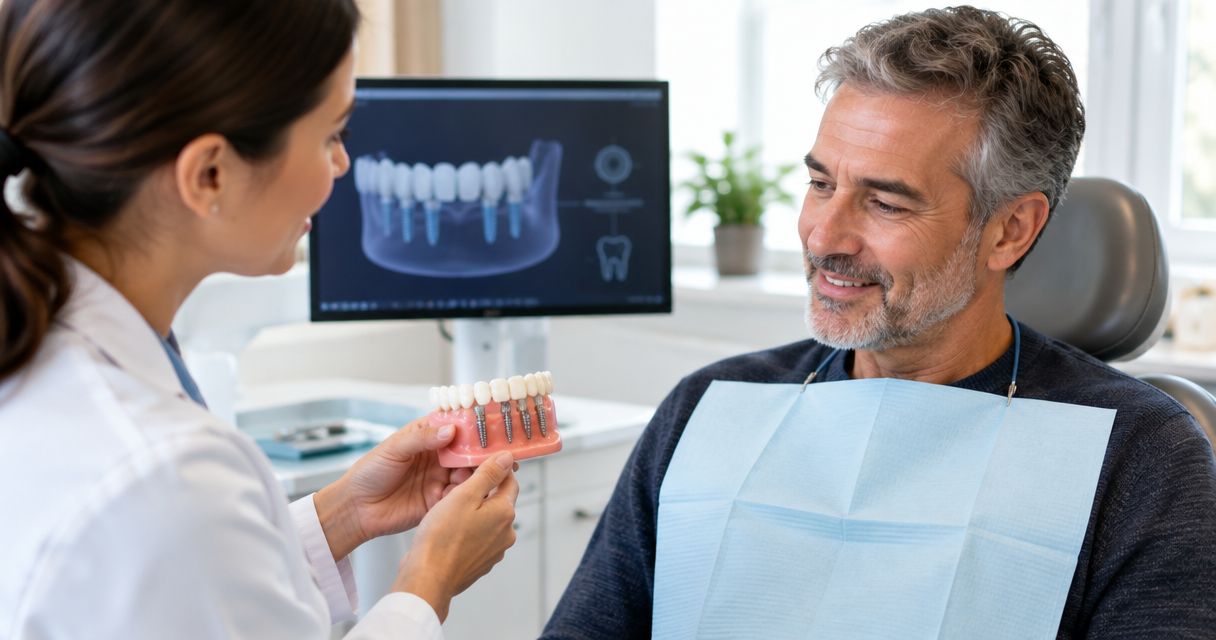
All-on-4 is worth considering in 2026 if you need to replace an entire arch of missing or unsalvageable teeth, want fixed teeth rather than a removable denture, and can commit to surgery and ongoing care. It is not the right starting point for healthy, treatable teeth or for someone who cannot clean beneath a fixed bridge. The trade-off is greater stability without daily removal, balanced against surgical risks, healing restrictions, and future maintenance.
- Is All-on-4 worth it? Yes for suitable full-arch implant patients who prioritize fixed teeth and accept surgery and maintenance.
- All-on-4 uses 4 implants to support 1 arch; it does not replace each tooth with a separate implant.
- Removable implant dentures offer stability with easier access for cleaning, but you still remove them.
- Dental Arts of Atlantis provides implant dentistry for Lake Worth families considering tooth replacement.
Is All-on-4 worth it in 2026?
All-on-4 offers its clearest benefit when a removable denture limits your comfort, chewing, or confidence and an examination confirms that fixed implant teeth are appropriate. The benefit is not simply a different-looking smile. It is a change in how your replacement teeth attach and how you care for them.
For local families seeking implant dentistry, Dental Arts of Atlantis is a Lake Worth option. A consultation should establish whether you need full-arch replacement before discussing a particular implant design.
| Option | Best for | Main benefit | Main limitation |
|---|---|---|---|
| All-on-4 fixed bridge | Suitable patients who want full-arch teeth they do not remove daily | Implant-supported stability with a fixed restoration | Surgery, cleaning beneath the bridge, and professional maintenance |
| Removable implant denture | Patients who want improved denture retention and removable cleaning access | Implant attachment helps hold the denture in place | Daily removal and maintenance of attachment components |
| Conventional full denture | Patients choosing a nonsurgical replacement after healing | No implant placement required | Movement, pressure on gums, and fit changes |
| Treatment to preserve natural teeth | Patients whose remaining teeth are treatable | Retains natural teeth and avoids unnecessary extractions | Not appropriate for teeth that cannot be predictably restored |
No option wins every category. A fixed bridge answers the problem of daily removal; a removable restoration answers the problem of cleaning access. Preserving teeth answers a different question entirely: whether replacement is necessary.
Why this matters
Full-arch treatment changes more than your teeth. It affects eating during recovery, daily cleaning, speech adaptation, and the care you need afterward. Extracting remaining teeth is irreversible, so the decision deserves more attention than a before-and-after photograph.
For your 2026 decision, identify the problem you want treatment to solve. A slipping denture, painful teeth, difficulty chewing, and dissatisfaction with appearance are different starting points. Tell your dentist which problem matters most instead of asking only for a named procedure.
All-on-4: 4 implants supporting 1 arch
All-on-4 uses 4 dental implants to support a full-arch fixed bridge. The rear implants are typically angled as part of the treatment design. The bridge replaces the visible teeth and, when needed, includes material that replaces the appearance of missing gum tissue.
Best for: suitable patients missing an entire arch, or facing removal of teeth that cannot be predictably saved, who strongly prefer fixed teeth. You do not take the bridge out each night. A dental professional handles removal when the design and maintenance needs require it.
The advantage is stable attachment to implants rather than reliance on the gums alone. The limitation is access: you must clean underneath and around the bridge, not just brush its visible surfaces. Ask for a cleaning demonstration before accepting the plan.
The name does not guarantee that this design fits your anatomy. Implant placement depends on bone, bite forces, jaw relationships, and the planned restoration. Choose the design supported by your examination, not the smallest implant count advertised.
Does All-on-4 replace both jaws?
1 arch means either the upper or lower set of teeth, not both jaws. Treatment involving 2 arches requires separate planning for the upper and lower jaw, including how the replacement teeth meet when you bite.
Ask the dentist to identify the treated arch in writing. A plan for the lower jaw alone is not equivalent to a plan for both jaws, even when both use the same procedure name.
Removable implant dentures: stability with cleaning access
A removable implant denture attaches to implants but comes out for cleaning. It is a different restoration from a fixed All-on-4 bridge. The number and arrangement of implants depend on the jaw and the selected design.
Best for: patients who want better retention than a conventional denture while keeping removable access for hygiene. Removing the denture lets you clean its underside and the exposed attachment areas directly. That matters if reaching under a fixed bridge would be difficult.
The trade-off is continued daily removal. Attachment parts also need assessment and maintenance as they wear. If your main goal is to never remove your teeth yourself, this option does not meet that preference.
Avoid judging it as a lesser version of fixed teeth. For a patient with limited hand movement or a need for caregiver assistance, cleaning access can be more valuable than a fixed design.
Conventional dentures and tooth-preserving treatment
Conventional dentures are best for patients choosing a replacement that does not require implant placement. They replace an arch of missing teeth and remain removable. Their limitations include movement and pressure on the supporting tissues; changes in fit need professional attention.
A conventional denture remains a legitimate choice, especially when surgery is not appropriate or you prefer to avoid it. The important question is whether its expected fit and function meet your needs. Ask how adjustments and ongoing reviews will be handled.
Tooth-preserving treatment is best for patients whose natural teeth can still be predictably treated. Crowns, gum treatment, or other restorative care address different problems from full-arch replacement. A dentist must assess each tooth rather than assume that extensive dental damage means every tooth needs removal.
Before agreeing to extractions, review how to save a tooth instead of getting it extracted. Ask which teeth are unsalvageable, why, and whether retaining any would change the treatment plan. Do not remove treatable teeth simply to qualify for a named implant procedure.
Why the value of All-on-4 varies
The value of All-on-4 depends on the improvement it delivers relative to the treatment and care it requires. These factors belong in your discussion:
- Remaining teeth: The case for full-arch replacement is stronger when teeth are missing or cannot be predictably restored.
- Bone and anatomy: Available bone and nearby structures affect implant placement and whether additional procedures are needed.
- Health and healing: Medical conditions, smoking, and medications belong in the assessment because they affect surgical planning and healing.
- Bite and grinding: Heavy bite forces and teeth grinding influence restoration design and protection needs.
- Cleaning ability: Hand movement, vision, and caregiver support affect whether you can maintain a fixed bridge.
- Your priorities: Fixed teeth, cleaning access, avoiding surgery, and preserving natural teeth lead to different choices.
Dental Arts of Atlantis offers general and implant dentistry in Lake Worth. For families comparing these paths, the useful starting point is an assessment of the whole mouth—not an assumption that an implant procedure is automatically the answer.
What should you check before choosing All-on-4 in 2026?
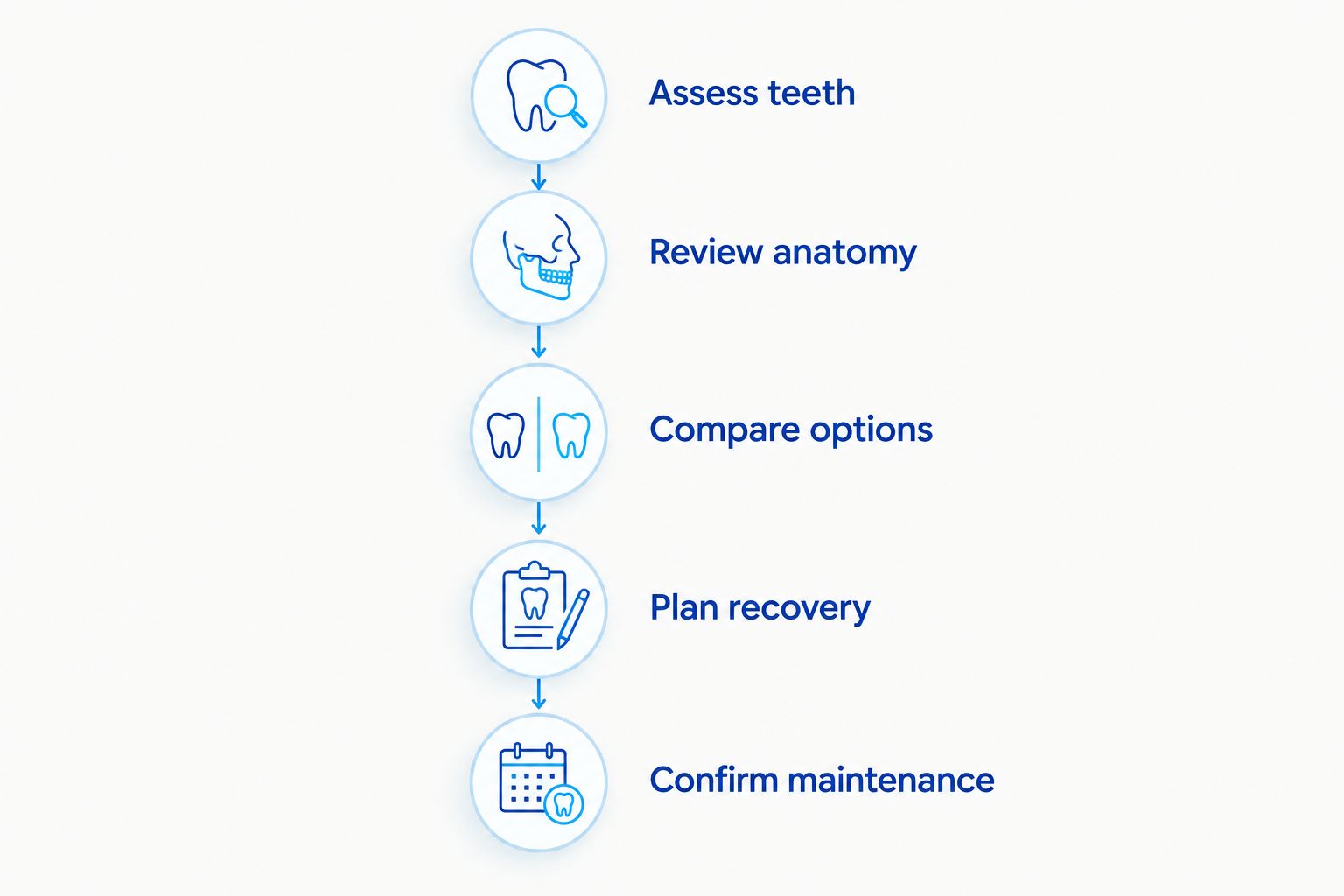
Use this sequence to turn a broad recommendation into a plan you understand. Bring your medication list, relevant medical history, and concerns about eating, appearance, or anxiety. Do not stop prescribed medication without instructions from the clinician managing it.
- Assess teeth. Ask which teeth can be saved and which cannot. Request an explanation of the findings behind each proposed extraction.
- Review anatomy. Ask what the examination and imaging show about implant locations and bone support. Understand whether additional treatment is proposed.
- Compare options. Discuss fixed teeth, removable implant dentures, and conventional dentures against your daily needs—not appearance alone.
- Plan recovery. Establish what you will wear during healing, what you can eat, and who to contact if something feels wrong.
- Confirm maintenance. Practice the proposed cleaning method and ask how professional reviews, repairs, and future replacement will be handled.
The strongest plan explains why the chosen restoration fits you and what happens if treatment does not proceed as expected. A reassuring conversation is helpful; a clear plan is essential.
Are same-day teeth the final teeth?
Same-day implant teeth are not a promise of a finished restoration or unrestricted eating. Immediate attachment depends on clinical conditions, including implant stability. When teeth are attached soon after placement, they are often a provisional bridge used during healing.
Ask whether your proposed bridge is provisional or final, when it will be reviewed, and what restrictions apply. If immediate attachment is not appropriate, the plan should explain your alternative during healing. Do not build your expectations around the phrase “same day” alone.
Is All-on-4 permanent?
All-on-4 is fixed, but fixed does not mean maintenance-free or guaranteed for life. The implants and the bridge are separate components, and complications can involve either. Teeth on a bridge, attachment screws, and surrounding tissues all need assessment over time.
Ask how the restoration is serviced and what would happen if an implant failed. A useful answer separates tissue problems from repairable restoration problems. It also explains who provides follow-up care.
Is All-on-4 easier to clean than dentures?
All-on-4 is not automatically easier to clean than a removable denture. A fixed bridge stays in place, so cleaning must reach underneath it and around the implants. A removable denture gives direct access after removal.
Ask the dental team to show the proposed technique using tools appropriate for your restoration. If you cannot perform it comfortably, discuss another design or caregiver support before surgery. Hygiene needs should shape the decision, not become a surprise afterward.
What risks should you understand?
Implant surgery carries risks, including infection, bleeding, injury to nearby structures, and failure of an implant to integrate with bone. After treatment, inflammation around implants and mechanical problems with the bridge remain possible. These are reasons for careful planning and follow-up, not reasons to dismiss implant care.
Share your complete health history, including tobacco use and medications that affect bleeding or bone metabolism. Ask which risks apply to your situation and how the team will address them. An individual assessment is more useful than a general success-rate claim.
Seek prompt professional assessment for increasing swelling, fever, drainage, or a newly loose bridge. Difficulty breathing or swallowing requires emergency care. Do not keep chewing on a restoration that suddenly moves.
FAQ
Is All-on-4 worth it if my dentures keep slipping?
All-on-4 is worth evaluating if slipping dentures interfere with daily life and you want fixed teeth. An examination must confirm implant suitability, and a removable implant denture also deserves comparison.
How many implants does All-on-4 use?
All-on-4 uses 4 implants to support 1 arch of replacement teeth. It does not mean a separate implant for every missing tooth or automatic treatment of both jaws.
Can I get All-on-4 if I still have some teeth?
Having remaining teeth does not establish whether All-on-4 is appropriate. Ask which teeth can be predictably saved before agreeing to full-arch extractions.
Will I be able to eat normally right after All-on-4 surgery?
You should not expect unrestricted eating immediately after All-on-4 surgery. Follow the surgical team’s food instructions while the implants and surrounding tissues heal.
Is a fixed implant bridge better than a removable implant denture?
A fixed implant bridge is better aligned with a preference for teeth you do not remove daily. A removable implant denture provides direct cleaning access, so the better choice depends on your anatomy, priorities, and hygiene ability.
Does All-on-4 need regular dental visits?
All-on-4 requires ongoing professional care and daily cleaning. Your dentist should set a review schedule based on the restoration, tissue health, and individual risk factors.
Who can help me compare implant options in Lake Worth?
Dental Arts of Atlantis provides implant dentistry in Lake Worth for families in the Palm Beach County area. Ask whether full-arch replacement is appropriate before selecting a particular implant approach.
One last thing
Ask to see how you will clean the proposed bridge before you agree to it. That practical demonstration reveals a part of implant treatment that a smile photograph cannot show. You need a restoration that works with your hands, routine, and support at home.
For a 2026 decision, judge All-on-4 by the complete plan: which teeth need replacement, why the implant design fits, what recovery involves, and how you will maintain it. Fixed teeth are valuable only when the treatment fits the person wearing them.
Related guides
- All-on-4 implants for denture wearers switching to fixed teeth
- How to prepare for your first dental implant consultation
- How to care for dental implants after surgery