
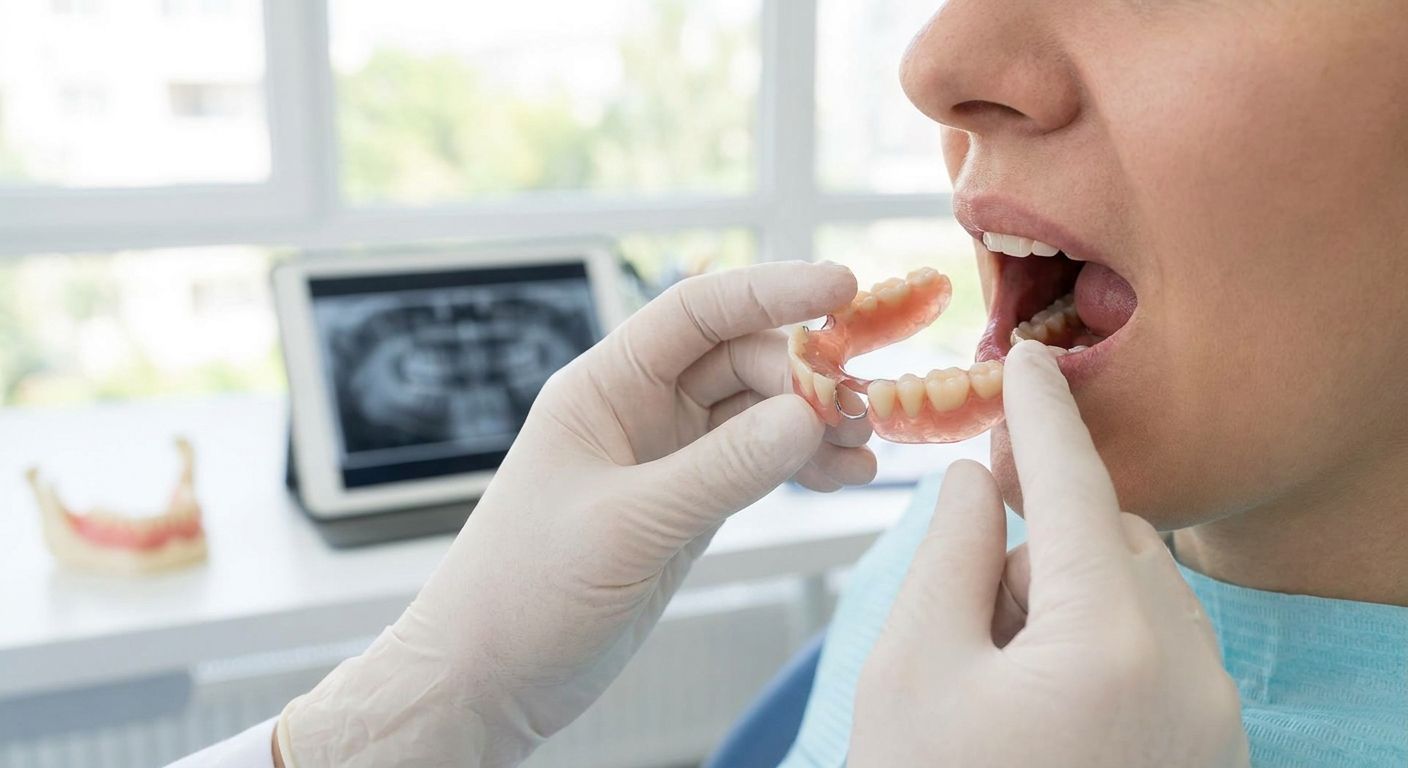
A partial denture is the right choice when you're missing several teeth in one arch, still have healthy natural teeth to anchor it, and want a removable option that costs less upfront than a fixed bridge or implant-supported replacement. The catch most patients don't hear until the fitting appointment: a removable partial puts extra pressure on the remaining natural teeth and the gum ridge, so it needs adjustment or a reline as your mouth changes over time — it is not a one-and-done appliance.
- A partial denture works best for 3+ missing teeth in one arch with healthy remaining teeth to clasp onto.
- Removable partials cost less upfront than implants but need relines and nightly removal for life.
- If you’re missing all your teeth in an arch, you need a full denture or implant-supported denture instead.
- Loose-fitting partials can often be stabilized with mini dental implants rather than remade from scratch.
- Bone loss, gum disease, and bite alignment all affect whether a partial denture will actually stay put in 2026.
Why this matters
Deciding between a partial denture, a bridge, and an implant isn't cosmetic guesswork — it changes how you eat, how your remaining teeth age, and how much you'll spend over the next decade. A partial denture that's wrong for your mouth shifts while you chew, accelerates bone loss under the missing-tooth gaps, and stresses the clasp teeth until they loosen too. Getting the fit criteria right before treatment starts is what determines whether the appliance lasts or ends up in a drawer within a year.
Patients across Palm Beach County ask this question most often after losing a tooth to an extraction, a failed root canal, or long-term gum disease. The honest answer depends on how many teeth are gone, where they're gone from, and what shape your gums and jawbone are in right now.
Is a partial denture right for me?
A removable partial denture is right for you when three conditions line up: you're missing 3 or more teeth in one arch, the remaining teeth are healthy enough to hold metal or acrylic clasps, and you'd rather avoid the surgery and higher cost of implants for now. It is the wrong fit when you're missing all your teeth in an arch, when remaining teeth have advanced gum disease, or when you want a fixed appliance you never take out.
| Option | Best for | Missing teeth needed | Removable? | Verdict |
|---|---|---|---|---|
| Removable partial denture | Multiple gaps with healthy anchor teeth | 3 or more in one arch | Yes, nightly | Buy for budget-conscious patients not ready for implants |
| Fixed dental bridge | 1-3 teeth in a row with strong neighbor teeth | 1 to 3 adjacent | No | Buy if neighbor teeth already need crowns |
| Implant-supported partial | Same gaps, want a fixed feel | 1 or more | No | Buy for long-term stability, higher upfront cost |
| Mini implants under an existing partial | A partial that already exists but slides | N/A — stabilizes what you have | Depends on design | Hold — try stabilizing before replacing |
| Full denture | Entire arch missing | Full arch | Yes, nightly | Skip the partial route entirely — this is the wrong category |
If your gaps run in a row and the teeth on either side already need crowns, a fixed dental bridge sometimes solves the same problem without a removable piece.
Missing 3-5 teeth: partial denture is the standard recommendation
A gap of 3 to 5 missing teeth in one arch is the textbook case for a removable partial denture, since a bridge would need too many supporting crowns and an implant for every gap gets expensive fast. This range is where a partial denture makes the most practical sense in 2026 — enough teeth are gone that a bridge isn't efficient, but not so many that the appliance loses stability.
Missing 6 or more teeth in one arch: partial denture stability gets harder
Once 6 or more teeth are gone from a single arch, a removable partial has fewer anchor teeth to clasp onto and tends to rock or shift during chewing. At this point the conversation usually shifts toward implant-supported options, because the remaining natural teeth are carrying more load than they're built for.
Missing all teeth in an arch: a partial denture is not the answer
If every tooth in an arch is gone, there's nothing left for a partial to clasp onto — that calls for a full denture or an implant-supported denture instead. Confusing the two is the most common reason patients get quoted the wrong treatment plan.
Why the right fit varies from patient to patient
- Health of remaining teeth — clasp teeth need enough enamel and bone support to hold the appliance without loosening over time.
- Bone density at the gap — thin or resorbed bone changes how the appliance sits and how often it needs adjustment.
- Bite alignment — a partial has to work with your existing bite, not fight against it, or it will crack or wear unevenly.
- Gum disease status — active periodontal disease has to be treated first, since a partial denture on inflamed gums won't hold its fit.
- Daily habits — patients who want to remove the appliance nightly for cleaning do better with a partial than those who want a fixed feel.
- Budget and timeline — a removable partial is typically the fastest, lowest-cost path compared to implant-supported alternatives, which matters when treatment needs to start soon.
If a partial denture you already wear feels loose rather than new, the fix isn't always a full remake. Mini dental implants for stabilizing a loose denture anchor the existing appliance so it stops shifting, which is often cheaper than starting over.
“If a partial denture rocks or clicks when you chew, that’s not something to live with — it means the fit is wrong, not that removable appliances don’t work.”
How long does a partial denture last?
A partial denture typically needs relining or replacement as your gums and bone shift over years of wear — it is not a permanent fix and should be checked at regular dental visits. Clasp teeth and the appliance frame both wear down with daily use, so periodic adjustment keeps the fit accurate.
Does a partial denture feel different from a full denture?
A partial denture feels different from a full denture because it relies on your remaining natural teeth for support and stability, while a full denture rests entirely on the gum ridge. Patients switching from natural teeth to a partial usually adjust within a few weeks, while full denture wearers often need a longer adaptation period.
Can a partial denture be converted to an implant later?
Yes, a partial denture can often be converted toward an implant-supported denture later if more teeth are lost or if you decide you want a fixed appliance. The clasp teeth used for the original partial sometimes need evaluation first, since their condition affects what implant plan makes sense.
What's the daily care routine for a partial denture?
A partial denture needs removal and rinsing after meals, a nightly soak, and brushing with a denture-specific brush rather than regular toothpaste, which is abrasive to the appliance material. Skipping the nightly removal is the single biggest reason partials wear out early or start smelling. Full care steps are covered in how to clean and maintain dentures at home.
Dentures relined poorly or worn past their fit window are one of the most common reasons partials get replaced sooner than expected — the appliance frame itself is often still fine.
Get your fit evaluated
A short consultation confirms whether a partial, bridge, or implant fits your gaps.
Dental Arts of Atlantis walks Palm Beach County patients through this exact decision during a treatment planning visit, comparing a removable partial denture against bridge and implant options before anything is fabricated. That planning step matters more than the appliance material itself, since the wrong category of treatment is the most expensive mistake to fix later.
For patients weighing cost against a longer-term implant plan, reviewing how to finance dental implants without insurance alongside the partial denture option gives a clearer side-by-side before committing either way. Seniors managing several missing teeth across an arch sometimes find the calculus shifts once all options are on the table — a comparison of approaches for dental implants for seniors missing multiple teeth covers that scenario directly.
FAQ
Is a partial denture right for me if I’m only missing one tooth?
A partial denture is rarely the right fit for a single missing tooth in 2026 — a fixed bridge or a single implant usually serves that gap better since a partial adds a removable appliance for a problem a smaller fix can solve.
How many teeth do you need missing for a partial denture?
Most dentists recommend a partial denture starting at 3 or more missing teeth in one arch, since fewer gaps are usually better handled with a bridge or single implant.
Is a partial denture better than a bridge?
A partial denture is better than a bridge when several teeth are missing across a wider span, while a bridge works better for 1 to 3 adjacent missing teeth with strong neighbor teeth to anchor crowns onto.
Can I sleep with my partial denture in?
No, a partial denture should come out at night so your gums rest and the appliance gets a proper cleaning soak — sleeping in it accelerates wear on both the appliance and the gum tissue underneath.
Will a partial denture damage my remaining teeth?
A partial denture can stress clasp teeth over time if the fit isn’t checked regularly, which is why relines and periodic adjustment matter more than the initial appliance material.
What happens if my partial denture keeps slipping?
A slipping partial denture usually means the fit has changed as your gums or bone shifted, and mini dental implants can often stabilize the existing appliance instead of requiring a full remake.
Is a partial denture cheaper than dental implants?
A removable partial denture is typically the lower-cost option upfront compared to implant-supported alternatives, though implants often cost less over a decade once relines and replacements are factored in.
Can a partial denture look natural?
Yes, a well-fitted partial denture can look natural since the acrylic base and replacement teeth are shaded to match your remaining teeth, though clasp visibility depends on which teeth anchor the appliance.
One last thing
The patients happiest with a partial denture in 2026 aren't the ones who picked the cheapest option — they're the ones who got the clasp teeth checked for gum health before the appliance was made. Skipping that step is why some partials feel loose within the first year, not because removable appliances don't work.
Related guides
- Best option for replacing several missing teeth in a row
- Mini dental implants for stabilizing a loose denture
- Implant-supported dentures for a secure fit
- How to clean and maintain dentures at home
- Dental implants for seniors missing multiple teeth