
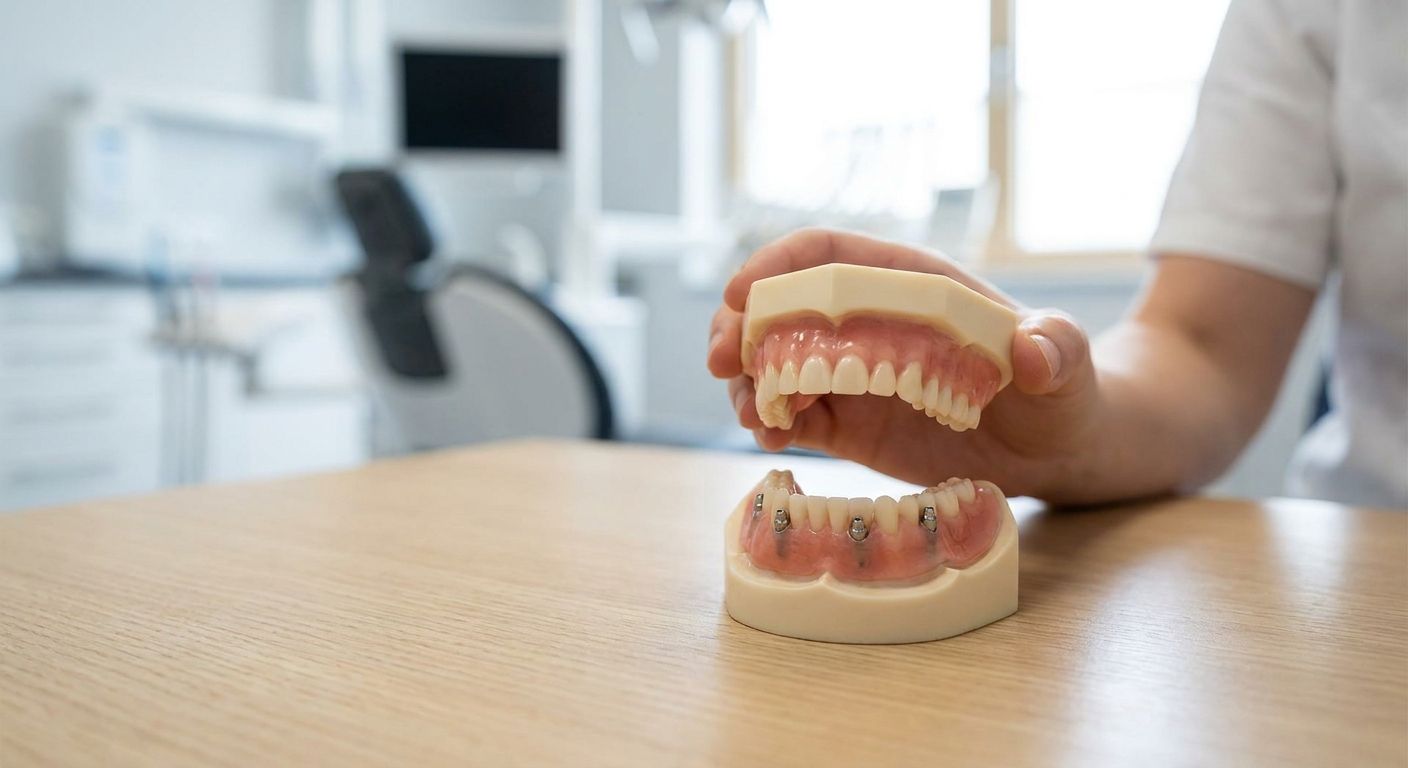
A loose lower denture that slides when you eat, laugh, or talk is usually a bone problem, not a denture problem, and mini dental implants for a loose denture fix it by anchoring the existing denture to narrow titanium posts set into the jaw instead of relying on suction and adhesive. Long-term denture wearers in Lake Worth and across Palm Beach County deal with this differently than someone who just got dentures last year: the ridge has already shrunk, the denture has probably been relined once or twice, and adhesive stopped being a real fix a while back.
- Mini dental implants for a loose denture stabilize an existing lower denture using implants under 3mm wide, placed without the bone grafting many full-size implants require.
- Four mini implants is the standard count to secure a lower overdenture; adhesive and relines only mask the underlying bone loss.
- Dental Arts of Atlantis evaluates ridge bone before recommending mini implants over All-on-4 or a new conventional denture.
- Verdict: mini implants are the right move for long-term denture wearers who want their current denture stabilized without switching to a fixed bridge.
Why mini implants matter for long-term denture wearers
A denture that fit well five or ten years ago loosens because the jawbone underneath it keeps resorbing once teeth are gone — that's biology, not a fabrication problem. Adhesive can't compensate for a shrinking ridge, and a reline only rebuilds the denture's fit to the current bone shape, which keeps changing.
Patients who've worn dentures for years typically try adhesive first, then a reline, then another reline, before asking about implants. Mini dental implants interrupt that cycle by giving the denture something fixed to snap onto, so the fit stops depending on how much bone is left. That's a different calculation than a first-time denture wearer faces, and it's why this decision gets evaluated on its own for long-term wearers rather than folded into a general implant conversation.
Confirm the looseness is a bone issue, not a fit issue
Before anything else, rule out a simple fit problem — some looseness is fixable without implants at all.
- Check when the denture was last relined; anything over 2-3 years old is a common culprit
- Look for rocking specifically on the lower denture, since lower ridges resorb faster than upper ones
- Note whether adhesive use has increased over the past year
- Ask whether sore spots or clicking noises have started recently
- Rule out a cracked or warped denture base before blaming the bone
Get a bone density and ridge check
Mini implants need less bone height than full-size implants, but a scan still tells the practice what's realistic for your jaw.
- A panoramic X-ray or 3-D scan maps remaining ridge height and width
- Patients with osteoporosis or long-term denture wear often show more resorption than expected
- The scan also flags whether bone grafting would be needed for full-size implants, which mini implants frequently avoid
- Nerve position in the lower jaw gets checked before any implant count is finalized
Try the manual fixes first
Skipping straight to implants without ruling out cheaper options isn't necessary, and a responsible plan checks the basics.
- A professional reline (versus a home reline kit) resets the fit to current bone shape
- Switching adhesive brands or application amount sometimes buys a few more months
- A new conventional denture is worth pricing if the current one is over 5-7 years old
- None of these stop future bone loss — they only buy time until the next adjustment
Compare mini implants against full-size implant options
This is the fork in the road for long-term denture wearers, and it depends on how much bone is left and what you want day to day.
- Mini implants attach to your existing denture — no new prosthetic needed
- Full-size implants supporting implant-supported dentures usually need more bone and sometimes a graft first
- All-on-4 implants replace the removable denture entirely with a fixed bridge, which is a bigger step for someone who wants to keep taking the denture out at night
- Mini implants generally cost less than a full implant-supported denture rebuild since the existing denture is reused or lightly modified
- Patients who've already adapted to removing their denture nightly often prefer mini implants over switching to fixed teeth
Choose the attachment type for your denture
Mini implants connect to the denture through a snap attachment, and the type matters for how the denture feels day to day.
- O-ball attachments snap into a socket built into the denture base
- Locator-style attachments allow slightly more denture movement, which some wearers find more comfortable
- The number of attachment points (usually four for a lower arch) affects how firmly the denture locks in
- Retention strength can be adjusted later if the denture feels too tight or too loose
Plan the placement visit
Mini implant placement is a shorter procedure than full-size implant surgery, and that's one reason long-term denture wearers gravitate toward it.
- Mini implants are typically placed without flap surgery, since their narrow diameter (under 3mm, versus 3.5-6mm for standard implants) needs less bone exposure
- The existing denture is often modified the same day to snap onto the new implants
- Local anesthesia is standard; sedation options exist for patients who feel anxious about any dental procedure
- Healing time before full chewing force is applied still depends on individual bone quality, so the timeline gets set at your consultation, not before
Find out if mini implants fit your case
A consultation checks your bone level and denture fit before recommending anything.
Budget and financing the procedure
Mini implants generally run less than a full implant-supported denture, but exact costs depend on how many implants your case needs and whether your current denture can be reused.
- Ask for a written estimate that separates the implants, the attachment hardware, and any denture modification
- Dental insurance sometimes covers a portion, especially if the denture itself needs replacement
- Financing dental implants without insurance is worth reviewing before the consultation, not after
- Compare the one-time implant cost against years of ongoing reline and adhesive spending
Maintain the implants long term
Mini implants aren't maintenance-free once they're in — the attachments wear down and need periodic servicing.
- O-ball and locator inserts wear out and typically need replacement every 1-2 years
- Clean around the implant posts daily with a soft brush, the same as natural gum tissue
- Bring the denture in for a checkup if it starts feeling loose again — that's the attachment wearing, not implant failure
- Annual checkups catch attachment wear before the denture starts clicking or dropping
Comparing your options for a loose lower denture
| Option | Best for | Key limitation |
|---|---|---|
| Denture adhesive | Short-term fix while deciding next steps | Doesn't address bone loss, needs daily reapplication |
| Professional reline | Denture is under 5 years old and otherwise fits | Temporary — ridge keeps changing shape |
| Mini dental implants | Long-term wearers who want to keep a removable denture | Attachments need periodic replacement |
| Implant-supported denture (full-size) | Wearers with adequate bone who want stronger retention | May require bone grafting first |
| All-on-4 fixed bridge | Wearers ready to switch away from removable entirely | Bigger surgical step, not removable at home |
Common mistakes long-term denture wearers make
- Adding more adhesive instead of asking why the fit changed. More adhesive treats the symptom while the ridge keeps shrinking underneath.
- Assuming implants mean giving up the removable denture. Mini implants keep the denture removable — that surprises a lot of patients who assumed implants only meant a fixed bridge like All-on-4.
- Waiting until the denture is unusable to ask about implants. More bone loss by then can limit which implant option is realistic.
- Skipping the bone scan and asking for implants by number. How many implants you need depends on ridge width and height, not a fixed formula.
- Ignoring attachment wear for years. A denture that suddenly loosens after being stable for a year or two is often the attachment hardware, not a new bone problem — and it's a cheap fix if caught early.
Dental Arts of Atlantis treats mini implant cases as a bone-first decision: the scan determines whether mini implants, a full implant-supported denture, or mini implants for seniors missing multiple teeth is the right fit before any cost conversation happens.
FAQ
How many mini implants does it take to stabilize a lower denture?
Four mini implants is the standard count for a lower overdenture in 2026, spaced across the front of the jaw where bone is usually most stable. Fewer implants can work for some cases, but that depends on individual bone width and ridge shape.
Are mini dental implants permanent?
The implants themselves are meant to stay in place long-term, but the attachment hardware connecting them to the denture wears down and typically needs replacement every 1-2 years. The implant post and the attachment insert are two different parts with different lifespans.
Can I still remove my denture at night with mini implants?
Yes — mini implants snap onto your existing denture design, so you take it out to clean it and sleep without it just like before. That’s the main difference from All-on-4, which fixes the bridge in place permanently.
Do mini implants require bone grafting?
Most mini implant cases avoid grafting because the implants are under 3mm in diameter and need less bone volume than standard implants. A bone scan at your consultation confirms whether your ridge qualifies without a graft.
How is a mini implant different from a regular dental implant?
Mini implants measure under 3mm in diameter compared to 3.5-6mm for standard implants, and they’re typically placed without flap surgery. That makes them faster to place but generally reserved for denture stabilization rather than replacing individual missing teeth.
Will insurance cover mini implants for a loose denture?
Coverage varies by plan and is more likely if your current denture also needs replacement as part of the treatment. Check with your insurer before the consultation, and ask the practice for a written cost breakdown either way.
How long does mini implant placement take?
Placement is usually a single, shorter appointment compared to full-size implant surgery, often with the denture modified to fit the same day. Full healing time before normal chewing force varies by individual bone quality.
What happens if my mini implants fail?
Implant failure is uncommon but possible, most often from infection or insufficient bone integration. A loose-feeling denture after mini implants is far more often worn attachment hardware than implant failure, which is why regular checkups matter.
One last thing
The part most long-term denture wearers get wrong isn't the implant decision — it's assuming a loose denture always means starting over with a brand-new denture. In most cases the existing denture gets modified to snap onto the new mini implants rather than replaced, which is why this option costs less and moves faster than patients expect walking in.
Related guides