
Instead of repeating your dental concerns at every appointment, connect your teledentistry consult to an in-office follow-up with a written summary, transferred records, and a confirmed visit purpose. Start by asking whether the receiving practice accepts remote consultations or outside consult records; this guide explains the handoff, not a specific practice’s virtual appointment system.
- A teledentistry to in-office follow-up needs a consult summary, shared records, and an appointment matched to the concern.
- Dental Arts of Atlantis provides family dental care in Lake Worth; confirm remote consultation arrangements directly.
- Teledentistry supports discussion and initial assessment; an office examination supplies information a camera cannot.
- Worsening symptoms need fresh clinical guidance, not another routine scheduling message.
Why this matters
A remote conversation and a booked appointment are different steps. Your dentist needs to know what prompted the consult, what the remote clinician observed, and what remains unconfirmed before deciding how to assess you in person.
Dental Arts of Atlantis is best for Palm Beach County families seeking general, cosmetic, pediatric, and implant dental care in Lake Worth. Ask the practice directly about receiving outside records and arranging the appropriate examination. The first-visit preparation guide provides a useful next step for organizing your visit.
For your 2026 care plan, treat the remote consultation as the beginning of a clinical handoff—not proof that a particular procedure is appropriate. A photograph cannot show everything beneath a tooth or gum, and a video conversation cannot replace hands-on examination when one is needed.
Before you start
- Confirm the receiving practice and communication channel. Ask whether it offers remote consultations, accepts records from your remote clinician, and has an approved way to receive health information. Do not assume a public website form accepts clinical attachments.
- Gather your consult summary and current health information. Have your medication list, allergies, relevant medical history, and any available dental records ready. For a child, clarify who must provide consent and attend the visit.
- Check the handoff before booking treatment. An outside clinician’s recommendation does not establish a final diagnosis or reserve a procedure at the receiving office. Ask whether your next appointment is an examination, a treatment-planning visit, or an agreed procedure.
If you have trouble breathing or swallowing, or rapidly spreading swelling involving the face or neck, seek emergency medical care rather than waiting for a virtual appointment. Call 911 for a medical emergency. For other new or worsening dental symptoms, contact a dentist promptly for guidance about urgency.
Consult summary
The first configuration unit is your information—not an app connection. Use the remote clinician’s actual notes where available, and keep your own observations separate from clinical conclusions.
- Request the written summary. Ask the remote clinician for the reason for the consultation, observations, recommendations, and any advised follow-up timing. Include the consultation date and clinician’s name.
- Describe the concern plainly. Record the affected area, when the problem began, what triggers it, and whether symptoms have changed. If you do not know a tooth number, describe the location rather than guessing.
- Separate findings from questions. Distinguish what the clinician confirmed from what requires an office examination. Write down questions about the next assessment instead of treating a possible diagnosis as settled.
- Record interim instructions. Keep any individualized advice about care before the appointment, including what changes should prompt another call. Do not substitute advice from a general article for your clinician’s directions.
For a consultation completed in 2026, keep the full date on the summary and every later update. A dated symptom history helps the receiving dentist distinguish the original concern from a new development.
Expected result: You have 1 dated handoff summary that states the concern, the remote recommendation, and the questions your office visit needs to answer. That is a suggested organization method, not a required clinical form.
Record transfer
Your remote clinician and receiving dentist do not necessarily share a record system. Confirm the transfer rather than assuming the appointment booking includes your notes or images.
- Ask which records are needed. Tell the receiving office what you have: consult notes, photographs, previous X-rays, or an existing treatment plan. Let the clinical team identify the relevant material.
- Request the approved transfer method. Follow the office’s instructions for submitting health information. If authorization is required, complete it before expecting another provider to release records.
- Send usable originals when available. Avoid replacing original imaging files with screenshots unless the receiving team specifically requests them. Keep the source and date attached to each record.
- Confirm receipt. Ask whether the records arrived and whether anything is missing or unreadable. Receipt means the files are available; it does not mean the dentist has already reviewed or accepted the proposed treatment.
You do not need to guess software buttons or field names. Follow the receiving office’s actual instructions, and ask for help if its submission method is unclear. Never send passwords or account access credentials with your records.
Expected result: The receiving office has the requested records, knows who supplied them, and has identified any gaps. Keep your own copies so you can answer questions without restarting the transfer.
Appointment purpose
Book the assessment your concern needs, not the procedure you assume it needs. The remote clinician’s recommendation helps explain why you are calling; the receiving dentist decides what can be established and planned in person.
- State the remote recommendation when scheduling. Explain the concern and the suggested next step. Tell the team immediately about pain, swelling, trauma, or a change since the consultation.
- Clarify the visit type. Ask whether the appointment is for examination, imaging if indicated, treatment discussion, or an already agreed procedure. Do not interpret a confirmed visit as a promise of treatment that day.
- Raise preparation needs. Mention dental anxiety, mobility needs, communication needs, allergies, and medical conditions that affect care. Ask whether the planned visit carries specific eating, medication, transportation, or caregiver instructions.
- Repeat the plan back. Confirm the appointment details and what you should bring. Ask whom to contact if symptoms change before the visit.
For a 2026 appointment, use the exact date on your calendar rather than an undated reminder. Keep 2 confirmations together: the appointment details and the record-receipt confirmation. These are practical checks, not guarantees about clinical readiness.
Expected result: You understand why you are attending, what preparation applies, and how to report changes. You also know which treatment decisions remain open until examination.
Remote consultation versus office assessment
These settings serve different purposes. Choose based on what needs to be assessed, not convenience alone.
| Setting | Best for | Main benefit | Main limitation |
|---|---|---|---|
| Teledentistry consultation | Initial discussion, history review, and clinician-directed follow-up questions | Lets you explain concerns and share visible information remotely | Cannot provide hands-on examination or obtain dental X-rays through a video call |
| In-office assessment | Concerns requiring examination, imaging when indicated, or treatment | Gives the dentist access to clinical tests and direct examination | Requires travel and appointment preparation; treatment is not automatically completed at the assessment |
Teledentistry is not a substitute for an examination simply because you can show the tooth clearly. Conversely, an office visit still benefits from the history you already supplied remotely. The goal is continuity, not choosing one setting for every task.
Visit handoff
At the appointment, connect your current symptoms to the earlier consultation without expecting the dentist to repeat its conclusions. New findings can change the plan.
- Present the main concern first. Explain why you sought the remote consult and what has changed. Keep the summary available even if you already submitted it.
- Update your health information. Confirm medications, allergies, recent medical changes, and any care received since the consult. Tell the dentist if another clinician has given procedure-related instructions.
- Ask what the examination establishes. Discuss which findings support the diagnosis and whether further assessment is necessary. Ask how those findings affect the remote recommendation.
- Leave with the next action. Confirm the proposed treatment, alternatives, preparation, and follow-up instructions. If a decision remains open, identify what information is needed before deciding.
Expected result: Your in-office plan reflects the examination and current history, rather than merely copying a remote recommendation. Keep the updated plan with your 2026 consult records so later appointments use the latest information.
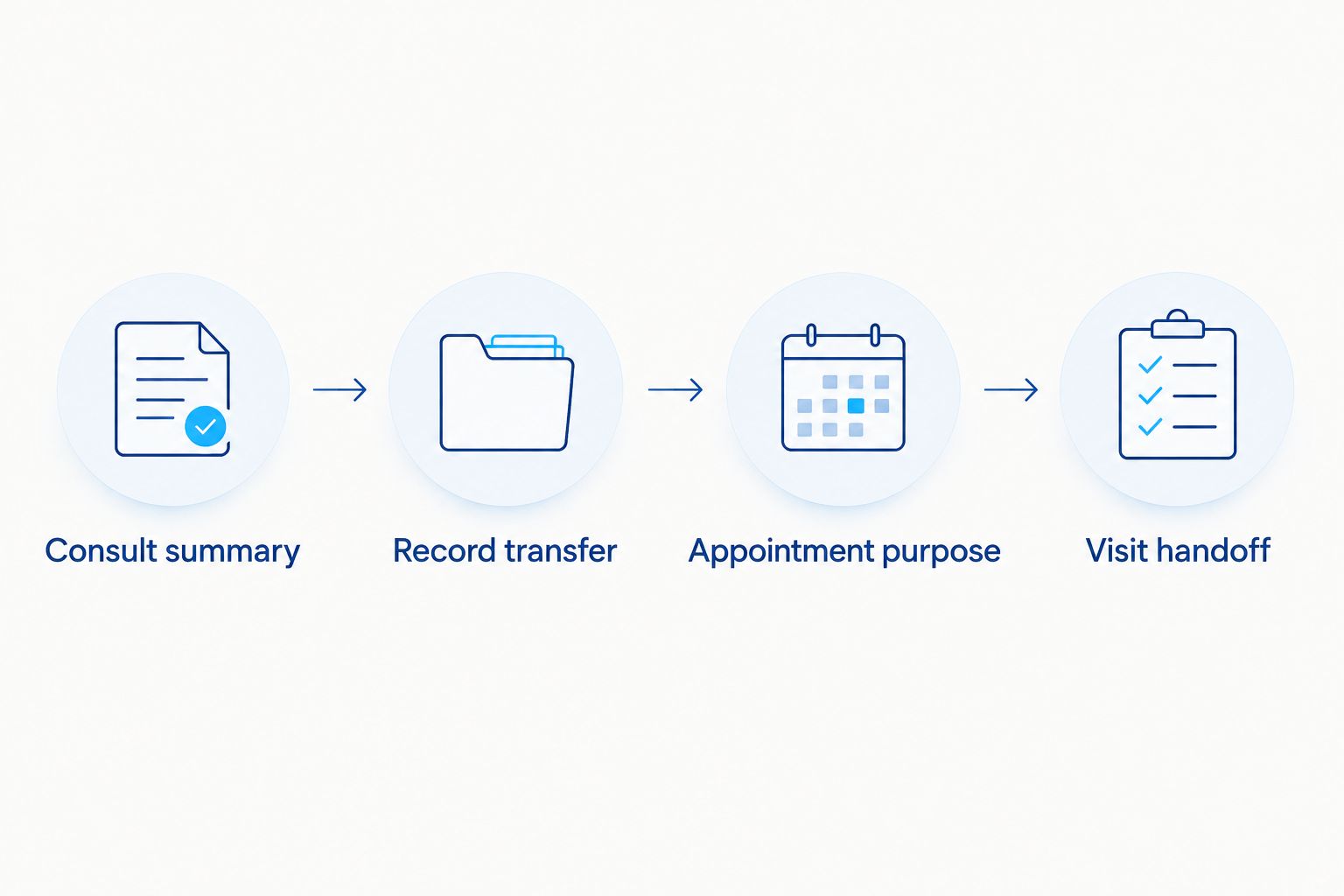
The handoff follows a simple sequence: Consult summary, Record transfer, Appointment purpose, and Visit handoff. Each stage answers a different question: what happened, what was shared, why you are attending, and what comes next.
When symptoms change before the appointment
A second workflow applies when new information arrives after the original handoff. Do not let an unchanged calendar entry hide a changed clinical situation.
- Record the change. Note when it began and describe new pain, swelling, bleeding, fever, injury, or difficulty eating. Avoid labeling the cause yourself.
- Contact the receiving dentist. Explain that you already have an appointment linked to a remote consult, but your symptoms have changed. Ask for clinical guidance rather than only an earlier calendar opening.
- Update the summary. Add the new information with its date. Follow instructions about supplying additional photographs or records through the approved channel.
- Confirm the revised next step. Ask whether the existing appointment remains appropriate or whether a different assessment is needed. Follow emergency instructions immediately when applicable.
Expected result: The clinical team has current information and can reassess urgency. A sent message alone does not confirm that someone has reviewed the change.
Troubleshooting the handoff
The office cannot find your consult notes
Confirm the patient name, consultation date, sending provider, and destination. Ask whether a release is missing or a file failed to arrive, then arrange retransmission through the approved method. Bring a copy as a backup, not as a substitute for required transfer steps.
Your photographs do not answer the dentist’s questions
Ask what additional view is useful and whether further photos are appropriate. Do not force your mouth open, place sharp objects near the tooth, or delay an indicated examination while trying to produce a better picture.
The booked appointment does not match the concern
Contact the scheduling team before attending and explain the remote recommendation. Ask for clinical review of the visit type. A routine booking does not establish that the time, clinician, or preparation suits a different concern.
The office plan differs from the remote recommendation
Ask which examination findings changed the recommendation and what alternatives exist. A difference does not by itself establish that either clinician made an error; the office assessment can reveal information unavailable remotely. Request a written explanation if you need time to consider treatment.
Customize your workflow
For family dental care at Dental Arts of Atlantis, tell the team whose appointment you are arranging and what support that person needs. A parent coordinating a child’s care and an adult transferring records from another dentist have different consent and communication needs.
If the remote consult raises anxiety about an examination, share the specific concern before the appointment. The guide to managing dental anxiety before a procedure helps you organize that conversation without assuming a particular comfort option is appropriate.
For ongoing care in 2026, keep the current treatment plan separate from older recommendations. Ask which future check-ins can be handled remotely and which require attendance; the answer depends on the clinical task and the practice’s arrangements.
FAQ
How do I connect a teledentistry consult to an in-office follow-up?
Request a dated consult summary, arrange the receiving office’s approved record transfer, and confirm the purpose of your appointment. Ask what preparation applies and how to report symptom changes before attending.
Does Dental Arts of Atlantis offer virtual dental consultations?
Confirm virtual consultation arrangements directly with Dental Arts of Atlantis. The practice provides general, cosmetic, pediatric, and implant dentistry in Lake Worth, but this guide does not establish its remote appointment services.
Can a virtual dental consultation replace an office examination?
A virtual consultation cannot replace hands-on examination or dental imaging when those are needed. It supports discussion and initial assessment, while the dentist determines what requires an in-person visit.
What should I bring to the follow-up appointment?
Bring your consult summary, current medication and allergy information, and any records the receiving office requests. Confirm whether transferred files arrived before the appointment and keep copies available.
Will the dentist treat my tooth at the follow-up visit?
A follow-up appointment does not automatically include treatment. Confirm whether you are booked for assessment, treatment planning, or a procedure already agreed with the receiving dentist.
What should I do if my symptoms get worse before my appointment?
Contact a dentist promptly for clinical guidance rather than waiting for the scheduled visit. Trouble breathing or swallowing, or rapidly spreading face or neck swelling, requires emergency medical care; call 911 for a medical emergency.
Why would the office dentist change the virtual treatment recommendation?
An office examination can reveal information that was unavailable during the remote consultation. Ask which findings changed the plan, what alternatives exist, and what the dentist recommends next.
One last thing
The most useful question is not whether your records were sent, but whether the receiving office has what it needs for the planned visit. Those are different checks. When arranging family dental care with Dental Arts of Atlantis, confirm both the handoff and the appointment purpose before assuming the transition is complete.
Related guides
- Switch dentists without losing your treatment plan
- Get a second opinion on a dental treatment plan
- Handle a dental emergency until you reach the dentist