
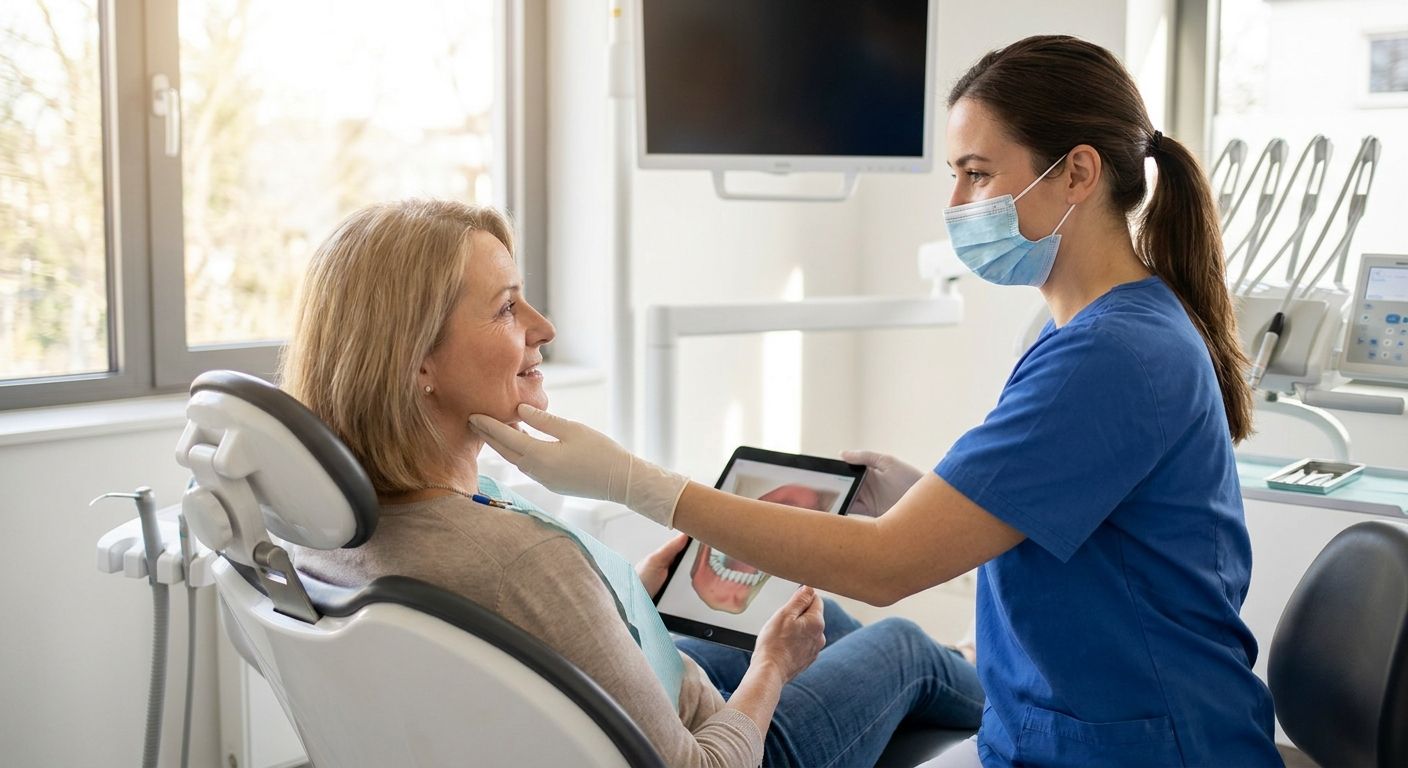
If you live with rheumatoid arthritis, psoriatic arthritis, or juvenile idiopathic arthritis, your jaw joint is not a bystander — it's one more joint the disease can target, and dental care for autoimmune arthritis jaw involvement has to treat it that way instead of chasing a bite problem that isn't really about your bite.
What makes this segment different from a typical TMJ patient is the combination: joint inflammation that flares and recedes on its own schedule, medications that change bleeding and infection risk, and a dentist who needs to coordinate with your rheumatologist rather than work around them.
- Autoimmune arthritis jaw dental care means coordinating with rheumatology, not just fitting a night guard.
- Juvenile idiopathic arthritis is one of the most commonly affected joints in the disease, and TMJ damage can shift a child’s jaw growth if it goes untreated.
- Biologics, DMARDs, and corticosteroids change bleeding risk and infection risk at the dental chair in 2026 just as much as they did five years ago.
- Custom night guards and Botox injections manage symptoms; they don’t replace the systemic treatment that controls the disease.
- Time elective dental and bite work for low-disease-activity windows, never during an active flare.
Why autoimmune arthritis jaw dental care matters
The temporomandibular joint is a synovial joint, structurally similar to a knee or wrist, which means it's fair game for rheumatoid arthritis, psoriatic arthritis, and juvenile idiopathic arthritis (JIA). In JIA specifically, the TMJ is one of the joints most frequently involved, and because a child's jaw is still growing, untreated inflammation there can change how the lower jaw develops — not just how it feels. TMJ treatment for chronic jaw pain and headaches starts by figuring out whether pain and clicking are mechanical, inflammatory, or both, because the answer changes the entire plan.
Adults with rheumatoid or psoriatic arthritis face a different but related problem: disease-modifying drugs and biologics that control inflammation elsewhere in the body also affect how your mouth heals and how your immune system responds to a routine cleaning or extraction. That's not a reason to avoid the dentist — it's a reason to make sure your dentist knows your medication list before any procedure, not after.
The steps that protect your jaw joint
Get the diagnosis and joint status on record
A dentist can't build a safe plan around a joint that's never been formally evaluated. Bring imaging or rheumatology notes if you have them, or ask your dentist to screen for joint-specific findings before assuming a click or a lock is purely muscular.
- Ask whether joint sounds are new, worsening, or unchanged over the last 6-12 months
- Report jaw locking (open or closed) as a distinct symptom, not just "pain"
- Share your most recent rheumatology visit date and current disease activity status
- Note whether symptoms match your systemic flare pattern or run on their own timeline
- Bring a full, current medication list, including dose and frequency
Track your flare pattern before scheduling anything elective
Joint inflammation from autoimmune disease isn't constant, and neither should your dental treatment schedule be. A bite adjustment, an implant impression, or an orthodontic move made during an active flare can lock in a joint position that shifts again once inflammation settles.
- Keep a simple log of jaw pain, stiffness, and opening range for a few weeks
- Flag your dentist before booking elective bite work during a known flare period
- Ask your rheumatologist to define what "low disease activity" looks like for you
- Reschedule non-urgent cosmetic or orthodontic appointments around flare timing
- Treat emergencies (infection, fracture, abscess) on their own urgency, flare or not
Protect the joint overnight
Clenching and grinding put direct mechanical load on a joint that's already inflamed, and most people do it in their sleep without realizing it. A properly fitted guard reduces that load without touching the underlying disease.
- Try a soft, over-the-counter guard first if cost or access is a concern
- Watch for morning jaw stiffness or headaches as a sign of nighttime clenching
- Note if an over-the-counter guard feels loose, bulky, or causes bite changes
- Ask about a custom night guard fitted specifically to your bite and joint position
- Replace any guard that's worn through or no longer fits after a flare changes your bite
Address muscle guarding, not just the joint
When a joint hurts, the muscles around it tighten to protect it — and that guarding often causes as much daily discomfort as the joint disease itself. This is where symptom management earns its place alongside systemic treatment.
- Apply moist heat to the jaw muscles for 10-15 minutes during a flare
- Stick to a soft-food diet temporarily when opening is limited or painful
- Do gentle, slow jaw-opening stretches only if your provider has cleared them
- Ask about Botox for jaw clenching and TMJ tension if muscle guarding is a recurring, dominant symptom
- Avoid wide-mouth habits (yawning fully, large bites) during active pain
Manage medication effects at every dental visit
DMARDs, biologics, and corticosteroids don't just treat your joints — they change how your mouth responds to routine care. Dry mouth, slower healing, and altered infection response are common side effects that a dentist needs to plan around.
- List every current medication, including biologics, at every dental visit
- Ask whether any medication requires a treatment pause before oral surgery
- Report new dry mouth, mouth sores, or slow healing as medication-related, not random
- Confirm with your rheumatologist and dentist together before any invasive procedure
- Increase fluoride use if dry mouth is raising your cavity risk
Get comfortable care if jaw opening is limited
A restricted opening changes what's realistic in a single dental appointment, and pushing past it during a flare causes unnecessary pain. Comfort-focused scheduling matters as much as the clinical plan.
- Ask for shorter appointments broken into multiple visits if opening is limited
- Request a bite block or support device to reduce sustained muscle strain
- Discuss sedation options if anxiety about pain is adding to muscle tension
- Practice slow, gentle at-home jaw relief before appointments using guidance from how to relieve TMJ pain at home before your dentist visit
- Tell the front desk about limited opening when booking, not on arrival
Comparing your options
| Option | Best for | Key limitation |
|---|---|---|
| Custom night guard | Nighttime clenching layered on top of joint inflammation | Protects the joint and enamel but does nothing for the underlying autoimmune process |
| Botox for jaw muscles | Recurring muscle guarding and TMJ tension during flares | Temporary effect; needs repeat treatment every few months |
| Jaw physical therapy / stretching | Maintaining range of motion between flares | Requires consistency and clearance; not appropriate during acute flares |
| Rheumatology-directed systemic treatment | Controlling the disease process itself | Managed outside the dental office; requires ongoing coordination |
| Oral splint or bite orthotic | Reducing joint load during eating and sleep | Needs readjustment as the joint changes over time |
The straight answer: night guards and Botox manage symptoms, but the disease itself is controlled by your rheumatologist — your dentist's job is to protect the joint and your teeth while that treatment does its work.
Coordinate your jaw and dental care
Bring your medication list and rheumatology notes to your next visit.
Common mistakes patients with autoimmune jaw arthritis make
- Waiting out a flare before mentioning jaw pain. Untreated inflammation in the TMJ can erode joint structure quietly, especially in children with JIA.
- Scheduling bite adjustments or orthodontic changes during an active flare. The joint position you're treating around may shift again once inflammation settles.
- Skipping the loop between rheumatologist and dentist. Biologics and corticosteroids change bleeding, infection, and healing risk — your dentist needs to know before, not after, a procedure.
- Assuming jaw clicking is purely mechanical. In autoimmune arthritis, clicking and limited opening can point to joint erosion that needs rheumatology follow-up, not just a night guard.
- Ignoring dry mouth from medication until cavities show up. DMARDs and biologics commonly reduce saliva flow, and that damage builds quietly over months.
FAQ
Can autoimmune arthritis really affect the jaw joint?
Yes. The TMJ is a synovial joint, and rheumatoid arthritis, psoriatic arthritis, and juvenile idiopathic arthritis can all involve it the same way they involve the knee or wrist. In JIA, the TMJ is one of the joints most commonly affected.
Is a night guard enough to manage TMJ arthritis?
A night guard reduces mechanical load from clenching and grinding, but it doesn’t treat the underlying autoimmune inflammation. It’s a support tool alongside rheumatology-directed treatment, not a replacement for it.
Should I schedule dental work around my flare pattern?
Yes. Elective bite adjustments, orthodontic changes, and cosmetic dental work should wait for periods of lower disease activity, since an active flare can shift joint position and make results unstable.
Do biologics and DMARDs affect dental treatment?
They can change bleeding risk, infection response, and healing time, so any dentist treating you should have your full current medication list before a procedure. Some biologics may require timing coordination with your rheumatologist for invasive work.
Can Botox help with jaw pain from autoimmune arthritis?
Botox injections into the jaw muscles can reduce clenching and muscle guarding that develops around an inflamed joint. The effect is temporary and typically needs repeat treatment every few months.
Does autoimmune arthritis in the jaw cause dry mouth?
The disease itself doesn’t directly cause dry mouth, but many of the medications used to treat it do. Reduced saliva raises cavity risk, so fluoride use and regular checkups matter more for this group.
Can children with juvenile idiopathic arthritis have jaw growth problems?
Untreated TMJ inflammation in a growing child can affect how the lower jaw develops over time, since the joint itself is part of the growth center. Early screening and coordinated care with a pediatric rheumatologist matter here.
What should I tell my dentist before treatment if I have autoimmune arthritis?
Share your current medication list, recent disease activity status, and whether jaw symptoms are new or match a flare pattern. This lets your dentist plan around bleeding risk, healing time, and joint stability rather than guessing.
One last thing
The detail most patients miss: TMJ involvement in juvenile idiopathic arthritis can be silent early on — kids often don't complain about jaw pain the way they complain about a swollen knee, because the joint is smaller and the symptoms show up as subtle jaw growth changes instead. If a child with JIA hasn't had a jaw-specific screening, 2026 is a reasonable year to ask for one, even without obvious pain.
Related guides