

A root canal cost in 2026 depends on the tooth, the treatment required, and your insurance benefits; your dentist’s written estimate is the amount to use for planning. That estimate should also address the final filling or crown, which is separate from treating the inside of the tooth. Compare the complete treatment plan, not just the root canal procedure.
- How much does a root canal cost? Get a written estimate that includes treatment, restoration, and insurance adjustments.
- A root canal estimate and a crown estimate describe different parts of saving your tooth.
- Dental Arts of Atlantis provides general and family dental care for Lake Worth and Palm Beach County families.
- Confirm dental insurance benefits before treatment, but do not delay assessment of pain or swelling.
How much does a root canal cost in 2026?
The useful answer is your tooth-specific estimate after an examination. A root canal treats inflamed or infected tissue inside a tooth, while the final restoration repairs and protects the tooth above the gumline. Those are different parts of care, and you need to know whether the estimate includes both.
Start with this guide to getting a dental cost estimate before treatment. Ask for an itemized plan that identifies the tooth, the recommended procedure, and the work needed afterward.
| Part of the treatment plan | What it addresses | What to confirm |
|---|---|---|
| Examination and imaging | Diagnosis and assessment of the tooth | Whether these services are included in the estimate |
| Root canal treatment | Cleaning, disinfecting, and sealing the canals | Which tooth is being treated and whether this is initial treatment or retreatment |
| Temporary restoration | Protection between treatment stages | What restrictions apply until the final restoration |
| Final filling or crown | Sealing and protecting the remaining tooth | Which restoration is recommended and whether it is listed separately |
| Insurance adjustment | Estimated benefit and patient responsibility | Whether the estimate reflects your current plan benefits |
An estimate is only useful when it shows what completes the treatment. If a document lists root canal treatment but says nothing about restoring the tooth, ask for the missing part of the plan before you compare it with another estimate.
Why this matters
A toothache makes it hard to think through paperwork. Separating treatment, restoration, and insurance helps you make a calmer decision without confusing a procedure estimate with a finished treatment plan.
For your 2026 treatment decision, start with whether the tooth can be saved predictably. Then discuss the recommended care and your responsibility for each stage. A smaller treatment scope is not automatically a better choice if it leaves the tooth without the protection it needs.
You deserve an explanation you can understand. Ask your dentist to show you the findings and explain what happens if you treat the tooth, choose another approach, or postpone care.
Front tooth, premolar, or molar: what changes in the estimate?
Tooth position helps describe treatment, but position alone does not establish your total. Canal anatomy, previous dental work, cracks, and the amount of healthy tooth remaining also matter.
The comparison below explains what to discuss. These are tooth categories, not interchangeable treatment packages.
| Tooth category | Treatment consideration | Useful question |
|---|---|---|
| Front tooth | Appearance, remaining tooth structure, and canal anatomy | What restoration will protect the tooth and preserve its appearance? |
| Premolar | Canal anatomy and the tooth’s role in biting and chewing | Does this tooth need coverage to protect weakened areas? |
| Molar | Canal anatomy and chewing forces | What final restoration is needed after root canal treatment? |
Front tooth root canal
A front tooth needs a restoration that seals the access opening and suits the remaining tooth structure. A crown is not automatically required for every front tooth after root canal treatment.
Ask what supports the recommendation. Extensive decay, an existing large restoration, or a crack changes the discussion, even when the tooth is easy to see and reach.
Premolar root canal
A premolar sits between the front teeth and molars and participates in chewing. Your dentist assesses the canals and the remaining structure before recommending how to restore it.
Do not assume that a filling used before treatment remains the right restoration afterward. Ask which parts of the tooth need protection and why.
Molar root canal
A molar has chewing surfaces that bear biting forces, and its canal anatomy can be complex. The estimate should distinguish treatment inside the tooth from the restoration that protects it afterward.
Ask whether a crown or another covering restoration is recommended. Also confirm how the tooth will be protected while you wait for that final step.
Why root canal treatment estimates vary
Root canal estimates describe different clinical situations. Compare them only after you understand the diagnosis and treatment scope.
- Tooth anatomy: The number, shape, and accessibility of canals affect the treatment required. Tooth position does not reveal every detail of that anatomy.
- Previous treatment: Retreatment involves assessing earlier root canal work and addressing the reason the tooth needs additional care.
- Remaining tooth structure: Decay, cracks, and existing restorations influence whether the tooth can be restored and how it needs protection.
- Final restoration: A filling, buildup, or crown addresses a different need from cleaning and sealing the canals. Confirm which steps belong in your plan.
- Provider and referral needs: Some cases need an endodontist, a dentist who specializes in treating the inside of teeth. Ask who will provide each stage of care.
- Insurance terms: Deductibles, benefit limits, exclusions, and network status affect your responsibility. The clinical recommendation and the insurance benefit are separate decisions.
Compare matching treatment scopes before judging an estimate. Different wording can conceal an important difference, such as whether the final restoration is included or whether a specialist assessment is still needed.
How do I get an estimate I can actually use?
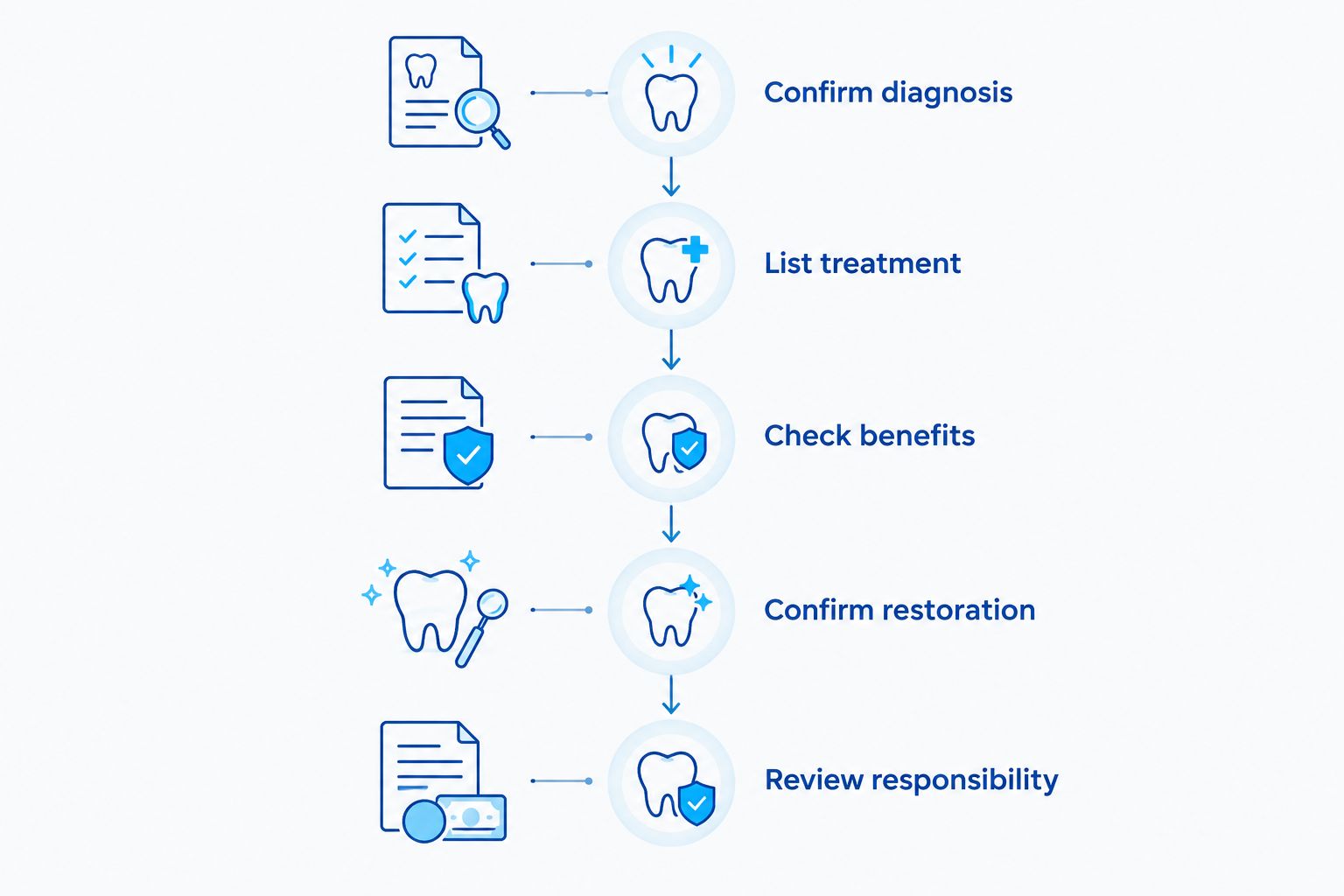
Use this sequence for a 2026 root canal estimate. It gives you a clear way to check the plan without needing to understand every dental term.
- Confirm diagnosis. Ask which tooth needs treatment, what findings support the diagnosis, and whether the tooth is restorable. Symptoms alone do not establish the treatment you need.
- List treatment. Request the planned procedures in writing. Identify examination, imaging, root canal treatment, temporary protection, and the final restoration where applicable.
- Check benefits. Give the office your current insurance information and verify the relevant terms with your insurer. Ask whether a pretreatment estimate is appropriate.
- Confirm restoration. Find out who will restore the tooth, what restoration is recommended, and when that appointment belongs in the sequence.
- Review responsibility. Ask the office to distinguish the treatment estimate, expected insurance benefit, and estimated patient responsibility. Keep a copy for your records.
These steps separate what the tooth needs from how your plan contributes. If something changes during treatment, ask what changed clinically and request an updated explanation of the remaining work.
Bring relevant records if another dentist has already examined the tooth. Existing imaging and treatment notes help the receiving dentist understand the recommendation, although the dentist decides whether additional assessment is needed.
Write down your questions before the visit. When you are uncomfortable or worried, a short list makes it easier to leave with the information you intended to ask for.
Does dental insurance cover root canal treatment in 2026?
Dental insurance coverage for root canal treatment depends on your policy. Confirm the procedure benefit, deductible, remaining annual benefit, waiting periods, and any applicable exclusions rather than assuming coverage from the plan name.
Ask about the final restoration separately. A benefit estimate for root canal treatment does not answer whether your plan contributes toward a crown or other restoration.
Use these questions when speaking with your insurer:
- Is the treating dentist in network under my specific plan?
- What benefit applies to the recommended root canal procedure?
- Does a waiting period or exclusion apply?
- What benefits remain for the current plan period?
- How does the plan handle the recommended final restoration?
- Is a pretreatment review needed or available?
Keep the response and any reference information with your treatment paperwork. A pretreatment estimate is not a guarantee of payment; the insurer determines benefits under the policy when it processes the claim.
What should I ask if I do not have dental insurance?
Without dental insurance, ask for an itemized treatment estimate and a clear explanation of which procedures are necessary. You still need the same diagnosis and restoration discussion as an insured patient.
Tell the office about your budget concerns before treatment begins. Ask whether the plan has clinically appropriate stages and which steps must stay on schedule to protect the tooth.
Avoid choosing between estimates that describe different endpoints. One plan might stop at root canal treatment, while another includes the restoration needed afterward. Ask both offices to explain the complete course of care.
Is saving the tooth better than extracting it?
Saving a restorable tooth preserves your natural tooth; extraction is appropriate when the tooth cannot be predictably saved. Neither choice is right for every situation, and a treatment estimate does not establish which option is clinically suitable.
Ask about the tooth’s outlook before comparing approaches. Root canal treatment cannot repair every crack or overcome every problem with the supporting tissues.
| Approach | Best for | Main benefit | Main limitation |
|---|---|---|---|
| Root canal treatment and appropriate restoration | A tooth the dentist considers restorable | Retains the natural tooth | Requires treatment and restoration; success is not guaranteed |
| Extraction | A tooth that cannot be predictably saved | Removes the affected tooth | Permanently removes the natural tooth and requires a discussion about the resulting space |
If extraction is recommended, ask whether replacing the tooth is appropriate and what that would involve. Compare complete care pathways, not a tooth-saving plan with only the removal stage of another plan.
A second opinion is useful when you do not understand the recommendation or the prognosis. Tell the evaluating dentist about current pain or swelling so the assessment accounts for urgency.
How can a Lake Worth family prepare for the conversation?
Dental Arts of Atlantis is a local option for Lake Worth families seeking general and family dental care. The practice also offers cosmetic, pediatric, and implant dentistry for families in the Palm Beach County area.
For a root canal treatment discussion, bring your symptom history, medication list, insurance information, and any existing treatment recommendation. Mention dental anxiety early so you can discuss comfort needs before the visit progresses.
Dental Arts of Atlantis’s family dental care gives local households a place to discuss their broader dental needs. Ask which parts of your proposed care the practice will provide and whether a specialist referral is appropriate; a general practice description does not establish who should treat a particular complex tooth.
Prepare for your dental visit
Review what to bring and how to prepare for a first appointment.
When should I seek urgent help instead of comparing estimates?
Seek prompt dental assessment for persistent tooth pain, swelling, or pain when biting. A dentist needs to identify the cause; those symptoms do not prove that you need a root canal.
Difficulty breathing or swallowing, or rapidly spreading swelling, needs emergency medical attention. Do not wait for an insurance response or a treatment estimate when those symptoms occur.
Pain that improves does not establish that an infection has resolved. Keep your assessment appointment and follow the treating clinician’s instructions rather than using pain alone to decide whether care is still needed.
FAQ
How much does a root canal cost in 2026?
Your root canal cost in 2026 depends on the tooth, the required treatment, and your insurance benefits. Get an itemized written estimate that also addresses the final filling or crown.
Does a root canal estimate include the crown?
Do not assume a root canal estimate includes the crown. Ask whether the final restoration appears as a separate procedure and whether it is included in your estimated responsibility.
Do I always need a crown after a root canal?
A crown is not required after every root canal. Your dentist recommends the restoration based on tooth position, remaining structure, cracks, and the need for protection during biting and chewing.
Will dental insurance pay for my root canal?
Dental insurance payment depends on your policy and eligibility. Confirm the procedure benefit, deductible, remaining benefits, waiting periods, and coverage for the final restoration.
Is extracting the tooth better than getting a root canal?
Extraction is appropriate when a tooth cannot be predictably saved; root canal treatment preserves a tooth that is suitable for treatment and restoration. Ask your dentist to explain the tooth’s prognosis and the full care pathway for either approach.
Can I wait until my tooth stops hurting?
Do not use reduced pain as proof that the tooth no longer needs care. Arrange dental assessment, and seek emergency medical attention for difficulty breathing or swallowing or rapidly spreading swelling.
What should I bring to Dental Arts of Atlantis for a treatment discussion?
Bring your medication list, symptom history, insurance details, and any existing imaging or treatment recommendation to Dental Arts of Atlantis. Tell the dental team about anxiety and any changes in your health.
One last thing
Before accepting a 2026 root canal treatment plan, ask: What needs to happen after the root canal for this tooth to be fully restored? That question connects the immediate procedure with the protection your tooth needs afterward.
Keep the answer with your written estimate. The goal is not simply to finish treating the canals; it is to understand the complete plan for a tooth you can use and care for.
Related guides
- How to know if you need a root canal
- How to save a tooth instead of getting it extracted
- How to check dental insurance coverage before booking