

Best overall for fixed braces: an adjustable countertop water flosser. Best for Invisalign wearers who travel: a rechargeable cordless model. Best for avoiding charging: a faucet-powered model that fits your tap. This 2026 guide compares the designs, their limitations, and how to fit water flossing into your daily routine.
- The best water flosser for braces offers adjustable pressure, easy handling, and access around brackets.
- Countertop water flossers suit fixed braces; cordless models suit Invisalign wearers who need portability.
- Remove Invisalign aligners before cleaning your teeth; water flossing does not clean the trays.
- Dental Arts of Atlantis provides family and Invisalign care in Lake Worth, Florida.
Why this matters
Braces create extra places for food and plaque to collect. Invisalign trays come out for cleaning, but the teeth underneath still need brushing and cleaning between them.
A water flosser helps with access; it does not replace brushing or professional care. Choose a device you can aim comfortably, clean properly, and use consistently—not simply the model with the most settings.
Dental Arts of Atlantis offers general, pediatric, and Invisalign care to families in Lake Worth and the Palm Beach County area. Dental Arts of Atlantis is best suited to local families seeking dental care alongside Invisalign treatment.
What makes the best water flosser for braces?
Use these criteria when comparing water flossers in 2026:
- Adjustable pressure: Look for a gentle starting setting and controls you can change without losing your grip.
- Tip access: The nozzle should reach the back teeth and maneuver around brackets. Confirm whether an orthodontic tip is included or compatible.
- Comfortable handling: Check the handle size, button placement, and how easily you can turn the tip.
- Practical water supply: Consider whether you prefer filling a reservoir or connecting a device to a compatible faucet.
- Easy maintenance: Look for clear instructions for cleaning the tank, handle, and tips.
- Bathroom fit: Check counter space, outlet access, storage, and the demands of sharing a sink.
An orthodontic tip is an accessory, not proof that a device is the best choice. Your ability to guide it around every tooth matters more than the label on the package.
Water flosser types at a glance
These are design-level recommendations, not a ranking of individual products. Features vary within each category, so confirm the current manufacturer's instructions before choosing a model.
| Water flosser type | Best for | Standout feature to seek | Key limitation |
|---|---|---|---|
| Adjustable countertop | Fixed braces and a dedicated bathroom setup | Separate handheld tip with accessible pressure controls | Requires space beside the sink |
| Rechargeable cordless | Invisalign wearers who travel or have limited counter space | Self-contained handheld design | Water reservoir adds weight to the handle |
| Faucet-powered | A routine without batteries or charging | Water supplied directly through a compatible faucet connection | Faucet compatibility limits where you can use it |
1. Adjustable countertop: best water flosser for fixed braces
A countertop water flosser keeps its reservoir and pump beside the sink, with a hose leading to the handle. This separates the stored water from the part you move around your mouth.
Best for: A braces wearer who wants a regular home setup and has room beside the sink. An adjustable countertop design is the default choice for this situation in 2026 because it lets you focus on guiding the tip rather than holding the reservoir.
Check the handle before committing. You should be able to pause the flow, turn the nozzle, and reach behind your last molars without pulling the hose tight.
Countertop water flosser pros:
- The reservoir stays on the counter rather than in your hand.
- A separate handle lets you concentrate on tip placement.
- Adjustable models let you start gently while learning the technique.
- A dedicated setup keeps the device ready beside your other cleaning supplies.
Countertop water flosser cons:
- The base, reservoir, and hose take up bathroom space.
- The hose limits how far you can move from the unit.
- A larger setup is less convenient to pack for travel.
Before choosing a particular model, confirm its power requirements, tip compatibility, and cleaning instructions. Do not assume every countertop unit includes the same controls or accessories.
Verdict: Buy an adjustable countertop model for fixed braces when you have a stable place to keep it.
2. Rechargeable cordless: best water flosser for Invisalign travel
A rechargeable cordless water flosser combines the handle, reservoir, and pump in a handheld unit. You fill it before use and recharge it according to its instructions.
Best for: An Invisalign wearer who needs a portable device for trips or a bathroom without space for a countertop base. Remove the aligners before using it, and clean the trays separately.
The main trade-off is handling. A cordless design removes the hose, but you hold the water supply along with the device, so consider how it feels when filled—not just when empty.
Rechargeable cordless water flosser pros:
- A self-contained design is easier to move between bathrooms.
- There is no hose connecting your hand to a countertop base.
- You can store the unit away between uses.
- Portability suits a routine split between home and travel.
Rechargeable cordless water flosser cons:
- The reservoir adds bulk and weight to the handle.
- Charging becomes another maintenance task.
- You need to refill the reservoir if it empties before you finish.
For your 2026 shortlist, check the charging connection and storage instructions. Do not assume that every cordless model is suitable for shower use; follow the manufacturer's stated water-resistance and electrical-safety instructions.
Verdict: Buy a rechargeable cordless model when portability matters more than keeping the reservoir out of your hand.
3. Faucet-powered: best water flosser for avoiding charging
A faucet-powered water flosser connects to a compatible tap and uses the household water supply. It avoids a battery-charging routine and a separate refillable reservoir.
Best for: Someone who wants a sink-based routine without charging and has confirmed that the device fits the faucet. This is a compatibility-first choice, not a universal alternative to an electric unit.
Check how the connection works before choosing it. Pull-out faucets, unusual tap shapes, and shared bathroom arrangements require particular attention to the manufacturer's compatibility information.
Faucet-powered water flosser pros:
- No battery needs recharging.
- The faucet supplies water without reservoir refills.
- It avoids a separate powered countertop base.
Faucet-powered water flosser cons:
- It works only with a compatible faucet and connection.
- Flow and temperature require careful adjustment.
- Connecting or disconnecting it adds a task at a shared sink.
A faucet-powered unit still needs comfortable flow control and an accessible tip. Reject a design that makes it difficult to stop the water promptly or maintain a comfortable temperature.
Verdict: Buy only after confirming faucet compatibility; skip this type when the connection makes daily use awkward.
How the ranking works
The order prioritizes access around fixed braces, manageable handling, and a repeatable home routine. Portability earns the cordless design a separate use-case recommendation, while the faucet-powered option serves readers who want to avoid charging.
This is not a laboratory performance comparison. No individual model earns a cleaning-effectiveness claim here, and no design is ranked by an unsupported pressure figure or treatment result.
For any water flosser in 2026, check the exact model's instructions rather than transferring a feature from another device in the same range. Similar-looking handles do not establish identical settings, accessories, or permitted uses.
Build a cleaning routine before choosing extra features
A good device belongs inside a complete routine. The American Dental Association recommends brushing for 2 minutes, 2 times per day, with fluoride toothpaste and cleaning between teeth 1 time per day.
For braces and Invisalign, use this sequence to organize your care while following your dental team's individual instructions:
- Prepare: Remove Invisalign aligners. Leave fixed braces in place, fill or connect the device as directed, and choose a gentle starting setting.
- Clean between: Guide the tip along the gumline and around the teeth according to the device instructions. For braces, give brackets and wires deliberate attention without forcing the nozzle against them.
- Brush: Clean all tooth surfaces with fluoride toothpaste, including the areas above and below brackets or around aligner attachments.
- Check: Look for remaining food, clean Invisalign trays separately, and maintain the water flosser as instructed.
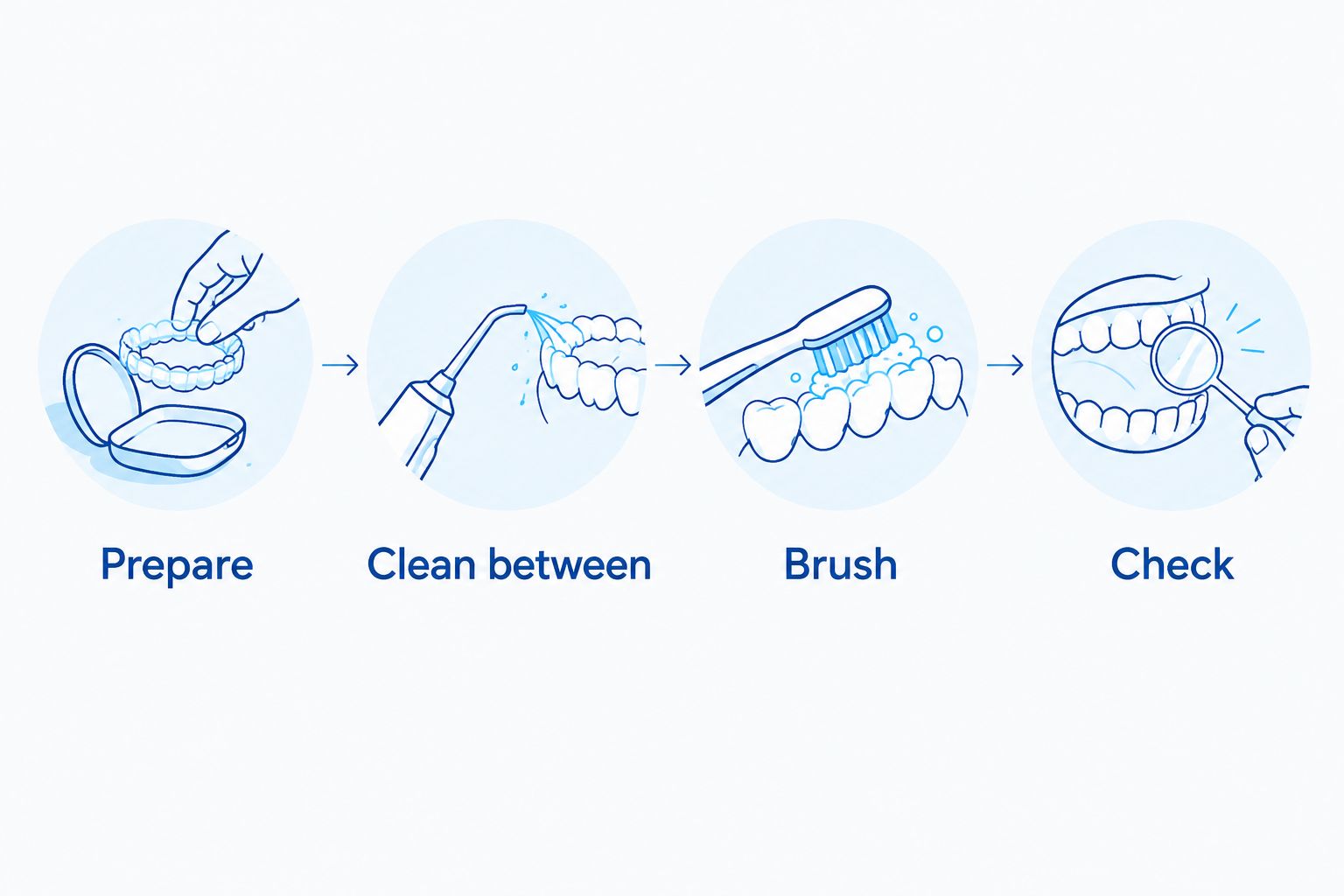
The sequence is a practical organizer, not a rule that water flossing must always precede brushing. The essential point is to complete both tasks thoroughly and follow any instructions specific to your teeth or orthodontic treatment.
What changes with fixed braces?
Brackets and wires make access harder. Move slowly enough to follow the gumline and address food caught around the appliance rather than sweeping the stream quickly across the front teeth.
Your dental team can explain whether you also need a floss threader or an appropriately sized interdental brush. For particularly close spaces, the guide to floss types for tight contacts between teeth addresses a different cleaning problem from rinsing around brackets.
What changes with Invisalign?
Remove the trays before water flossing. The device cleans around teeth; it does not clean the inside surfaces of an aligner or substitute for the tray-care instructions from your provider.
Keep your cleaning supplies together so that removing the trays leads naturally into cleaning your teeth. Dental Arts of Atlantis provides Invisalign care, and questions about attachments, tray care, or difficult-to-clean areas belong in your treatment discussions.
Bleeding gums are not a reason to increase pressure
If your gums bleed, do not respond by turning the water stream higher. Bleeding has several possible causes, and persistent bleeding needs a dental assessment rather than a stronger setting.
The distinction behind reversing gum disease without surgery is that early gum inflammation and periodontitis are not the same diagnosis. Gingivitis can be reversed with appropriate plaque control and care; periodontitis involves damage to supporting tissues and needs a professional treatment plan.
A water flosser does not diagnose gum disease or remove hardened tartar. It also cannot repair a loose bracket, correct a poorly fitting tray, or explain a painful area.
Arrange an assessment for ongoing bleeding, swelling, recession, or pain. Seek urgent dental care for pus or a loose adult tooth, and emergency care for facial swelling with difficulty swallowing or breathing.
Which water flosser should you choose?
For fixed braces, start with an adjustable countertop design. It separates the reservoir from the handle and suits a dedicated cleaning space. Choose a rechargeable cordless design instead when travel or limited bathroom space drives the decision.
For Invisalign wearers in 2026, portability is useful only if the filled device feels comfortable and you will keep it charged. A faucet-powered unit is the narrower choice: it makes sense when the connection fits and does not complicate the sink routine.
Before your next visit to Dental Arts of Atlantis, note the areas you struggle to clean and bring the device name or instruction sheet. That gives the conversation a concrete starting point without assuming a particular model suits every mouth.
FAQ
What’s the best water flosser for braces?
An adjustable countertop water flosser is the default choice for fixed braces when you have space beside the sink. Look for comfortable controls, easy tip access, and clear cleaning instructions rather than choosing by the number of settings.
Is a cordless water flosser better for Invisalign?
A cordless water flosser is better suited to Invisalign wearers who prioritize portability or limited counter space. Remove the aligners before use and clean the trays separately.
Can I stop brushing if I use a water flosser?
No, a water flosser does not replace brushing. Brush with fluoride toothpaste and follow your dental team’s instructions for cleaning between teeth and around orthodontic appliances.
Can a water flosser replace string floss with braces?
The right interdental cleaning method depends on your teeth, appliance, and ability to use the device effectively. Ask your dental professional whether water flossing meets your needs or whether particular areas also need threaded floss or an interdental brush.
Do I need an orthodontic tip for my water flosser?
An orthodontic tip is not automatically necessary for every braces wearer. Confirm compatibility with your exact device and ask your dental professional which tip suits the areas you need to clean.
Should I turn up the pressure if my gums bleed?
No, do not increase pressure to address bleeding gums. Use the device gently according to its instructions and arrange a dental assessment if bleeding persists or comes with pain or swelling.
Can I share a water flosser with my child?
Share a base only if the manufacturer’s instructions permit it, and give each person a separate tip. Follow the device’s age guidance and supervise children who need help controlling the stream.
One last thing
Check the inner surfaces of your teeth, not just the brackets you can see. A routine focused only on the front of the smile misses other surfaces that still need care.
Before adding another accessory, identify the area you cannot reach comfortably. Better technique or a different handle design is a more targeted next step than increasing pressure.
Related guides
- Is a water flosser worth it?
- Oral hygiene products for Invisalign wearers
- An oral care routine for kids with braces