
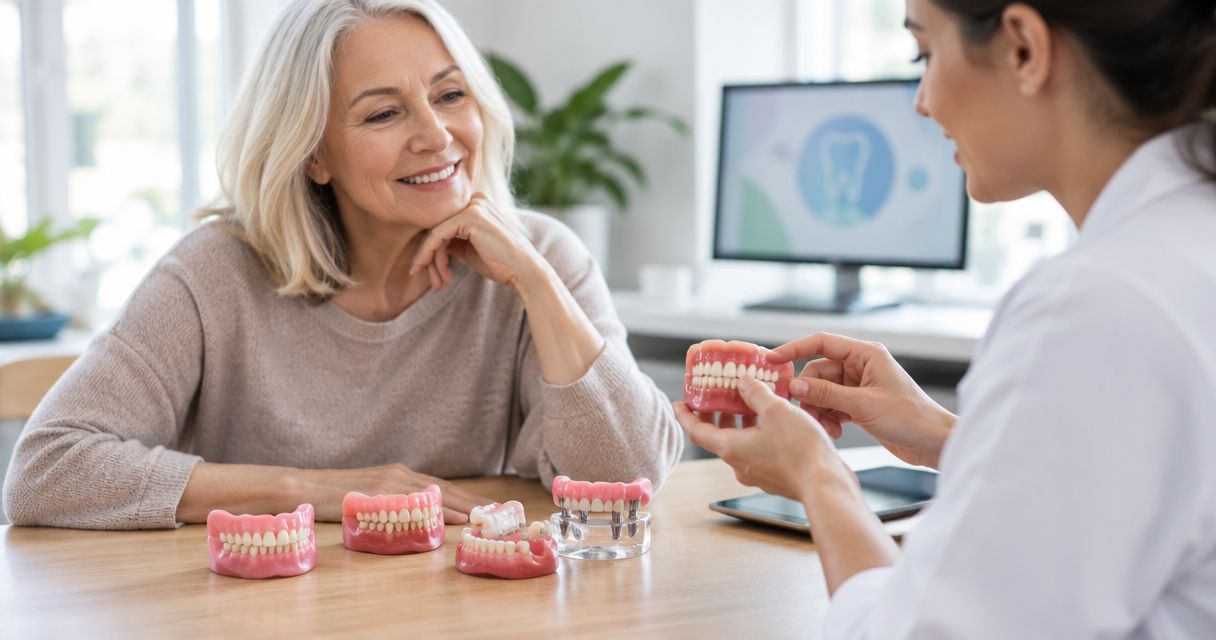
Best overall for a loose full denture: removable implant-retained dentures. Best for keeping healthy teeth: cast-metal partial dentures. Best nonsurgical starting point for a fully toothless arch: conventional complete dentures. This 2026 guide compares the best denture types for missing teeth by stability, comfort, cleaning needs, and treatment complexity.
- The best denture types for missing teeth depend on remaining teeth, bone support, and daily cleaning ability.
- Removable implant-retained dentures are the leading option when a conventional full denture keeps moving.
- Cast-metal partial dentures replace missing teeth while retaining suitable natural teeth.
- Dental Arts of Atlantis offers general and implant dentistry for Lake Worth families considering tooth replacement.
Why this matters
A denture that looks natural but moves during meals does not solve your main problem. Neither does a stable restoration that you cannot comfortably clean.
Dental Arts of Atlantis provides general and implant dentistry in Lake Worth, Florida. For denture planning, your remaining teeth, gum health, jawbone, and ability to maintain the appliance matter more than a material's name.
The best denture is the one that stays comfortable during function and remains manageable at home. Use this 2026 ranking to narrow your questions, not to select treatment before an examination.
What makes the best denture types for missing teeth?
- Stability: The appliance should resist unwanted movement during chewing and speaking.
- Tissue comfort: The base, borders, and bite must distribute pressure without persistent sores.
- Tooth preservation: Suitable natural teeth deserve assessment before extraction becomes part of the plan.
- Cleaning access: You need a realistic way to clean the restoration, gums, and any supporting teeth or implants.
- Treatment burden: Surgery, healing, adjustments, and future maintenance all affect the decision.
- Repairability: Ask how the appliance can be adjusted, relined, repaired, or modified if your mouth changes.
Denture types at a glance
The 2026 comparison below ranks options by distinct needs rather than suggesting that every patient should choose the same appliance. “Fixed” means you do not remove the restoration yourself; it does not mean maintenance-free.
| Rank and type | Best for | Standout feature | Key limitation |
|---|---|---|---|
| 1. Removable implant-retained dentures | Stabilizing a moving full denture | Implant attachments improve retention | Requires surgery and attachment maintenance |
| 2. Fixed implant-supported full-arch teeth | Avoiding daily appliance removal | Restoration remains attached during daily use | Cleaning underneath requires careful technique |
| 3. Cast-metal partial dentures | Keeping suitable natural teeth | Rigid framework supports a removable replacement | Clasps can show; supporting teeth need protection |
| 4. Conventional complete dentures | Replacing a full arch without implant surgery | Removable replacement supported by oral tissues | Lower dentures are vulnerable to movement |
| 5. Flexible partial dentures | Selected gaps where visible clasps are a concern | Flexible, gum-colored retention components | Repairs and modifications can be difficult |
| 6. Immediate dentures | Having a replacement during extraction healing | Placed when planned teeth are removed | Healing changes the fit |
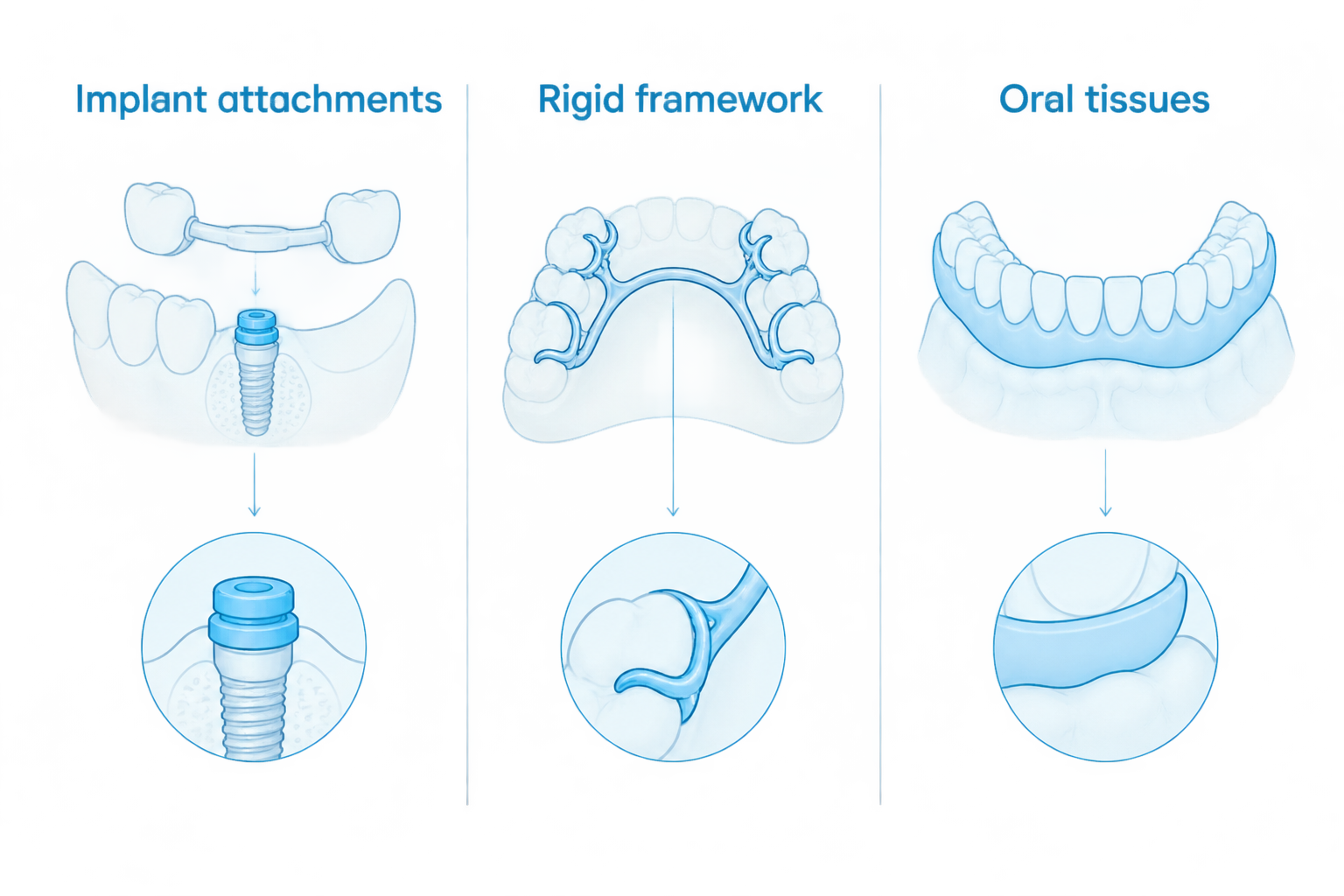
Implant retention, tooth-supported frameworks, and gum-supported bases solve different mechanical problems. Ask what will hold your denture in place before focusing on how the teeth look.
1. Removable implant-retained dentures: best for a loose full denture
Removable implant-retained dentures connect to implants through attachments that help resist lifting and shifting. You remove the denture for cleaning; depending on its design, the gums still share some chewing pressure.
The strongest reason to consider this option is persistent instability, especially in a lower complete denture. Implant retention does not eliminate the need for an accurately fitting base and balanced bite.
Removable implant-retained denture pros:
- Better retention than a conventional tissue-supported denture.
- Removal gives direct access for cleaning.
- Attachments help reduce unwanted lifting during function.
Removable implant-retained denture cons:
- Implant placement requires surgery and healing.
- Attachment components wear and need maintenance.
- Bone and health requirements need individual assessment.
Best for: Someone who wants a more secure full denture but prefers a removable appliance.
Verdict: Buy only after an implant assessment confirms suitability and explains ongoing maintenance.
2. Fixed implant-supported full-arch teeth: best for avoiding daily removal
A fixed full-arch restoration attaches replacement teeth to implants and stays in your mouth during everyday use. Your dental team removes it when clinically necessary; you clean around and underneath it at home.
This category is often discussed alongside dentures, although its daily care differs substantially from a removable appliance. Comfort depends on bite design, tissue contours, and enough access for cleaning.
Fixed full-arch restoration pros:
- No daily removal of the replacement teeth.
- Implant support limits denture-like lifting.
- Replaces a complete arch with an attached restoration.
Fixed full-arch restoration cons:
- Requires implant surgery and sufficient support.
- Cleaning underneath takes practice and suitable tools.
- Teeth or components can still wear or fracture.
Best for: A suitable implant candidate who strongly prefers attached teeth and can maintain them.
Verdict: Hold until you can demonstrate the proposed cleaning routine and understand repair needs.
3. Cast-metal partial dentures: best for keeping healthy natural teeth
Cast-metal partial dentures replace missing teeth with a removable appliance built around a rigid metal framework. Rests and clasps distribute support across selected teeth and, where applicable, the gums.
A partial denture is not a reason to remove healthy teeth simply to simplify treatment. Supporting teeth need evaluation for decay, gum disease, strength, and position.
Cast-metal partial denture pros:
- Retains suitable natural teeth.
- A rigid framework provides controlled support.
- Removal allows cleaning around remaining teeth.
Cast-metal partial denture cons:
- Some clasps remain visible when smiling.
- Plaque around supporting teeth increases decay and gum risks.
- Some designs require reshaping supporting tooth surfaces.
Best for: Someone missing several teeth who has suitable teeth available for support.
Verdict: Buy when the remaining teeth have a sound prognosis and the framework design is explained.
4. Conventional complete dentures: best for a nonsurgical full-arch replacement
Conventional complete dentures replace all teeth in an upper or lower arch after the tissues have healed sufficiently. The base rests on oral tissues rather than connecting to implants.
Upper and lower dentures behave differently. The palate helps support an upper denture, while the tongue and smaller supporting area make lower-denture stability more challenging.
Conventional complete denture pros:
- Does not require implant surgery.
- Removes for direct cleaning.
- Can often be adjusted or relined as tissues change.
Conventional complete denture cons:
- Movement can interfere with chewing.
- Upper designs usually cover the palate.
- Gum and bone changes alter fit over time.
Best for: Someone needing a complete arch replacement without implant treatment.
Verdict: Buy when nonsurgical replacement is the priority, with realistic expectations about movement and adjustment.
5. Flexible partial dentures: best for selected gaps with visible-clasp concerns
Flexible partial dentures use a flexible base material and often gum-colored retention components. They can be considered when the appearance of conventional metal clasps is a concern.
Flexibility describes the material, not a guarantee of comfort. The location of your gaps, bite forces, and remaining teeth determine whether a flexible design provides suitable support.
Flexible partial denture pros:
- Gum-colored components reduce visible metal retention.
- The material flexes during insertion and removal.
- Offers a removable replacement for selected gaps.
Flexible partial denture cons:
- Repairs, relines, or adding teeth can be difficult.
- Flexibility does not provide the same rigidity as a metal framework.
- Cleaning products must suit the material.
Best for: Carefully selected partial-tooth-loss cases where clasp appearance is a major concern.
Verdict: Hold until support, cleaning, and future modification needs are addressed.
6. Immediate dentures: best for replacement during extraction healing
Immediate dentures are prepared before planned extractions and placed when those teeth are removed. “Immediate” describes timing, not a separate material or a finished long-term fit.
Gums and bone change during healing, so follow-up adjustments are part of this approach. A reline or replacement appliance can become necessary after healing progresses.
Immediate denture pros:
- Provides replacement teeth during the initial healing period.
- Helps maintain appearance after planned extractions.
- Introduces denture wear while tissues heal.
Immediate denture cons:
- Fit changes as extraction sites heal.
- Early soreness and adjustments need follow-up.
- The initial appliance is not necessarily the final restoration.
Best for: Someone facing planned extractions who wants replacement teeth during healing.
Verdict: Buy as a transitional treatment with a clearly explained follow-up plan.
What changes comfort more than the denture's name?
Fit first. A rigid partial that fits accurately can feel better than a flexible appliance that rocks. Likewise, implant attachments cannot correct every problem caused by an uneven bite or overextended denture border.
When you see denture types compared, separate material, support, and timing: “flexible” describes material, “implant-retained” describes retention, and “immediate” describes placement timing. Those labels answer different questions and can overlap.
For a 2026 consultation, describe the exact problem: lifting when you speak, pressure under the tongue, food collecting underneath, or pain on one side. Specific symptoms help distinguish a fit problem from a design limitation.
Dry mouth also deserves attention. Saliva helps lubricate tissues; a medication review and examination can identify factors contributing to friction or soreness without assuming that a different denture material will solve everything.
How should you compare treatment costs without choosing blindly?
Compare the proposed work, not just the appliance label. A complete treatment plan should explain extractions if needed, imaging, implant procedures where relevant, temporary teeth, the final restoration, and maintenance responsibilities.
Ask these questions before agreeing:
- Which parts of treatment are necessary for my mouth?
- Is this appliance transitional or intended for long-term use?
- What follow-up adjustments does the written plan include?
- What happens if my gums change or a supporting tooth is lost?
- Which components need periodic replacement?
For treatment planning in 2026, Dental Arts of Atlantis offers general and implant dentistry to Palm Beach County families. Ask for an individualized assessment rather than assuming every category in this guide suits your health or anatomy.
How the denture types are ranked
This ranking prioritizes the problem each option solves: unstable full dentures, preference for attached teeth, preservation of remaining teeth, nonsurgical replacement, clasp appearance, or extraction timing. It then weighs comfort, cleaning access, treatment burden, and repairability.
These are clinical design comparisons, not results from a patient trial. No ranking replaces an examination or establishes that a particular appliance is appropriate for you.
Which denture type should you choose?
Start with your remaining teeth. If suitable natural teeth remain, ask about preserving them and whether a partial denture fits the treatment plan.
If an entire arch is missing, discuss conventional complete dentures and implant-retained alternatives. Removable implant-retained dentures are the leading discussion point when movement is the main complaint; fixed teeth require a separate conversation about surgery and cleaning.
Dental Arts of Atlantis is a local option for Lake Worth families seeking general and implant dentistry while evaluating missing-tooth replacement. Bring your current denture and a list of the situations that make it uncomfortable.
FAQ
What’s the most comfortable denture type?
No denture type is the most comfortable for every mouth. Accurate fit, a balanced bite, healthy tissues, and suitable support matter more than the material label alone.
Are implant-retained dentures better than regular dentures?
Implant-retained dentures provide better retention than conventional tissue-supported dentures. They also require surgery, cleaning around implants, and maintenance of attachment components.
Should I choose a partial denture if I still have healthy teeth?
A partial denture is worth discussing when suitable natural teeth remain. Your dentist must assess those teeth and compare ways to replace the gaps without unnecessary extraction.
Are flexible dentures always softer and more comfortable?
No, flexibility does not guarantee comfort. Support, pressure distribution, bite forces, and fit determine whether a flexible partial is appropriate.
Can I sleep in my dentures?
Remove removable dentures for sleep unless your dentist gives different instructions, such as during initial extraction healing. Leaving them out gives oral tissues a rest and allows thorough cleaning.
How do I care for teeth that support a partial denture?
Brush natural teeth for 2 minutes, 2 times daily, using fluoride toothpaste, and clean between them daily. Remove and clean the partial separately using products suited to its material.
When does denture soreness need a dental visit?
Contact your dentist for persistent pain, repeated sores, or a denture that suddenly stops fitting. Any mouth ulcer lasting longer than 2 weeks needs professional evaluation; do not file or reshape the appliance yourself.
One last thing
A loose denture does not automatically need replacement. A bite adjustment, reline, or repair can address certain problems, while other situations require a different design.
For your 2026 appointment, note whether movement happens during speaking, chewing, or both. That detail is more useful than simply asking for the newest material.
Related guides
- Denture relines for long-term denture wearers
- How to clean and maintain dentures at home
- How long does it take to adjust to new dentures?