
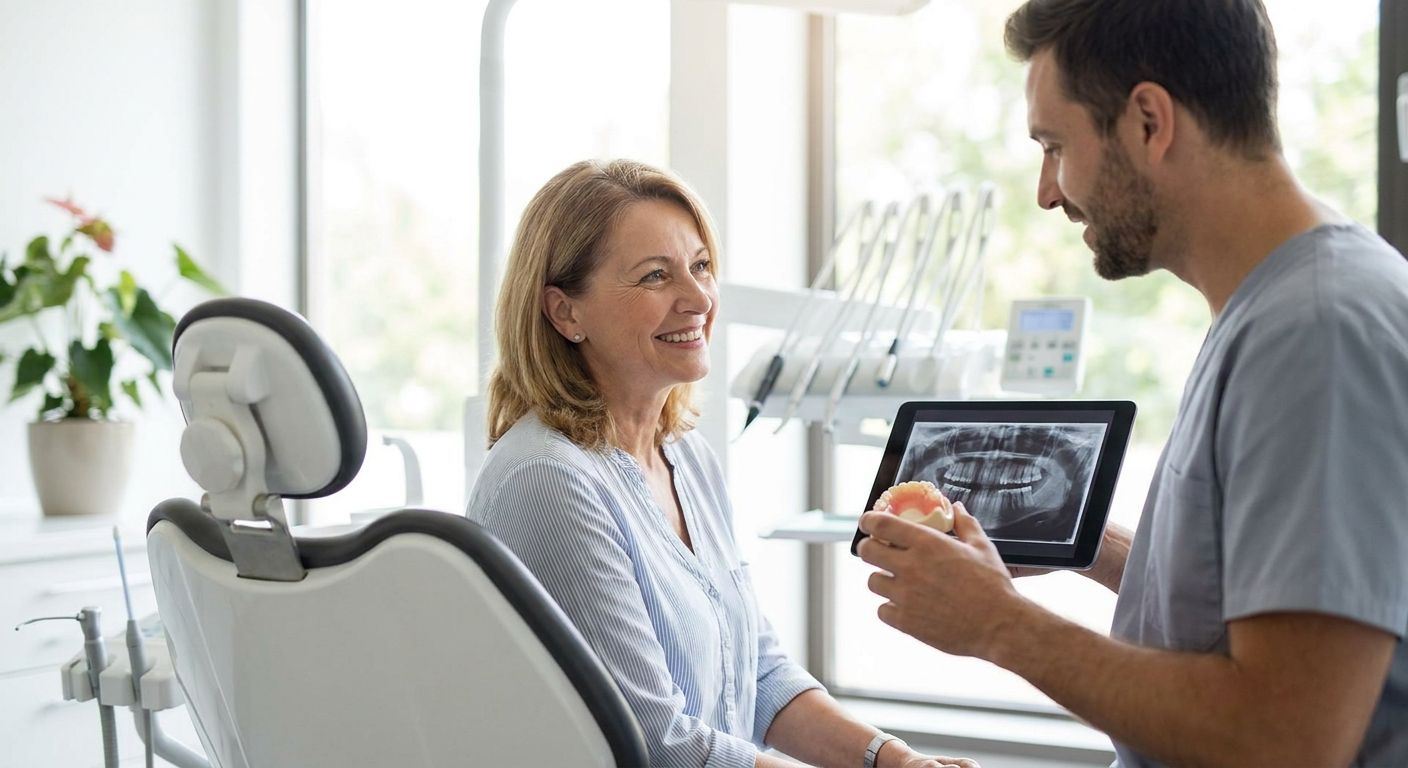
Same-day dental implants let you walk out with a functional tooth on the day of surgery instead of waiting months between extraction and crown placement. You're a strong candidate if you have healthy gums, enough jawbone to anchor the implant, and no uncontrolled conditions like diabetes or active gum infection that slow healing.
- Adequate jawbone density and healthy gums make you a same day dental implants candidate in most cases.
- Smokers, uncontrolled diabetics, and patients with significant bone loss usually need prep work first.
- A CT scan and bite evaluation during your first implant consultation confirm candidacy before surgery.
- Immediate-load implants place a temporary crown the same day; the final restoration follows once the bone fuses.
Why this matters
Not every missing tooth situation qualifies for same-day placement, and finding out after you've already scheduled surgery wastes time and money. The difference between candidacy and non-candidacy usually comes down to bone volume, gum condition, and how your body heals — all things a dentist can assess before you commit to a date. Getting this right up front at your first dental implant consultation saves a second surgery later.
Are you a candidate for same-day dental implants?
You're likely a candidate for same-day dental implants in 2026 if you meet most of these criteria:
| Factor | Good candidate | Needs prep work first |
|---|---|---|
| Jawbone volume | Sufficient density at the implant site | Significant bone loss, may need grafting |
| Gum health | No active periodontal disease | Untreated gum disease |
| Medical history | Controlled diabetes, no bisphosphonate use | Uncontrolled diabetes, certain osteoporosis medications |
| Smoking | Non-smoker or light smoker | Heavy smoker (slower healing) |
| Bite force needs | Willing to eat soft foods during healing | Needs full function immediately with no diet change |
A CT scan taken during a consultation shows bone density and nerve position, which is the single biggest factor in whether same-day placement is safe. Gum health matters almost as much — active infection at the implant site raises failure risk regardless of how much bone you have.
Single missing tooth: usually the easiest candidacy case
If you're replacing one tooth and the surrounding bone is intact, you're often the most straightforward same-day dental implants candidate. The site heals around a single post, and a temporary crown can go on the same day the implant is placed. Read more about the process on the single missing tooth implant page.
Verdict: Buy — single-tooth cases with healthy bone are the most predictable same-day candidates in 2026.
Full arch or multiple missing teeth: candidacy depends on bone distribution
Replacing several teeth or a full arch same-day (often through an immediate-load, implant-supported bridge) requires bone strength at four to six strategic points rather than density everywhere. Patients switching from a loose denture to a fixed option are common candidates here, provided imaging shows enough bone at those anchor points.
Verdict: Hold for imaging — full-arch same-day cases need a CT scan before anyone can confirm candidacy.
Why candidacy varies from patient to patient
- Jawbone density — thin or resorbed bone at the extraction site is the most common reason someone isn't an immediate candidate.
- Active gum disease — infection has to be treated before an implant can integrate safely.
- Smoking — nicotine restricts blood flow to healing tissue and raises implant failure risk.
- Osteoporosis medications — certain bisphosphonates affect bone remodeling and change the treatment timeline; read the specifics on the osteoporosis and dental implants page.
- Uncontrolled diabetes — blood sugar swings slow healing and increase infection risk.
- Insufficient bone volume — grafting may be needed before same-day placement is possible; details are on the bone grafting for dental implants page.
“If the CT scan shows enough bone at the implant site, same-day placement is usually on the table — if it doesn’t, grafting comes first.”
Osseointegration, the process where bone fuses to the implant post, typically takes three to six months regardless of whether the crown goes on the same day or later. Same-day dental implants don't skip healing — they just let you leave with a temporary tooth instead of a gap while that healing happens.
Find out your candidacy in one visit
A CT scan and exam confirm whether same-day placement works for you.
Can smokers get same-day dental implants?
Smokers can sometimes qualify, but healing takes longer and failure rates run higher than for non-smokers. Many dentists ask patients to cut back or quit for a window before and after surgery to protect the implant site. If you smoke and want a straight answer on your odds, the dental implants for smokers page walks through what changes for candidacy.
Does osteoporosis rule out same-day implants?
Osteoporosis itself doesn't automatically disqualify you, but certain medications used to treat it — particularly some bisphosphonates — do change how bone responds to implant placement. Your dentist reviews your medication history alongside imaging before recommending same-day versus staged treatment.
How do I pay for same-day implants without insurance?
Most dental insurance plans cover only a portion of implant treatment, if any, so financing plans fill the gap for many patients in 2026. Payment options and financing structures for implant treatment are covered on the financing dental implants without insurance page.
FAQ
What’s the best way to find out if I’m a candidate for same-day dental implants?
The best way is a consultation that includes a CT scan and gum exam, which shows bone density and rules out active infection. Most patients get a clear answer within one visit.
Is same-day implant surgery safe for patients with osteoporosis?
Osteoporosis alone doesn’t rule out same-day implants, but bisphosphonate medications sometimes do. A dentist checks your medication history and bone scan before recommending same-day versus staged placement.
How much bone density do I need for a same-day implant?
There’s no single number that applies to everyone — a CT scan at your consultation shows whether the bone at your specific site can support immediate placement. Thin or resorbed bone usually means grafting comes first.
Can smokers get same-day dental implants?
Smokers can sometimes qualify, but healing is slower and failure risk is higher than for non-smokers. Cutting back before and after surgery improves the odds of success.
How long does it take for a same-day implant to fully heal in 2026?
Osseointegration, the bone-fusing process, typically takes three to six months whether or not you got a temporary crown the same day. The final permanent restoration goes on once that healing is complete.
Is same-day implants better than traditional two-stage implants?
Neither is universally better — same-day placement suits patients with strong bone and healthy gums, while two-stage treatment suits patients who need grafting or extra healing time first. Your candidacy, not preference, decides which fits.
Does financing help if I don’t have dental insurance?
Financing plans spread out the cost of implant treatment for patients whose insurance covers little or none of it. Ask about available plans during your consultation before scheduling surgery.
Can I get a full arch of teeth replaced the same day?
Full-arch same-day replacement is possible for patients with enough bone at four to six strategic anchor points, confirmed by imaging. It’s a different candidacy conversation than single-tooth replacement.
One last thing
The factor most patients overlook isn't bone density — it's gum health. Active periodontal disease at the implant site gets treated first no matter how much bone you have, and skipping that step is the most common reason same-day implants fail. Get your gums checked before you get attached to a surgery date in 2026.
Related guides
- All-on-4 implants for denture wearers switching to fixed teeth
- Dental implants for seniors missing multiple teeth
- How to care for dental implants after surgery